New research finds early humans first used fire over one million years ago
Wonderwerk Cave bones suggest early humans carried natural fire deep inside and kept it burning far earlier than confirmed.

 Edited By: Joseph Shavit

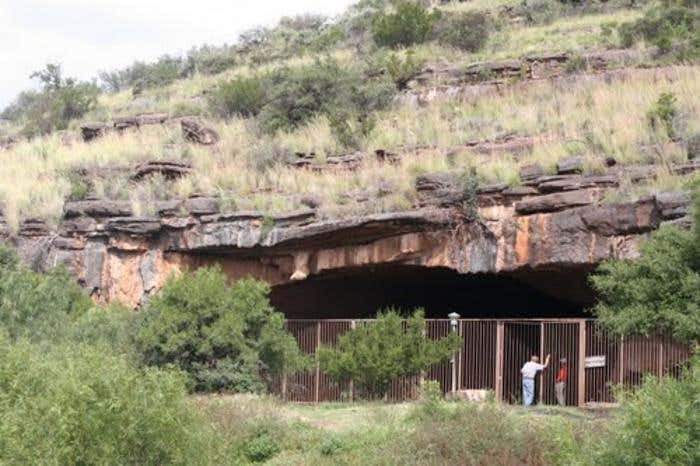
The Wonderwerk Cave entrance. Burned fossil bones in Wonderwerk Cave suggest early humans used fire there between 1.07 and 1.79 million years ago. (CREDIT: The Wonderwerk Cave Project)
Fire leaves behind a simple story when it is fresh. Ash settles, bones blacken, wood chars. Over a million years later, that story becomes much harder to read. In South Africa’s Wonderwerk Cave, researchers now say some of the oldest traces of fire linked to early humans reach back between 1.07 and 1.79 million years.
That pushes the timeline deeper into the Early Acheulean and strengthens the case that hominins were not merely encountering wildfire on the landscape. They were likely bringing it into the cave and sustaining it there.
The new evidence comes from Wonderwerk Cave in the Kalahari Desert, a site that has already played a central role in debates over early fire use. Earlier work there had identified strong evidence of burning around 1 million years ago. The latest study, published in PLOS One, extends that chronology with signs of repeated burning in older deposits.
At the center of the new work is a method that picks up traces of intense heat in fossil bone by using light.
Reading fire through fossil bone
The team, part of a long-running international collaboration at Wonderwerk Cave, includes Dr. Liora Kolska Horwitz of the Hebrew University of Jerusalem's National Natural History Collections (co-director of the Wonderwerk Cave project with Prof Michael Chazan, University of Toronto) and researchers from Spain, Argentina, Canada, USA, South Africa, Portugal and Israel.
The team tested hundreds of tiny fossil bones left by owls that once roosted inside the cave. Those micromammal remains, mostly from prey trapped in owl pellets, accumulated naturally on the cave floor over long periods.
That mattered because the bones were not left there by hominins as food waste. They offered what the researchers described as an independent record of events inside the cave.
The new approach relies on luminescence. When certain bones that were exposed to intense heat are illuminated with a specific wavelength of light, they emit a distinctive glow. Researchers combined that non-destructive optical test with Fourier Transform Infrared Spectroscopy, or FTIR, an established method for identifying thermal changes in bone.
“Evidence of fire from such ancient sites is often subtle and difficult to detect,” said Dr. Kolska Horwitz. “Our study provides new tools for identifying traces of ancient burning and reveals that fire was repeatedly present deep inside Wonderwerk Cave.”
The method is portable, non-invasive, and fast enough to be used on large fossil collections without damaging them. In a field where early fire claims often turn on faint or disputed clues, that is a significant advantage.
The researchers found burned remains in Stratum 10, where fire had already been documented, and in the older Stratum 11. That lower layer is dated to between 1.79 and 1.07 million years ago.
Too far inside for a wildfire
The location of the burned material is one of the study’s strongest points. During the Early Acheulean, the excavation area sat about 30 meters, roughly 98 feet, from the cave entrance. That is too deep inside the cave for a natural grass fire to have simply swept in and scorched the deposits.
The cave sequence also lacks signs that the burned material was washed or transported there later. Wonderwerk’s deposits are important partly because they preserve evidence in place, rather than as a secondary jumble of older material.
The team also ruled out another possible source of burning. The layer did not contain guano remains that might point to spontaneous combustion.
Instead, the pattern fits repeated episodes in which hominins introduced fire into the cave from outside. The study does not argue that these early humans knew how to make fire at will. Rather, it points to opportunistic use of naturally occurring fires, likely sparked by lightning or wildfire on the savanna.
Once brought inside, the fire appears to have been maintained until it burned out.
The researchers suggest that owl pellets carpeting the cave floor may have helped. Those pellets contained hair, feathers, and prey remains, including the tiny rodent bones studied here, all of which could have fed small fires and helped them persist.
A step short of fire-making, but still important
That distinction matters. This study is not evidence for hearths in the later, familiar sense, nor for cooking. The authors are careful on both points.
What it does show is behavior more complex than passive exposure to natural fire.
“These discoveries show that early humans were not simply passive observers of natural fires,” Dr. Kolska Horwitz explained. “They were actively engaging with fire and incorporating it into their lives.”
The archaeological context adds weight to that argument. The burned microfauna came from layers associated with Acheulean stone tools, including early handaxes, and likely with Homo erectus. In Wonderwerk’s sequence, Stratum 11 marks the onset of the Acheulean above older Oldowan deposits.
The team also found that burning in Stratum 11 was not spread evenly across the excavated area. Instead, it appeared in discrete concentrations, with heavily burned remains in separate squares several meters apart. That patchy distribution supports the idea of repeated burning events rather than a single accidental episode.
The results also help sharpen a long-running debate. Some earlier claims for very ancient fire come from open-air sites, where wildfire is always harder to rule out. Deep cave contexts like Wonderwerk offer a cleaner test.
That is one reason the site remains so important. It preserves a long record of occupation stretching across nearly 2 million years, and its deposits have yielded some of the strongest evidence yet for early human interaction with fire in Africa.
A tool for an old archaeological problem
Beyond Wonderwerk itself, the study offers archaeologists a new way to investigate one of prehistory’s hardest questions. Burned bone can be deceptive. Dark staining from mineral changes can mimic charring, while fossilization can alter a bone’s chemistry in ways that complicate diagnosis.
The luminescence method is not a cure-all. It cannot be applied to black bones, and like FTIR it has limits. But used alongside chemical analysis, it gives researchers another line of evidence and may reduce false positives.
That could matter far beyond one cave.
As the method is applied to other sites, it may help sort stronger cases from weaker ones and clarify how early humans first learned to exploit fire, long before they mastered making it themselves. Fire eventually changed diet, protection, mobility, and social life. The Wonderwerk evidence does not capture all of that, but it may show an earlier stage, when hominins were still learning how to keep a borrowed flame alive.
Practical implications of the research
The study gives archaeologists a new, non-destructive way to test large fossil collections for signs of burning, which could reshape how early fire use is identified at ancient sites.
At Wonderwerk Cave, that method strengthens the case that early hominins were repeatedly carrying natural fire into a deep cave and maintaining it there.
More broadly, the work could help narrow one of archaeology’s biggest unresolved questions: when fire shifted from an environmental force humans encountered to a tool they could reliably use.
Research findings are available online in the journal PLOS One.
The original story "New research finds early humans first used fire over one million years ago" is published in The Brighter Side of News.
Related Stories
- Ancient charcoal from Israel reveals how early humans used fire
- Scientists discover the earliest evidence of human fire-making dating back 400,000 years
- AI drone swarms revolutionize wildfire detection and air quality monitoring
Like these kind of feel good stories? Get The Brighter Side of News' newsletter.
Rebecca Shavit
Writer
Based in Los Angeles, Rebecca Shavit is a dedicated science and technology journalist who writes for The Brighter Side of News, an online publication committed to highlighting positive and transformative stories from around the world. Having published articles on MSN, AOL News, and Yahoo News, Rebecca's reporting spans a wide range of topics, from cutting-edge medical breakthroughs to historical discoveries and innovations. With a keen ability to translate complex concepts into engaging and accessible stories, she makes science and innovation relatable to a broad audience.