New study confirms Nanotyrannus was a grown dinosaur, not a baby T. rex
A new study says Nanotyrannus was an adult, not a young T. rex, using a tiny throat bone to settle a 60-year debate.

 Edited By: Joseph Shavit

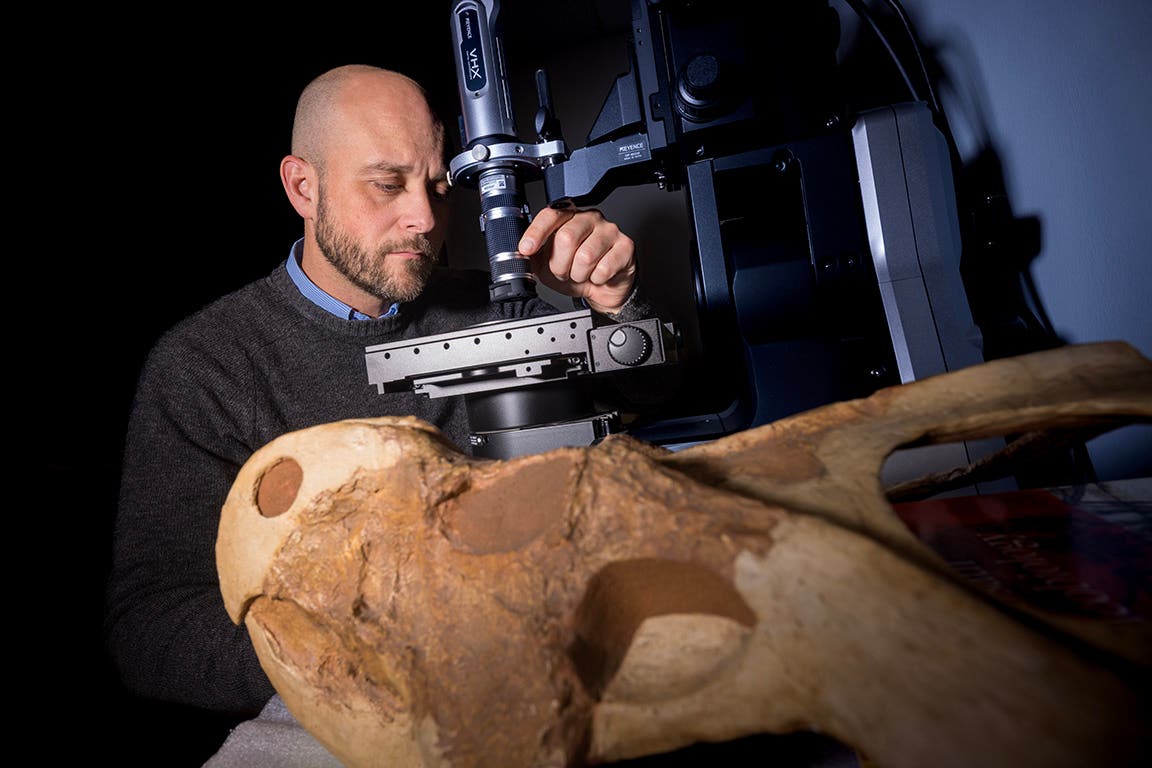
Poust uses a Keyence VHX-7000 microscope in his lab to examine a histological slide of the fossil bone tissue of a theropod dinosaur. (CREDIT: Jordan Opp | University Communication and Marketing)
For more than sixty years, one battered skull has stirred a fight that would not fade. The fossil, stored in Ohio, carried a name that many doubted: Nanotyrannus lancensis. Some experts said it was a true species, a small tyrant that lived beside the famous Tyrannosaurus rex. Others insisted it was only a teenage T. rex that had not finished growing. Each side had good points. None had a final answer.
That changed this month with a study published in Science. A team led by Christopher Griffin of Princeton University turned to a bone that few had ever studied in dinosaurs. The result, they say, ends the stalemate: the skull belonged to an adult animal and not a toddler T. rex.
“This small-bodied, in relation to the T. rex, meat-eater’s hyoid bone showed growth patterns that suggest maturity or approaching maturity,” said Ashley Poust, the Voorhies Endowed Curator of Vertebrate Paleontology at the University of Nebraska State Museum and a co-author on the study. “This lets us be confident in keeping the name Nanotyrannus, because this animal is clearly not on a growth path to becoming a Tyrannosaurus rex.”
If the finding holds, it redraws the family tree of late dinosaurs and reshapes how you picture life just before the mass extinction.
The bone that kept the secret
The team focused on a tiny bone in the throat called the ceratobranchial, part of the hyoid. In people, the hyoid helps you swallow and speak. In crocodiles and birds, close relatives of dinosaurs, the same bone forms early and keeps a record of growth.
Usually, scientists judge age from big bones like a thigh or rib. Those were missing from the skull in question, known as CMNH 7541. It sat alone, a face with no legs to speak for it. The ceratobranchial, however, was still attached.
The researchers sliced thin sections from the bone and read the pattern inside. Like rings in a tree, bone layers reveal bursts and pauses of growth. A structure called the external fundamental system, or EFS, is the clearest signal of adulthood. It forms when growth slows and nearly stops.
Before trusting the method, the team tested it on living animals. They studied ostriches and crocodilians at different ages. In young birds, the bone showed fast growth and loose tissue. In adults, it carried dense layers and the telltale EFS. Young alligators showed the same youth markers. Large ones showed many growth lines and slower tissue. The pattern matched.
Only then did they turn back to the fossil.
What the skull tells you
Inside the bone from CMNH 7541, the signals were plain. The inner cavity had a lining that forms after growth slows. The outer edge showed an EFS with tightly packed lines. In one area, that growth system covered most of the bone. In another, growth lingered a little longer. That mixed pattern is common in animals that have just reached maturity.
Even with some damage and wear, the count was clear. At least nine or ten growth marks sat between remodeled areas. Near the surface, five to eight more formed the EFS itself. That is not a juvenile pattern. It is the print of an adult.
For comparison, the team examined two T. rex ceratobranchials. One came from a small tyrannosaur with a skull larger than CMNH 7541. Its bone showed fast tissue and wide spacing between lines. It had no EFS. It was young. A second, towering T. rex also lacked an EFS. Even giants, it turns out, keep growing for years.
The little skull did not.
How small was this “small tyrant”?
Based on the skull size, the animal stood about 18 feet long. That is tiny next to T. rex, which stretched more than 40 feet from nose to tail. If the skull were a youngster, you would expect it to carry youth features, both inside and out. It did not.
One way around the result would be to claim wild size range within a single species. That would make T. rex unlike any other known dinosaur, and stranger still than most modern animals. Another would be extreme differences between males and females. The math fails there too. The gap would be the largest known among reptiles, birds, or mammals.
Could disease explain it? The bone shows no sign of dwarfing disorders.
That leaves a simpler answer. Nanotyrannus was real.
“At the time, the prevailing consensus was that the Nanotyrannus holotype skull represented an immature Tyrannosaurus rex, and was not a separate species,” Griffin said. “Our expectations were simply following along with that consensus, but once we sampled the hyoid and saw features that strongly indicated maturity, we knew that we had to examine that idea more skeptically.”
The skull’s shape also supports the split. Its teeth, eye openings and jaw differ from T. rex in ways you do not see in mere age changes.
A busier world before the fall
A second paper recently looked at another small tyrant fossil and reached similar conclusions. Together, the studies suggest the late Cretaceous world held more hunters than once thought. A small adult tyrant likely shared the marshy plains with a giant cousin.
That matters because predators shape the life around them. Two sizes of tyrants would have hunted different prey. That spreads pressure across the ecosystem and hints at deeper complexity. Western North America, warm and green near the end, may have held a hidden range of carnivores.
It also changes how you see young giants. If medium predators already filled a niche, juvenile T. rex may not have needed to. That frees young tyrants to grow fast and aim for giant prey later.
A tiny tool with big promise
The study does more than name a dinosaur. It opens a door. Bones like the ceratobranchial are often preserved with skulls, even when limbs are gone. That means scientists now have a way to judge age from fossils long considered unreadable.
Poust, who led much of the bone work, said the surprise was how faithful the signal proved to be.
“It’s expanding, in a small way, the ability to learn about animals’ past lives,” he said. “It was exciting to show that the growth signal is so conserved across the body. Maybe this is a tiny wedge to start investigating that in some different ways.”
For you, a case that once felt stuck now feels alive again. A small bone spoke. A small tyrant steps out of a giant’s shadow.
Practical implications of the research
This work offers a new way to read growth from tiny bones, helping scientists study fossils that lack limbs. It can refine species counts and improve age estimates for extinct animals. That leads to clearer pictures of ancient food chains and climate impacts before mass extinctions.
Better tools also mean fewer debates based on guesswork and more answers based on evidence. Over time, museums may reexamine old skulls and reveal hidden species that reshape Earth’s deep history.
Research findings are available online in the journal Science.
Related Stories
- Decades old T. rex debate ends with stunning discovery
- How did the T. rex’s bite force compare to the largest carnivorous dinosaurs
- The rise of T. rex: New findings explain their size and origins
Like these kind of feel good stories? Get The Brighter Side of News' newsletter.
Joshua Shavit
Writer and Editor
Joshua Shavit is a NorCal-based science and technology writer with a passion for exploring the breakthroughs shaping the future. As a co-founder of The Brighter Side of News, he focuses on positive and transformative advancements in technology, physics, engineering, robotics, and astronomy. Joshua's work highlights the innovators behind the ideas, bringing readers closer to the people driving progress.