Overfishing has made bottlenose dolphins in the Adriatic Sea heavily reliant on fishing trawlers for food
Bottlenose dolphins in the Adriatic are trailing trawlers at striking rates as natural prey grows harder to find.

 Edited By: Joseph Shavit

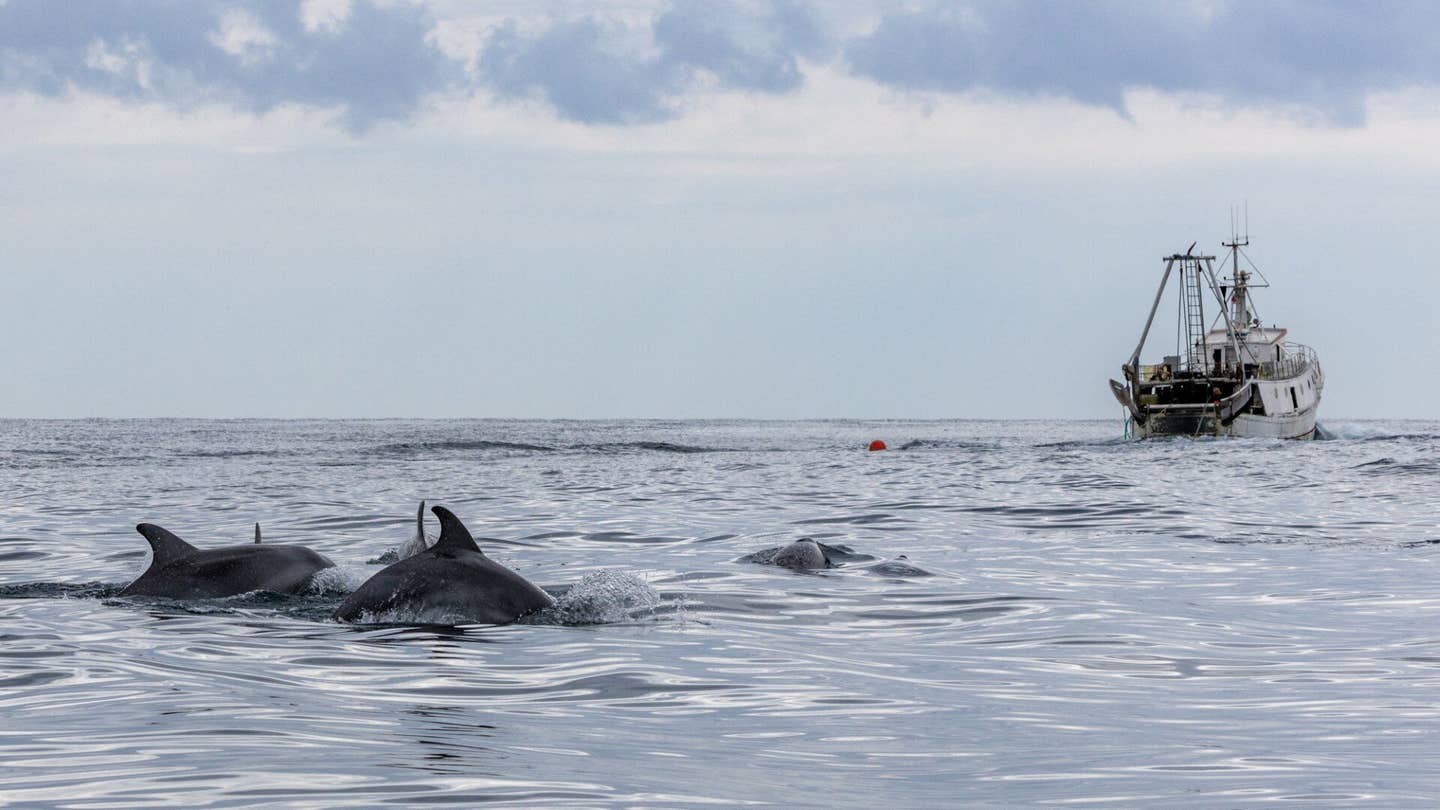
Adriatic bottlenose dolphins are increasingly following trawlers, suggesting overfishing may be reshaping how they survive. (CREDIT: Dolphin Biology and Conservation)
Bottlenose dolphins in the Adriatic Sea are spending so much time behind fishing trawlers that the pattern now looks less like opportunism and more like dependence. In some waters off Italy, dolphins were seen following three out of every four otter trawlers inspected. This raises a harder question about what is left for them to catch on their own.
The study, published in Frontiers in Mammal Science, tracked dolphin activity around trawlers off the Italian regions of Veneto and Marche. The waters are shallow and heavily worked. In addition, they are part of a wider Mediterranean fishery that has been pushed well beyond sustainable limits.
That background matters. The Adriatic has been bottom-trawled for decades, flattening habitats, depleting marine life, and helping drive sharp declines among top predators. Common dolphins, once abundant there, have virtually disappeared. Bottlenose dolphins remain, but the new research suggests many are making a living in the wake of industrial fishing.
High degree of reliance on fishery
“Long-term, consistent, and deliberate association with trawlers suggests a high degree of reliance on that fishery,” said Dr. Giovanni Bearzi, president of Dolphin Biology and Conservation in Italy and the study’s lead author. “While dolphins would still need to forage independently when trawling does not occur, on days of trawling they forage predominantly near trawl nets.”
From 2018 through 2024 in Veneto, and in 2025 in Marche, researchers carried out 859 inspections of active fishing trawlers over 148 survey days. They covered 17,755 kilometers at sea. Furthermore, they photographed dolphins to identify individuals by their dorsal fins.
Across all gear types, dolphins were present behind 212 of the 859 trawlers, or 24.7%. But that average hides big differences.
A meal at the back of the net
Otter trawlers drew dolphins far more often than beam trawlers. Of 375 otter trawlers inspected, 155, or 41.3%, had dolphins in their wake. Midwater trawlers showed a similar pattern, with dolphins behind 35.1% of them. Beam trawlers were a different story: just 1.5% were followed.
The likely reason is practical. Otter and midwater trawls use wider, more accessible nets and target species dolphins are more likely to want. Meanwhile, beam trawlers in this region tow narrower gear that is harder to exploit and often target prey that appears less attractive to dolphins.
The regional split was even more striking. In Veneto, 25.9% of inspected otter trawlers were followed by dolphins. In Marche, that figure jumped to 75.9%. The researchers said the difference was significant and unlikely to be explained by sampling bias alone. However, they could not fully explain it.
“We estimated that the bottlenose dolphin populations of Veneto and Marche, combined, exceed 1000 individuals,” said Silvia Bonizzoni of Dolphin Biology and Conservation, a co-author of the paper. “Between 86 and 90% of the dolphins, depending on region, were photographed one or more times while they were following trawlers. The evidence suggests that the majority of a relatively large community of dolphins regularly forage behind trawlers.”
That last point may be the most unsettling. This was not a handful of specialist animals. The photo-identification work suggests the behavior reaches across most of the local bottlenose dolphin community.
Risky feeding in a damaged food web
Dolphins have long been known to follow fishing boats. What stands out here is the scale and the setting. In an earlier Adriatic study from the 1990s, only about 10% of otter trawlers were followed by dolphins. In the new work, the rates were much higher.
The authors place that shift inside a broader ecological decline. In the Mediterranean, 63% of fish populations are fished unsustainably, according to FAO figures cited in the paper. Fishing pressure is about twice the sustainable level. Within that basin, the Adriatic is described as the most heavily overfished area, with some of the world’s highest bottom-trawling intensity and one of the poorest seabed conditions.
When natural prey drops, predators often move toward predictable food tied to people. The paper compares that pattern to polar bears scavenging at garbage dumps when access to prey becomes more difficult.
Trawlers and dolphin feeding habits
For dolphins, trawlers can provide discarded fish, stunned animals churned up by the gear, catch lost during hauling, and even prey taken directly from the moving net. During observations, dolphins surfaced and dived close behind the vessels. Sometimes they were only meters from the stern during hauling. In some cases, young animals were present too, including calves and newborns moving with adults over the nets.
That raises the possibility that this behavior is being learned early and passed along.
Specialized feeding habits in dolphins can spread culturally, the authors note, with younger animals picking up techniques by staying close to adults. That may help explain how trawler-foraging becomes entrenched within a population. Even so, it can carry serious costs.
“It is known that bottlenose dolphins are occasionally injured or killed by trawl gear, and that foraging behind trawlers can affect dolphins’ diet, social organization, and communication,” said Dr. Randall Reeves, the study’s senior author and chairman of the Committee of Scientific Advisors at the U.S. Marine Mammal Commission. “Dolphins may also suffer hearing damage that results from chronic exposure to the noise of trawlers. It is risky behavior. However, finding sufficient prey away from trawlers in an overfished sea may be too difficult. It appears that for these animals, taking the risks is better than going hungry.”
What recovery might look like
The paper does not portray bottlenose dolphins as doomed. It portrays them as adaptable animals coping with a sea that has been altered around them.
The researchers argue that reducing or banning destructive trawling could give the ecosystem room to rebuild. If prey recovers and marine habitats improve, they say, bottlenose dolphins could shift back toward more natural feeding patterns. Other species that have sharply declined might also have a chance to return.
The study also points to limits in what is known. Sampling was uneven between the two regions, with seven years of surveys in Veneto but only one in Marche. The authors say the Marche results were still robust because the number of otter trawlers inspected there was high. However, they also say the regional contrast should be tested further.
What remains clear is the larger pattern. In a sea stripped of much of its former abundance, the animals still at the top are now trailing the machinery that helped reshape it.
Practical implications of the research
The findings sharpen the case for stricter controls on bottom trawling in the Adriatic, especially in areas important to marine mammals.
They also suggest that protecting dolphins cannot be separated from rebuilding fish stocks and seabed habitats.
Measures aimed only at keeping dolphins away from nets may fall short if the deeper problem is food scarcity in a damaged ecosystem.
Research findings are available online in the journal Frontiers in Mammal Science.
The original story "Overfishing has made bottlenose dolphins in the Adriatic Sea heavily reliant on fishing trawlers for food" is published in The Brighter Side of News.
Related Stories
- Helping Hand: Volunteers save 125 dolphins in massive Cape Cod stranding
- Researchers discover new bottlenose dolphin sense
- Animatronic dolphins could replace captive animals at theme parks
Like these kind of feel good stories? Get The Brighter Side of News' newsletter.
Hannah Shavit-Weiner
Medical & Health Writer
Hannah Shavit-Weiner is a Los Angeles–based medical and health journalist for The Brighter Side of News, an online publication focused on uplifting, transformative stories from around the globe. Having published articles on AOL.com, MSN and Yahoo News, Hannah covers a broad spectrum of topics—from medical breakthroughs and health information to animal science. With a talent for making complex science clear and compelling, she connects readers to the advancements shaping a brighter, more hopeful future.