518-million-year-old fossil reveals where spider fangs came from
Ancient fossil Urokodia may reveal how spiders’ fang-like mouthparts first began to take shape.
 Edited By: Joshua Shavit

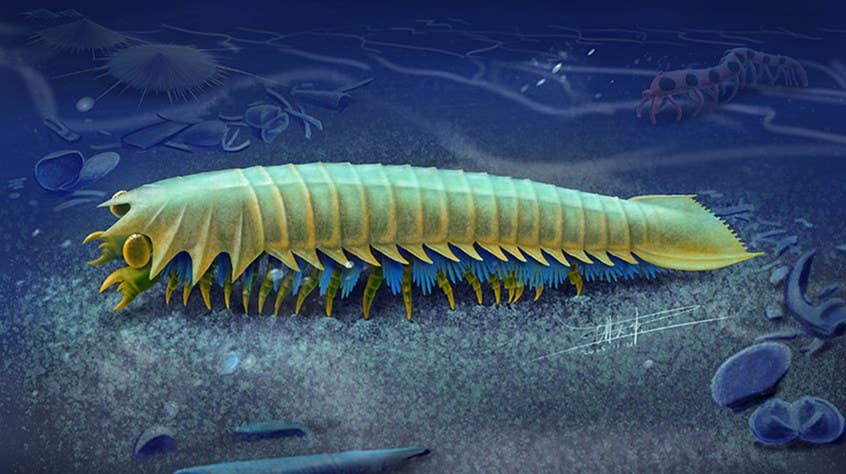
Artist’s impression of Urokodia. 518-million-year-old fossil from China may preserve the earliest known precursors to spiders’ fangs. (CREDIT: Xiaodong Wang)
Spiders are famous for the business end of their bodies, the sharp mouthparts that seize prey and help explain their unnerving reputation. A fossil from 518 million years ago now suggests those structures were taking shape far earlier than the fossil record had clearly shown.
The animal is called Urokodia aequalis, a small marine arthropod from the Chengjiang fossil site in Yunnan Province, China. In a study published in Nature, scientists report that the fossil preserves pincer-like front limbs that they interpret as the earliest known precursors of chelicerae, the specialized appendages that later became the fangs of spiders and the pincers of other chelicerates.
That matters because chelicerates, the broader group that includes horseshoe crabs, spiders, scorpions and ticks, make up about 120,000 described species. They rank among the most diverse terrestrial invertebrates on Earth. Yet the path from their early Cambrian ancestors to the hunting tools seen in living species has remained murky.
The new work argues that Urokodia helps fill that gap.
A body that did not look very spider-like
At first glance, the animal hardly resembles a spider. It was only about 2 to 3 centimeters long, with a slender segmented body, a head shield, 15 trunk segments, a tail shield and large eyes perched on stalks. It lived in the sea, not on land, in an ecosystem that the researchers say held more than 200 kinds of animals.
But the details hidden inside the rock turned out to be more revealing than the fossil’s outline.
Using X-ray microtomography, a three-dimensional imaging method, the team examined specimens from Yunnan University and found that much of the soft anatomy remained preserved. That let them look beneath the compressed exterior and reconstruct structures on the underside of the animal, where some of the most important evolutionary clues were buried.
Professor Yu Liu of Yunnan University, who led the study and is also a visiting professor at the University of Leicester, said: “We were using x-ray tomography analysis of these fossils to reveal their soft anatomy buried in the rocks for hundreds of millions of years, when suddenly we noticed the pincer-like limbs at the front of the animal. We knew immediately that this was a very exciting fossil and indeed a distant ancestor of living chelicerates like scorpions and spiders.”
The missing step between claws and fangs
Those front appendages are the heart of the paper. Earlier work had interpreted them as antennae. The new scans instead suggest they were pincer-like specialized limbs positioned just behind the eyes.
The researchers argue that these limbs represent an intermediate form between the multi-part grasping appendages seen in older relatives called megacheirans and the more refined chelicerae found in later chelicerates. In Urokodia, one element appears to oppose a fused set of other elements, creating a structure that could open and close like a pincer.
In other words, the fossil may preserve a transition in progress, not yet a modern chelicera, but no longer the older limb design either. The team places Urokodia on the upper stem of the chelicerate lineage, outside true chelicerates but closer to them than the more primitive forms below it.
Their phylogenetic analyses, including Bayesian and parsimony approaches, consistently recovered that broad placement, even if some nearby relationships remained uncertain. The study says Urokodia is about 10 million years older than Mollisonia plenovenatrix and about 14 million years older than Megachelicerax cousteaui, two middle Cambrian fossils previously central to the story of early chelicerates.
The new fossil also appears to preserve another important clue. Its trunk appendages carried flap-like structures that the team interprets as early precursors to book gills, the layered respiratory organs seen in living horseshoe crabs and thought to be related to the evolutionary history of breathing structures in chelicerates.
A clearer view of an old evolutionary puzzle
The study’s broader claim is that several hallmark features of chelicerates did not appear suddenly. They were assembled step by step through modifications of structures that were already present in older arthropods.
The head of Urokodia seems to include seven segments, matching the segmental pattern of the prosoma, the front body region of chelicerates. The authors argue that this points to an early stage in the organization of the body plan, with segment fusion happening before the appendages became fully specialized.
Its trunk limbs tell a similar story. The fossil shows exite-bearing appendages with overlapping flaps, which the researchers argue foreshadow the book gills of later chelicerates. Rather than proposing a sudden evolutionary jump, they describe a continuous transformation series from older limb branches to respiratory surfaces.
Cambrian arthropod fossils
That kind of argument depends heavily on preservation. Cambrian arthropod fossils are often flattened, and crucial structures on the underside can be obscured or overlapped. The three-dimensional preservation in Urokodia let the team inspect the geometry of the appendages in unusual detail, which is one reason the fossil may prove so important in future debates.
Professor Mark Williams of the University of Leicester said: “Urokodia was part of an ancient ecosystem of over 200 different types of animals living in the seas over 500 million years ago. These spectacularly preserved fossils provide real insights into how life was evolving on our planet at the very dawn of animals.”
The paper does not claim to settle every question. Some relationships among early chelicerate relatives remain unstable across analyses, and the authors note that the exact positions of several groups still need better evidence. But the new reconstruction gives paleontologists something they have wanted for years: a fossil that appears to bridge a major anatomical gap.
Practical implications of the research
This work gives scientists a more concrete framework for tracing how some of the defining tools of spiders, scorpions and their relatives evolved.
By showing a possible intermediate stage for both early chelicerae and early gill structures, Urokodia could help researchers score fossil anatomy more consistently and test competing family trees with greater confidence.
More broadly, it sharpens the picture of how complex body parts can emerge through gradual reworking of older structures rather than appearing all at once.
Research findings are available online in the journal Nature.
The original story "518-million-year-old fossil reveals where spider fangs came from" is published in The Brighter Side of News.
Related Stories
- Spider and horseshoe crab relatives emerged 20 million years earlier than scientists thought
- Ancient fossil reveals spiders and their relatives originated in the ocean, not on land
- Spider venom heart drug trial could revolutionize cardiac medicine
Like these kind of feel good stories? Get The Brighter Side of News' newsletter.
Joshua Shavit
Writer and Editor
Joshua Shavit is a NorCal-based science and technology writer with a passion for exploring the breakthroughs shaping the future. As a co-founder of The Brighter Side of News, he focuses on positive and transformative advancements in technology, physics, engineering, robotics, and astronomy. Having published articles on AOL.com, MSN, Yahoo News, and Ground News, Joshua's work highlights the innovators behind the ideas, bringing readers closer to the people driving progress.