Printed artificial neurons can communicate with living brain cells
Northwestern engineers printed flexible artificial neurons that send realistic signals to living brain cells.

 Edited By: Joseph Shavit

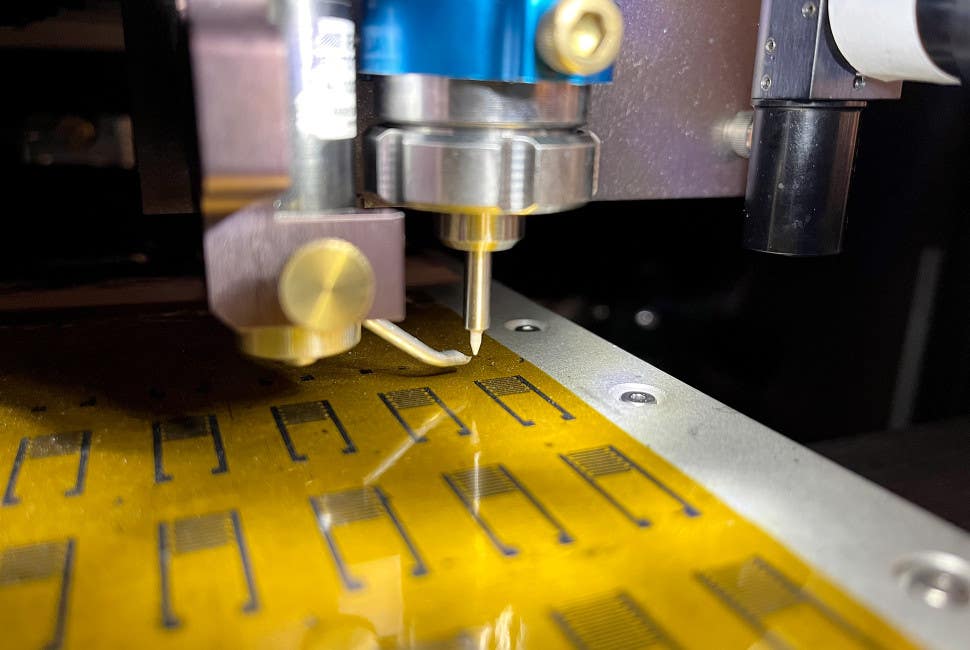
New printed artificial neurons can fire brain-like electrical signals and activate real neurons, opening paths for neuroprosthetics and efficient AI hardware. (CREDIT: Mark Hersam)
A new kind of printed electronic neuron may bring scientists closer to machines that communicate directly with living brain cells. Northwestern University engineers have developed soft, flexible devices that fire electrical signals similar to real neurons. In early tests, those artificial signals activated living brain cells from mouse tissue.
The work could shape future brain-machine interfaces, neuroprosthetics and energy-saving computers. It also offers a new path for technology inspired by the most efficient computer known: the human brain.
“The world we live in today is dominated by artificial intelligence (AI),” said Northwestern’s Mark C. Hersam, who led the study. “The way you make AI smarter is by training it on more and more data. This data-intensive training leads to a massive power-consumption problem. Therefore, we have to come up with more efficient hardware to handle big data and AI. Because the brain is five orders of magnitude more energy efficient than a digital computer, it makes sense to look to the brain for inspiration for next-generation computing.”
Why Brain-Like Electronics Matter
Today’s computers rely on billions of nearly identical transistors packed onto rigid silicon chips. These systems can perform huge tasks, but they use enormous energy. Once built, they also remain fixed.
The brain works differently. It contains many types of neurons, each with its own role. These cells form soft, three-dimensional networks that change as people learn, move and adapt.
“Silicon achieves complexity by having billions of identical devices,” Hersam said. “Everything is the same, rigid and fixed once it’s fabricated. The brain is the opposite. It’s heterogeneous, dynamic and three-dimensional. To move in that direction, we need new materials and new ways to build electronics.”
Other artificial neurons already exist, but many produce signals that are too simple. Some fire too slowly. Others fire too quickly. Because of that, engineers often need large, power-hungry networks to mimic complex brain activity.
Turning A Flaw Into A Feature
Hersam’s team built the artificial neurons with printable inks made from nanoscale flakes. One material, molybdenum disulfide, acts like a semiconductor. Another, graphene, conducts electricity.
The researchers used aerosol jet printing to place the inks onto flexible polymer surfaces. This created soft electronic devices that could bend more easily than rigid silicon chips.
Usually, scientists try to remove stabilizing polymers from these inks because they can block electrical flow. Hersam’s team took a different approach. They partly decomposed the polymer and used that change to create brain-like behavior.
“Instead of fully removing the polymer, we partially decompose it,” he said. “Then, when we pass current through the device, we drive further decomposition of the polymer. This decomposition occurs in a spatially inhomogeneous manner, leading to formation of a conductive filament, such that all the current is constricted into a narrow region in space.”
That narrow pathway allows the device to create sudden electrical spikes. These spikes resemble the way living neurons send signals.
Signals That Look More Like Life
The printed neurons can produce many firing patterns. They can create single spikes, steady firing and bursts of activity. These patterns matter because real brain cells do not all behave the same way.
The devices can generate spikes at frequencies up to 20 kilohertz. They also remained stable for more than 1 million cycles. That durability matters for future implants and computing systems.
The artificial neurons showed several layers of complexity. In one mode, they acted like basic neurons that fire only after crossing a threshold. In another, they fired repeatedly. In a third mode, they produced bursts, which resemble rhythmic signals seen in some nervous system circuits.
By giving each artificial neuron richer behavior, engineers may need fewer parts overall. That could make future systems smaller, faster and more energy efficient.
Testing Artificial Signals On Real Brain Cells
To see whether the devices could truly talk to biology, the team worked with Indira M. Raman, the Bill and Gayle Cook Professor of Neurobiology at Northwestern’s Weinberg College of Arts and Sciences.
Researchers applied artificial voltage spikes to slices of mouse cerebellum. The cerebellum helps coordinate movement and contains neurons with well-studied electrical behavior.
The artificial spikes matched key features of real neuron signals, including timing and duration. They successfully activated Purkinje neurons, a major type of cerebellar brain cell.
“Other labs have tried to make artificial neurons with organic materials, and they spiked too slowly,” Hersam said. “Or they used metal oxides, which are too fast. We are within a temporal range that was not previously demonstrated for artificial neurons. You can see the living neurons respond to our artificial neuron. So, we’ve demonstrated signals that are not only the right timescale but also the right spike shape to interact directly with living neurons.”
Toward Softer Implants And Smarter Machines
The discovery could help researchers build better brain-machine interfaces. These systems may one day support implants for hearing, vision or movement. They could also help prosthetic devices receive or send more natural signals.
The devices have another advantage: they are printed. Additive printing places material only where needed, which reduces waste. The process is also simpler and lower cost than many traditional electronics methods.
That matters as artificial intelligence expands. Tech companies are building large data centers to support AI systems, and those centers consume huge amounts of power and water.
“To meet the energy demands of AI, tech companies are building gigawatt data centers powered by dedicated nuclear power plants,” Hersam said. “It is evident that this massive power consumption will limit further scaling of computing since it’s hard to imagine a next-generation data center requiring 100 nuclear power plants. The other issue is that when you’re dissipating gigawatts of power, there’s a lot of heat. Because data centers are cooled with water, AI is putting severe stress on the water supply. However you look at it, we need to come up with more energy-efficient hardware for AI.”
Practical Implications Of The Research
This research could help build future medical devices that communicate with nerves more naturally. If artificial neurons can match the timing and shape of real brain signals, implants may become safer and more effective. That could matter for people who need help restoring hearing, sight, movement or sensory feedback.
The work may also improve brain-like computing. Instead of using huge networks of simple devices, future systems could use fewer artificial neurons with richer behavior. That could lower energy demand, reduce heat and make advanced computing more sustainable.
The study also shows that flexible, printed electronics can interact with living tissue. That opens the door to softer devices that fit the body better than rigid chips. Over time, this could help bridge the gap between machines and biology.
Research findings are available online in the journal Nature Nanotechnology.
The original story "Printed artificial neurons can communicate with living brain cells" is published in The Brighter Side of News.
Related Stories
- Zebra finch neurons offer new clues about learning, repair, and human brain limits
- Rejuvenating neurons found to restore learning and memory
- Neurons burn fat to keep your brain running and fight disease
Like these kind of feel good stories? Get The Brighter Side of News' newsletter.
Rebecca Shavit
Writer
Based in Los Angeles, Rebecca Shavit is a dedicated science and technology journalist who writes for The Brighter Side of News, an online publication committed to highlighting positive and transformative stories from around the world. Having published articles on MSN, AOL News, and Yahoo News, Rebecca's reporting spans a wide range of topics, from cutting-edge medical breakthroughs to historical discoveries and innovations. With a keen ability to translate complex concepts into engaging and accessible stories, she makes science and innovation relatable to a broad audience.