Reusable brick walls could slash construction carbon emissions by 60%
Researchers developed reusable brick walls that can cut construction carbon emissions by 60% across three life cycles.

 Edited By: Joseph Shavit

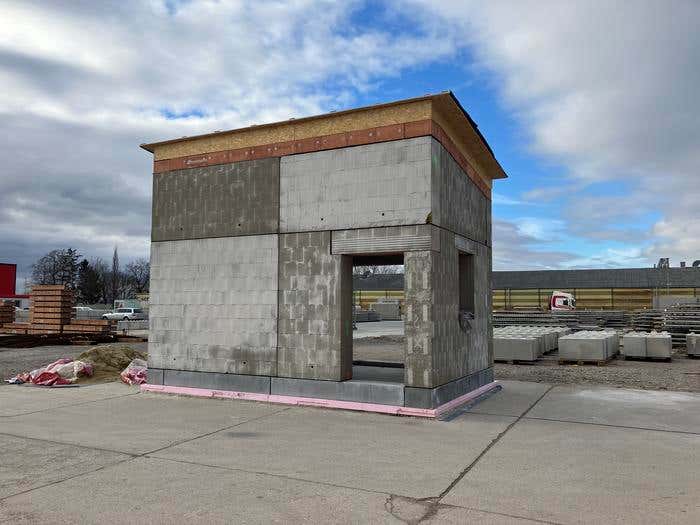
A new reusable brick wall system from Austrian researchers could reduce construction waste and cut carbon emissions by 60%. (CREDIT: IBPSC – TU Graz)
Brick construction creates lasting materials but often ends in waste when buildings are torn down early. Engineers in Austria built reusable brick walls that can be dismantled and rebuilt, cutting emissions and debris while suggesting a different future for buildings.
Construction sites often begin with new materials and end with massive piles of waste. Across the world, buildings are demolished long before the materials inside them wear out. Brick walls that could last for generations are frequently crushed and discarded after only a few decades of use.
Researchers at Graz University of Technology believe that cycle needs to change. Working with Austrian brick producer wienerberger, the team has developed reusable brick wall systems designed to survive beyond the life of a single building.
Instead of binding bricks together permanently with mortar, the researchers created industrially prefabricated wall elements connected through reversible joints. The walls can later be dismantled without destroying the materials, then rebuilt at another site.
The project, called Re-Use Ziegelwand, could help reduce greenhouse gas emissions and construction waste while giving buildings a much longer material life cycle.
Breaking the Link Between Buildings and Waste
Modern construction creates enormous environmental pressure. Buildings consume large amounts of raw materials and energy during production. Demolition then generates mountains of debris, much of which ends up in landfills.
Short-lived commercial buildings create an especially heavy burden. Structures such as consumer markets often remain in use for only 10 to 20 years before replacement.
“Bricks are very high-quality building materials and their production is very resource-intensive,” said Hans Hafellner, project manager at the Institute of Building Physics, Services and Construction at TU Graz. “It therefore offers enormous advantages if they can be removed non-destructively after a building has been used, and re-used elsewhere.”
The researchers wanted to separate the lifespan of the building material from the lifespan of the building itself. Rather than treating a demolished structure as waste, they envisioned it as a temporary assembly of reusable parts.
That idea reflects a growing movement toward circular construction, where materials remain in use for as long as possible instead of being discarded after one project.
A Brick Wall Designed To Come Apart
Traditional brick walls rely on mortar joints that permanently lock materials together. Once demolished, the bricks often crack or break apart. Reuse becomes difficult, expensive or impossible.
The Graz team approached the problem differently. They designed prefabricated brick wall elements using reversible connection systems instead of permanent mortar joints.
This required solving several engineering challenges at once. The walls needed to remain stable, airtight and weather resistant while still being removable years later.
The finished walls measure 44 centimeters thick and contain insulating wool inside the bricks to improve thermal performance. The walls are also pre-plastered in the factory, reducing labor at the construction site.
The researchers developed two structural stabilization options. One method relies on a heavy roof system to hold the building securely in place. The second uses vertically running threaded rods that pass through the bricks and are tensioned to stabilize the walls.
Every component had to meet strict standards for structural performance, tolerances, insulation and long-term durability.
Testing Whether Reuse Really Works
To test the system, the researchers built a full demonstrator structure. They then dismantled it and rebuilt it at another location.
The results showed that the reusable walls remained fully functional after reconstruction. The joints and wall systems met all required performance standards during both assembly and reassembly.
“The successful construction, dismantling and reassembly of the demonstrator on a large scale confirms the technical feasibility and robustness of the system under realistic conditions,” said Andreas Trummer from the Institute of Structural Design at TU Graz.
That success matters because reusable construction systems often fail outside laboratory conditions. Materials can weaken during transport, handling or disassembly. The Graz project demonstrated that the concept could survive real-world rebuilding conditions.
The researchers also considered how the walls might behave after 10 or 20 years of use. To monitor structural integrity over time, they plan to use modal analysis, a vibration-based testing method.
Listening to Buildings For Signs of Damage
Modal analysis works by measuring how a structure naturally vibrates. Researchers first determine the wall system’s natural frequency in a healthy state. If the frequency changes later, engineers can identify potential structural weakening or damage.
This method allows researchers to monitor load-bearing capacity without destructive testing.
In practice, that means future buildings could potentially be inspected and evaluated before disassembly. If the walls remain structurally sound, they could be reused again in another project.
This approach extends the useful life of the materials while lowering demand for new resource-intensive brick production.
Major Carbon Savings Across Multiple Life Cycles
The environmental gains could be substantial. According to the researchers, the reusable system may reduce carbon dioxide emissions by around 60% across three building life cycles compared with conventional brick construction.
That reduction comes largely from avoiding repeated manufacturing of new bricks and reducing demolition waste.
“The results of our research to date show that a significant proportion of total emissions can be avoided during the second phase of use through reuse by developing an innovative jointing solution,” Hafellner said.
Brick production requires high-temperature kilns and large energy inputs. Reusing existing bricks avoids much of that environmental cost.
The project also creates economic benefits. Buildings constructed with reusable components may retain greater residual value at the end of their service life because their wall systems can be recovered and reused instead of discarded.
“Ultimately, this solution not only benefits the users of the building, as it has a higher residual value at the end of its service life, but also the environment,” Trummer said.
A Shift in How Cities May Build
The project arrives at a time when the construction sector faces increasing pressure to reduce emissions. Buildings account for a major share of global carbon pollution and material consumption.
Many sustainability efforts focus on energy-efficient operation after construction. But researchers increasingly emphasize embodied carbon, the emissions tied to producing building materials themselves.
Reusable wall systems target that problem directly.
The Graz project also highlights a broader shift in thinking. Instead of designing buildings as permanent objects destined for demolition, engineers are beginning to design them as adaptable systems that can be disassembled and rebuilt.
The research involved multiple institutions at TU Graz, including the Institute of Building Physics, Services and Construction, the Institute of Structural Design and the Laboratory for Structural Engineering. The work received funding from the Austrian Research Promotion Agency FFG.
For now, reusable brick buildings remain an emerging idea. Yet the successful testing suggests that tomorrow’s cities may not need to start from scratch every time a building reaches the end of its use.
Practical Implications of the Research
This research could significantly reduce construction waste by allowing bricks and wall systems to remain in use across multiple buildings and decades. Instead of crushing old materials after demolition, builders may one day dismantle structures carefully and reuse the components elsewhere. That shift could lower landfill waste and reduce demand for new raw materials.
The reusable wall system may also help reduce greenhouse gas emissions linked to brick production. Since brick manufacturing requires large amounts of energy, extending the life of existing bricks could lower the construction sector’s carbon footprint. Over time, this approach may support more sustainable urban development and circular construction practices.
For the construction industry, reusable wall systems could create economic value as well. Buildings made from recoverable materials may retain higher value after demolition because their components can be reused rather than discarded. Researchers also believe that vibration-based monitoring methods could help engineers safely assess reusable materials years after installation.
Research findings are available online in the journal Buildings.
The original story "Reusable brick walls could slash construction carbon emissions by 60%" is published in The Brighter Side of News.
Related Stories
- New bacteria can repair bricks for stronger lunar homes
- Scientists create space bricks for moon base using microwaves and lunar soil
- AI could transform how construction projects are managed
Like these kind of feel good stories? Get The Brighter Side of News' newsletter.
Rebecca Shavit
Writer
Based in Los Angeles, Rebecca Shavit is a dedicated science and technology journalist who writes for The Brighter Side of News, an online publication committed to highlighting positive and transformative stories from around the world. Having published articles on MSN, AOL News, and Yahoo News, Rebecca's reporting spans a wide range of topics, from cutting-edge medical breakthroughs to historical discoveries and innovations. With a keen ability to translate complex concepts into engaging and accessible stories, she makes science and innovation relatable to a broad audience.