Myanmar’s deadliest earthquake results in 500 km rupture and signs of a rare supershear break
Myanmar’s March 28, 2025 earthquake did not just shake the ground around Mandalay, it ripped across the country on a scale that seismologists rarely get to study in such detail.

 Edited By: Joseph Shavit

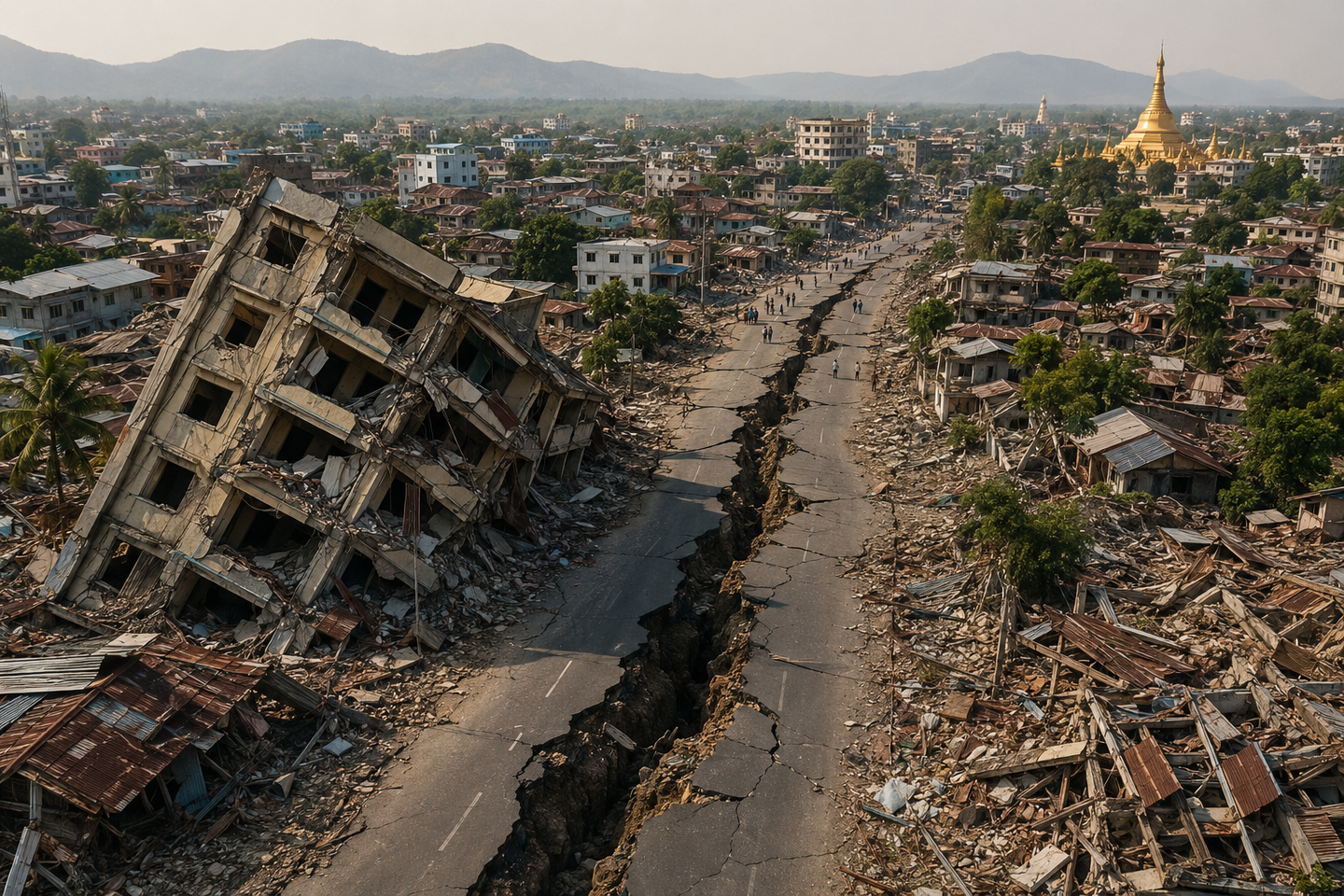
Satellite data show Myanmar’s 2025 quake ripped 500 kilometers along the Sagaing Fault with shallow slip and supershear signs. (CREDIT: AI-generated image / The Brighter Side of News)
Myanmar’s March 28, 2025 earthquake did not just shake the ground around Mandalay, it ripped across the country on a scale that seismologists rarely get to study in such detail.
The magnitude 7.7 quake killed thousands of people, injured more than 11,000, and damaged homes, roads, and critical infrastructure across a wide stretch of central Myanmar. Now a new analysis in Geodesy and Geodynamics shows that the destruction was tied to a long, shallow, fast-moving rupture along the Sagaing Fault, one of Southeast Asia’s most active fault systems.
Using satellite radar and pixel offset tracking, researchers mapped how the ground shifted during the quake and built models of the slip along the fault. They found that the rupture stretched about 500 kilometers, making it one of the longest documented strike-slip surface ruptures of its kind.
The event was dominated by horizontal motion, with most of the slip concentrated in the upper 12 kilometers of the crust. That matters because shallow ruptures are often more dangerous at the surface, where people, buildings, roads, and utilities are exposed.
A fault that broke hard at the surface
The team found that ground displacement at the surface reached about 4.6 meters. In many large earthquakes, movement near the surface is smaller than movement deeper underground, a pattern known as shallow slip deficit. That was not the case here.
“Notably, the ground at the surface moved up to about 4.6 m. In many similar earthquakes, surface movement is smaller than movement at depth, a pattern known as "shallow slip deficit," says corresponding author Shuai Wang from the China University of Mining and Technology. “But the 2025 earthquake in Myanmar showed no obvious shallow slip deficit, meaning the surface experienced the full extent of the movement, making it a devastating disaster for lives and properties.”
That result helps explain why the damage was so severe. When slip reaches the surface without much reduction, the crust does not absorb or spread out as much of the fault motion before it reaches towns and transport corridors above.
The researchers say the Sagaing Fault’s maturity may be part of the reason. It is a long-lived, right-lateral strike-slip fault that has accumulated hundreds of kilometers of displacement since the Miocene and has produced at least nine earthquakes of magnitude 7 or greater since 1900. Mature faults often have straighter geometry and smoother surfaces, conditions that can let rupture move more cleanly and directly.
Their preferred model split the rupture into three segments with different dip angles. Even with those differences, the picture stayed consistent: the earthquake was a shallow, right-lateral strike-slip event with peak slip near the top of the fault plane.
Clues that part of the rupture outran the crust
The study also points to another striking feature. Part of the rupture appears to have traveled at supershear speed, faster than shear waves normally move through the crust.
That is not a label researchers use lightly. The team based the conclusion on three lines of evidence: the fast-rupture zone had relatively few aftershocks, the earthquake’s moment-scaled radiated energy was lower than expected for a strike-slip event of this size, and the fault geometry in that section was simple and nearly linear.
“Supershear earthquakes are rare and highly destructive, but they tend to occur on faults that are straight, smooth, and structurally mature, which are the product of many earthquakes that have occurred over time,” notes Wang. “Recognizing this behavior helps us better understand why some faults produce particularly damaging earthquakes.When a fault breaks at very high speed without obstruction, most of the energy goes into fracturing the rock rather than producing strong ground shaking.”
The rupture appears to have started near the northern part of the break and then run mostly southward over about 70 to 90 seconds. According to the study, the southern part of the rupture may have transitioned from subshear to supershear speed after roughly the first 100 kilometers.
That southward growth may not have been random.
A long quiet stretch may have been storing strain
The authors argue that the earthquake likely broke through a section of the Sagaing Fault that had not seen a major event in a very long time. The northern end of the 2025 rupture partly overlapped with the southern part of a 2012 magnitude 6.8 earthquake, while the southern end appears to line up with the rupture area of a 1930 magnitude 7.5 event.
That leaves a long stretch in between that may have been storing tectonic strain for decades.
The team’s Coulomb stress calculations suggest the rupture on one segment promoted failure on neighboring segments, helping the break continue south. In one area, static stress transfer reached about 2 bars near the next section of fault, enough to help push it closer to failure.
The rupture also traveled much farther than standard empirical relations would predict for a magnitude 7.7 earthquake. The study notes that its length exceeded the roughly 250-kilometer upper limit often expected from those relationships.
Importance beyond Myanmar
That makes the event important beyond Myanmar. It offers a rare case of a large continental strike-slip earthquake on a mature fault system that appears to show both supershear behavior and no shallow slip deficit.
The researchers also compared the earthquake’s coseismic slip with how the fault behaves between earthquakes. In two major segments, the depth range of locking before the earthquake matched the depth range of rupture during it, and the ratio of slip between segments tracked with known differences in long-term slip rate.
That allowed the team to estimate recurrence intervals for large earthquakes on the affected segments.
“Based on seismic moment budget analysis and geodetic slip deficit modeling, we estimated a 104–131-year recurrence interval for Mw>7 earthquakes on the segments that ruptured in this event, while the northern segment may have a shorter one,” adds Wang.
What this rupture adds to the seismic picture
For earthquake science, the Myanmar event sharpens a long-running question about why some strike-slip faults break in especially damaging ways. The answer, at least here, seems to involve a combination of fault maturity, shallow rupture, a long seismic gap, and a geometry simple enough to let part of the rupture run exceptionally fast.
For Myanmar and the broader region, it is also a reminder that the Sagaing Fault is not just active, but capable of producing very large, complex earthquakes that affect dense population centers far beyond the epicenter.
Practical implications of the research
The findings could improve seismic hazard assessments in Myanmar and across Southeast Asia by identifying which parts of the Sagaing Fault may be capable of long, shallow, high-speed ruptures.
They also give planners and engineers better information about how fault maturity, rupture length, and near-surface slip can translate into damage on the ground.
That matters for rebuilding in affected areas and for strengthening infrastructure in places that sit along, or close to, the fault system.
Research findings are available online in the journal Geodesy and Geodynamics.
The original story "Myanmar's deadliest earthquake results in 500 km rupture and signs of a rare supershear break" is published in The Brighter Side of News.
Related Stories
- Cajon Pass appears primed for a massive earthquake crossing two major Southern California faults
- Scientists solve the 30-year mystery of 'clockwork' earthquakes
- Scientists create the first global map of rare, deep-mantle earthquakes
Like these kind of feel good stories? Get The Brighter Side of News' newsletter.
Joshua Shavit
Writer and Editor
Joshua Shavit is a NorCal-based science and technology writer with a passion for exploring the breakthroughs shaping the future. As a co-founder of The Brighter Side of News, he focuses on positive and transformative advancements in technology, physics, engineering, robotics, and astronomy. Having published articles on AOL.com, MSN, Yahoo News, and Ground News, Joshua's work highlights the innovators behind the ideas, bringing readers closer to the people driving progress.