Revolutionary new engine runs on the cold of space – no fuel required
A UC Davis team built an engine that runs after dark by exploiting the temperature gap between warm ground and a cold night sky — no fuel required.

 Edited By: Joseph Shavit

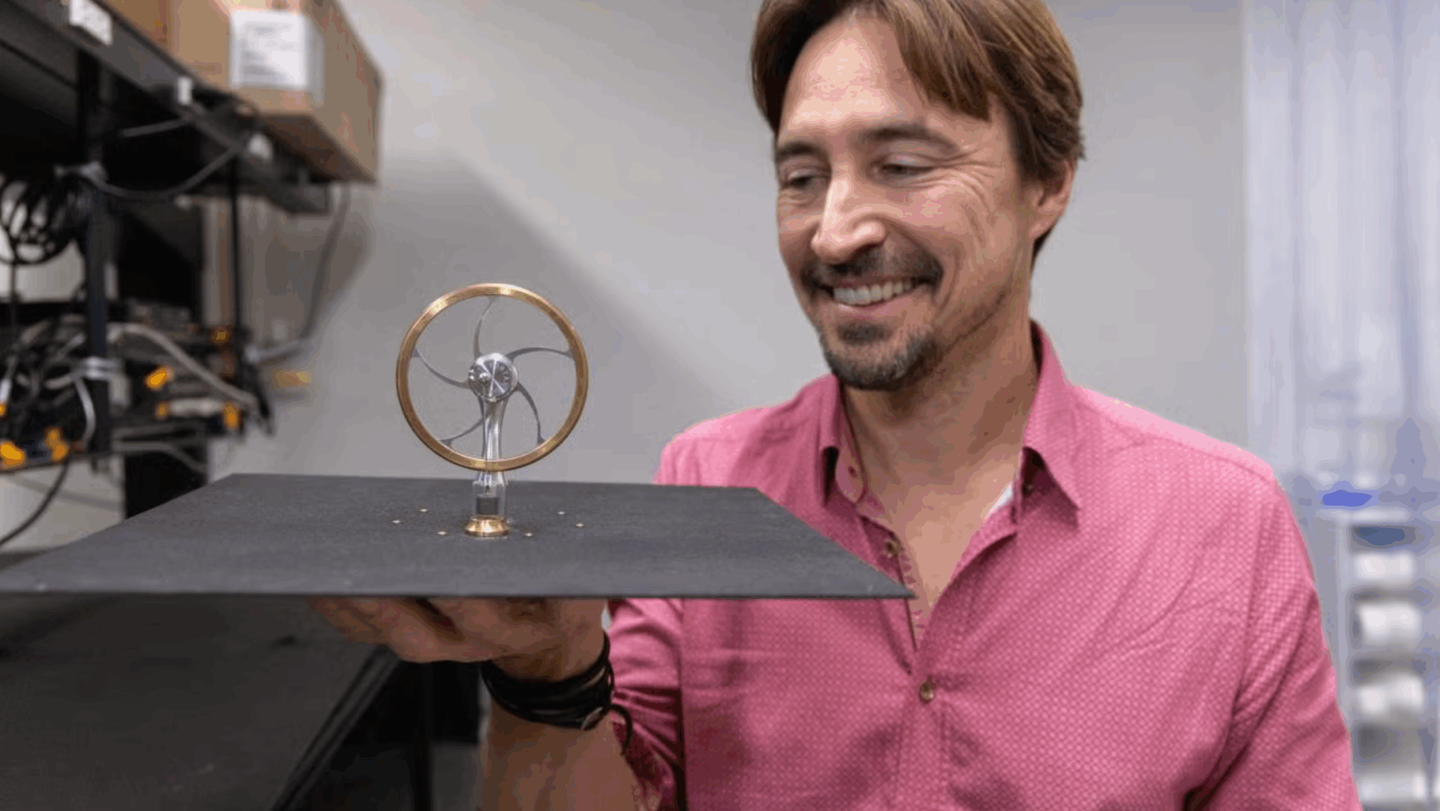
Professor Jeremy Munday has built an experimental engine that taps into the temperature gap between Earth and deep space, producing mechanical power simply by operating outdoors at night. (CREDIT Mario Rodriguez for UC Davis College of Engineering)
Every night, the sky does something invisible and enormous. Heat escapes from Earth's surface upward through the atmosphere and out into the cold of space. This is a process as old as the planet itself. However, no one had seriously tried to harness that nightly energy flow and turn it into usable mechanical power. A small team of engineers in California just did.
Researchers at the University of California, Davis built an engine that runs entirely on the temperature difference between warm ground and a cold night sky, no fuel, no batteries, no grid connection required. It sits outside, faces upward, and quietly pulls power from the dark. The demonstration is modest in scale. Even so, the underlying principle opens a genuinely new category of off-grid energy technology.
The Cold Side of the Energy Equation
Solar panels capture sunlight by exploiting the fact that one side of a device is hotter than the other. The sun warms the active surface; the surroundings stay cool. Jeremy Munday, a professor of electrical and computer engineering at UC Davis, and graduate researcher Tristan Deppe asked a deceptively simple question: could the same logic work in reverse at night, with space acting as the cold side instead of the sun acting as the hot side?
The answer is yes, and the physics behind it has been understood for decades. Earth's atmosphere has a natural transparency window in the infrared range, roughly between 8 and 13 micrometers in wavelength. Through that window, surfaces facing the sky can radiate heat directly into space and cool well below the surrounding air temperature. On clear, dry nights, the effect is strong enough to frost a car roof even when the air temperature stays above freezing.
Munday and Deppe decided to attach an engine to that process.
They chose a Stirling engine, a well-established design that converts temperature differences into mechanical motion. Unlike combustion engines, Stirling engines require no burning fuel and can operate on very small thermal contrasts. The team pressed the engine's warm base plate against the ground, which retains heat after sunset. They coated the top plate with a special infrared-emitting paint to maximize heat radiation toward the sky. On clear nights during field tests in Davis and Utah, the top plate cooled by as much as 10 degrees Celsius relative to the base.
That gap, modest by the standards of conventional engines, was enough to spin the flywheel.
What the Engine Actually Produced
The research team ran both field and laboratory tests, the latter using controlled heated and cooled plates to systematically measure how power output responded to different temperature gaps. Output scaled predictably with the temperature difference applied.
At the 10-degree differentials measured outdoors, the device generated around 400 milliwatts of mechanical power per square meter of sky-facing surface. That number is a small fraction of what a solar panel produces on a sunny afternoon. However, the comparison misses the point entirely. This engine runs at night, autonomously, with no consumables and almost no complexity.
When the team attached a small DC motor to the flywheel, the mechanical energy converted to electricity at low efficiency, a few percent, with the device retaining roughly half its mechanical output as usable electrical current. Even at that level, the system was capable of powering small sensors, incrementally charging batteries, or maintaining basic electronics during overnight hours when solar sources are unavailable.
The most visually striking demonstration involved swapping the flywheel for a 3D-printed fan blade. The spinning fan pushed air at roughly 0.3 meters per second under moderate temperature differences. At temperature differentials above 30 degrees Celsius, airflow reached nearly 5 cubic feet per minute. As a result, the device crossed the threshold for baseline ventilation in large public spaces as defined by the American Society of Heating, Refrigerating, and Air Conditioning Engineers.
The practical image that emerges is not a power plant. It's a rooftop cooler paired with an indoor fan, drawing fresh night air through a building with no electricity, no noise, no moving parts beyond a slowly spinning blade.
Where It Works, and Where It Doesn't
Not every location is equally suited to radiative sky cooling. The team used NASA satellite data to map global performance potential. Dry regions and high-altitude environments performed best, as low humidity and clear air allow heat to escape to space with minimal interference. Parts of the Sahara, stretches of the Eurasian Steppe, and even summer conditions in Antarctica ranked among the strongest candidates.
Humid tropical regions performed poorly. Water vapor in the atmosphere absorbs infrared radiation before it can escape, reducing the cooling effect on the top plate and narrowing the temperature gap the engine depends on. Forested, moist environments offered the least favorable conditions.
Nighttime clouds and high humidity reduced, but didn't eliminate, cooling performance even in otherwise favorable locations. The team found that even on warmer, more humid nights, the top plate consistently cooled by some measurable amount before morning. This suggests year-round operation is achievable in many climates.
A Niche That Fits an Overlooked Problem
Radiative cooling engines sit in an odd position relative to mainstream clean energy conversation. They produce less power per square meter than solar panels. They require clear skies to perform well. Their efficiency, for now, is low.
None of that necessarily limits their value. The devices address a problem that batteries and solar panels leave partly unsolved: autonomous, low-maintenance overnight power for applications that don't need much of it. Remote sensing equipment, agricultural monitoring stations, small greenhouse ventilation systems, and basic communications hardware in resource-constrained settings all represent targets where a self-contained nocturnal power source, something with no fuel logistics and almost no failure points, would be genuinely useful.
The researchers also note a climate dimension. Earth currently absorbs approximately one watt per square meter more energy than it emits, the energy imbalance that drives global warming. Radiative cooling surfaces actively increase heat emission to space. Scaling that technology, even for reasons unrelated to climate, would nudge that imbalance in a favorable direction as a secondary effect.
Practical Implications
The prototype leaves meaningful room for improvement. Better infrared-emitting materials would increase heat loss from the top plate. A vacuum enclosure around that plate would prevent unwanted warming from contact with surrounding air.
Filling the engine with hydrogen or helium, gases with lower internal friction than air, would improve mechanical efficiency. Connecting the warm base plate to an industrial or building waste heat source rather than simply the ground would produce a larger temperature differential. As a result, the device generates more power without adding any separate energy input.
The core proposition, though, is already demonstrated. An engine with no fuel, no battery, no electronics, and a single moving part can sit outside at night, face the sky, and generate mechanical work from the temperature difference between a warm planet and the cold of space.
That's a new energy source, quiet and perpetual, powered by nothing but darkness.
Research findings are available online in the journal Science Advances.
The original story "Revolutionary new engine runs on the cold of space - no fuel required" is published in The Brighter Side of News.
Related Stories
- Race to Sedna: New fusion and solar sail engines could reach distant world in 10 years
- Next-generation jet engine converts electricity directly into thrust
- Cutting-edge rocket engine could accelerate to 99% the speed of light
Like these kind of feel good stories? Get The Brighter Side of News' newsletter.
Joshua Shavit
Writer and Editor
Joshua Shavit is a NorCal-based science and technology writer with a passion for exploring the breakthroughs shaping the future. As a co-founder of The Brighter Side of News, he focuses on positive and transformative advancements in technology, physics, engineering, robotics, and astronomy. Joshua's work highlights the innovators behind the ideas, bringing readers closer to the people driving progress.