Scientists find that Earth microbes can thrive in Mars-like conditions
A salt-loving Earth microbe grew in warm brine at low pressure for a Mars-inspired experiment, helping scientists test habitability and future life searches.
 University of Florida Writer: Eric Hamilton

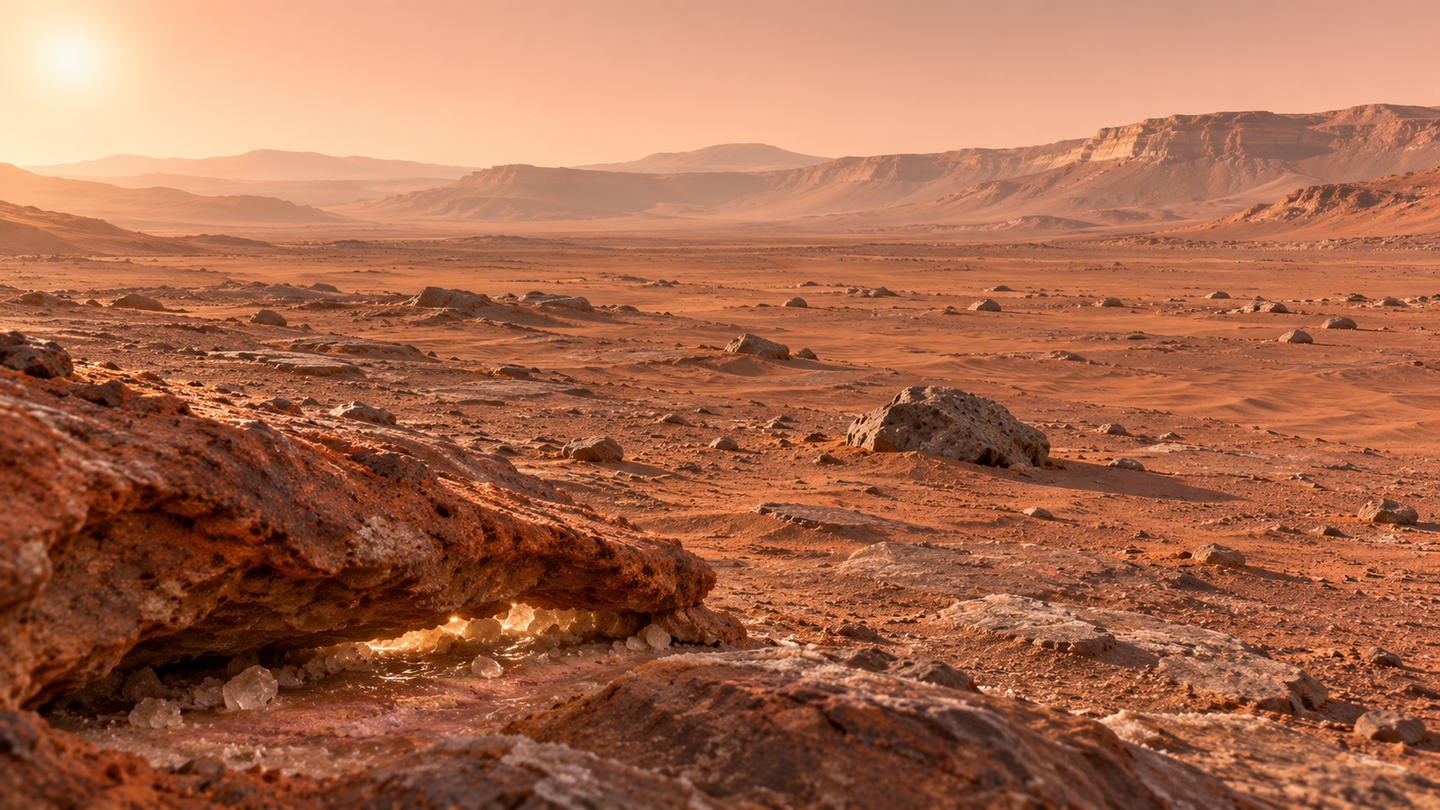
Artist’s concept of a Martian landscape with a sheltered, salt-rich crevice representing a hypothetical microbial habitat. Experiments with Earth microbes explore such possibilities, but life on Mars remains unconfirmed. (CREDIT: The Brighter Side of News)
- A salt-loving Earth microbe showed growth after 160 days in warm brine under low pressure and an oxygen-free, carbon dioxide-rich atmosphere.
- Cultures supplied with nitrate or perchlorate grew and altered those chemicals; controls without either remained viable without measurable growth.
- The experiment represents a hypothetical Martian habitat, with warmer temperatures and richer nutrients than confirmed conditions beneath Mars.
A salt-loving microorganism from Earth did more than endure a months-long experiment designed around possible conditions beneath Mars. It grew in concentrated brine under low pressure, using nitrate or perchlorate in place of oxygen during respiration. The result extends research on the resilience of Earth microbes. It also raises a question for Mars exploration: Which combinations of harsh conditions can still permit biological activity?
The experiment, led by Adam Robinson at the University of Florida, appears in Applied and Environmental Microbiology. Scott Perl of the Los Angeles Natural History Museum and Blue Marble Space Institute of Science co-led the work.
The findings could guide the search for life on Mars, but they do not establish that organisms live there. The chamber represented a proposed habitat, not an environment scientists have directly observed.
A salt-loving organism in thin air
The team selected Haloferax volcanii, a single-celled organism belonging to the archaea, a major branch of life distinct from bacteria. It tolerates unusually salty conditions on Earth, making it a useful experimental model. Such an organism cannot stand in for unknown Martian life. It can, however, show which combinations of stresses a known living cell can overcome.
Cultures spent 160 days in a carbon dioxide-rich atmosphere without added oxygen. Pressure stayed at 24 millibars, about 2.4% of Earth's sea-level atmospheric pressure. The liquid contained 225 grams of sodium chloride per liter, roughly seven times seawater's salinity. Researchers also supplied nutrients and kept the cultures at 21°C, approximately 70°F.
That combination matters because experiments often isolate one environmental stress or examine survival rather than growth. Reproducing cells must sustain metabolism, not simply remain capable of recovery later. “Far fewer have been able to combine these conditions together and show that microorganisms can actively grow,” Robinson said. The experiment therefore addressed a more demanding test of cellular life than short-term exposure alone.
Earlier work in Astrobiology found that the same organism remained viable for 113 days under similar low-pressure conditions, without detectable growth. That experiment used a less concentrated salt solution. Subsequent work clarified that conditions favoring growth without oxygen differ from those preferred during oxygen-supported growth. The new cultivation approach reflects those physiological differences.
Distinguishing growth from survival
The researchers compared the low-pressure cultures with cultures held at ordinary Earth pressure under matching chemical conditions. This helped isolate the effect of a much thinner atmosphere. They also included controls without added nitrate or perchlorate. Each treatment had three biological replicates, allowing comparisons between the different conditions.
Nitrate and perchlorate can serve as alternative electron acceptors during respiration. These chemicals help cells carry out energy-releasing reactions when oxygen is unavailable. Their relevance to Martian chemistry made them useful choices for the experiment. They were not the microbes' only supplies: the growth medium also contained nutrients provided by the researchers.
After 160 days, supplemented cultures showed statistically significant increases in optical density, a measurement of how strongly a culture blocks light. Nitrate and perchlorate concentrations also decreased, supporting the evidence for biological activity. Growth was substantially lower at low pressure than in Earth-pressure controls, and nitrate supported more growth than perchlorate. Cultures without either added chemical remained viable but showed no measurable growth, separating persistence from active cultivation.
Biofilms and chemical fingerprints
Electron microscopy revealed dense cell aggregates and biofilm-like structures in the growing low-pressure cultures. Cells appeared embedded in a surrounding matrix, rather than remaining entirely separate. Comparable structures were absent from the low-pressure controls that did not grow. The association suggests that biofilms may be part of the organism's response to these conditions.
The cultures also retained most of their water. Across all treatments, water loss remained below 4%, while the growing cultures lost approximately 1.6% to 2.1%. High salinity helped stabilize the liquid under conditions that otherwise encourage evaporation. Biofilms may have provided additional protection, but the experiment did not establish that they alone caused the low water loss.
The team also used Raman spectroscopy, which identifies chemical features through the way molecules scatter laser light. Signals from carotenoid pigments remained detectable after incubation, although their strength changed between treatments. Such pigments are possible biosignatures, or chemical traces that can help investigators search for biological material.
Understanding how conditions alter them could improve the interpretation of future life-detection measurements. A pigment signal alone would not establish that cells were still alive. Biological molecules can remain after death, while environmental chemistry can weaken or alter their signatures. Comparing chemical fingerprints with growth and metabolic activity helps researchers understand what a future detection might mean.
What the chamber did not reproduce
The largest qualification is temperature. Most of the Martian subsurface is far colder than the warm laboratory cultures, and the experiment did not reproduce daily or seasonal freezing cycles. Nor did it establish that the required pockets of liquid water exist on Mars. A brine that supports growth in a chamber is not automatically a habitat available on another planet.
“The environment that we're mimicking in this experiment has not been observed on Mars, but is theorized to exist,” Robinson said. The pressure represented a hypothetical protected niche within the Martian subsurface, rather than typical conditions across the exposed surface.
The researchers also acknowledge that their nutrient-rich medium does not reflect established supplies of biologically available organic material on Mars. Together, those differences limit how directly the findings can be applied to the planet today.
Future experiments will bring those constraints into the cultivation tests. The team plans to include freeze–thaw cycles, more Mars-relevant nutrient mixtures and simulated Martian soil. Testing cold-adapted microorganisms alongside salt-loving ones could broaden the comparison. Those steps would help determine whether growth remains possible as experimental conditions move closer to actual Martian environments.
Designing a search without carrying the answer
The work also informs planetary protection, the effort to prevent biological contamination during space exploration. Knowing how Earth organisms behave under combinations of Martian stresses helps researchers assess contamination risks. Laboratory growth does not prove that this organism could reach and establish itself on Mars. It does identify conditions worth considering when evaluating safeguards for future missions.
For life-detection experiments, the distinction between survival and growth is equally important. An organism might remain viable under one set of conditions yet require different conditions to reproduce. Experiments must therefore consider the chemistry and physical setting needed to reveal activity. Otherwise, a test could overlook organisms because its cultivation conditions are unsuitable.
“We are adding to the growing body of evidence suggesting that we should consider the possibility of life on Mars today,” Robinson said. That possibility remains separate from evidence of an actual Martian organism.
What the team has demonstrated is narrower: one Earth archaeon can grow under a carefully defined combination of low pressure, high salinity and oxygen-free chemistry. Whether Mars supplies the necessary water, temperature and nutrients remains an open question.
Dig deeper into microbes and Martian habitability
These resources explore microbial growth, survival and the environmental limits that shape the search for life.
Perchlorate supported anaerobic growth in Haloferax volcanii reveals a novel metabolic capability with implications for biosignature degradation
Examines the salt concentrations and nutrient conditions that allow this archaeon to grow using perchlorate without oxygen. (Scientific Reports, June 2026)
Survival of NASA-cleanroom microbial isolates under simulated space and Martian conditions
Investigates the resistance of spacecraft-associated microbes, providing context for contamination safeguards and the difference between survival and growth. (Applied and Environmental Microbiology, April 2026)
Haloferax volcanii Remains Viable and Shows Morphological Changes under Anoxic (CO2-Enriched) and Hypobaric (2.4 kPa) Atmospheric Conditions
Reports the earlier low-pressure survival experiment that preceded the successful cultivation approach. (Astrobiology, March 2022)
Distribution and habitability of (meta)stable brines on present-day Mars
Models brine formation and explains why cold temperatures and limited water availability can prevent apparently promising liquids from being habitable. (Nature Astronomy, May 2020)
Planetary Protection
Explains NASA's approach to protecting other worlds from Earth contamination and safeguarding Earth during sample-return exploration. (NASA)
Research findings are available online in the journal Applied and Environmental Microbiology.
The original story "Scientists find that Earth microbes can thrive in Mars-like conditions" is published in The Brighter Side of News.
Related Stories
- New analysis finds signs of life on Mars actually came from Earth
- Scientists discover 16 giant river networks on ancient Mars where life could have thrived
- Strange new mineral found on Mars points to past potential for life
Like these kind of feel good stories? Get The Brighter Side of News' newsletter.
Joseph Shavit
Writer, Editor-At-Large and Publisher
Joseph Shavit, based in Los Angeles, is a seasoned science journalist, editor and co-founder of The Brighter Side of News, where he transforms complex discoveries into clear, engaging stories for general readers. With vast experience at major media companies like The Los Angeles Times, Times Mirror and Tribune Publishing, he writes with both authority and curiosity. His writing focuses on space science, planetary science, quantum mechanics, geology. Known for linking breakthroughs to real-world markets, he highlights how research transitions into products and industries that shape daily life.