Seven new diamond frog species reveal Madagascar’s hidden biodiversity
Scientists identify seven new Madagascar diamond frog species, highlighting hidden biodiversity and urgent conservation needs.
 University of Copenhagen Writer: Robin Crisp

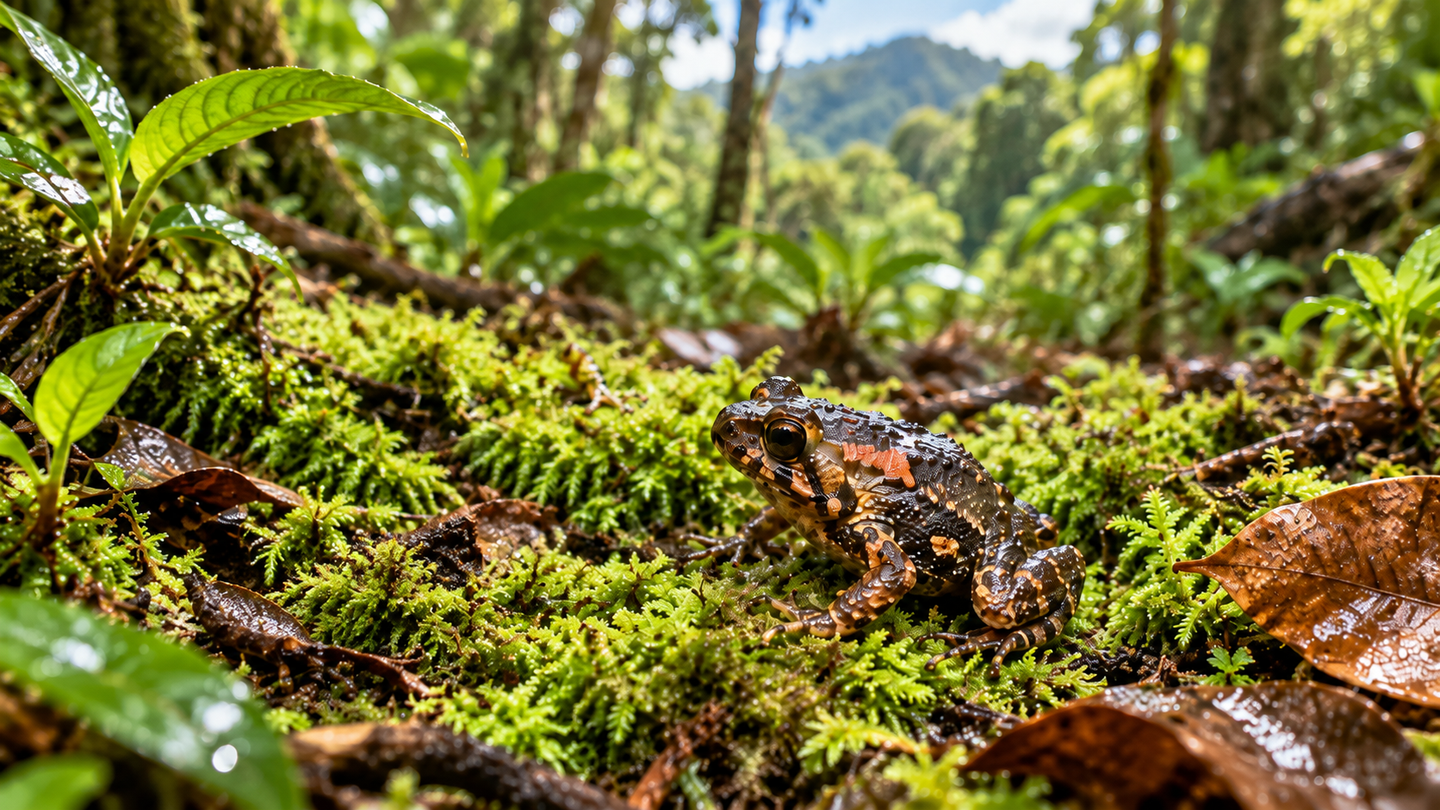
Scientists name seven new diamond frogs in Madagascar, raising the genus to 27 species and revealing urgent conservation risks. (CREDIT: Shutterstock)
- Scientists have described seven new species of Madagascar’s secretive diamond frogs, increasing the known genus Rhombophryne from 20 to 27 species.
- Researchers combined modern specimens with DNA recovered from decades-old museum material, frog calls, body measurements and micro-CT scans to untangle difficult species identities.
- The revision estimates that 24 of the 27 recognized species are threatened, showing why identifying Madagascar’s hidden biodiversity can directly influence conservation.
A quiet world beneath Madagascar’s forest floor has just become far richer. An international team of scientists has described seven new species of diamond frogs, a secretive group known as Rhombophryne. The discovery raises the known total from 20 species to 27 and shows that one of Madagascar’s least-understood amphibian groups still holds many hidden lives.
These frogs are easy to miss. Many spend their lives under leaf litter, soil and damp forest debris. Some are round and strong-bodied, built for burrowing. Others have longer legs and move through moss, roots and forest floor plants. At first glance, many look brown and plain, but some flash orange, white or black markings when disturbed.
“Diamond frogs have been hiding their diversity beneath our feet,” said Dr. Mark D. Scherz, Curator of Herpetology at the Natural History Museum Denmark and lead author of the study.
A Hidden Family Comes Into Focus
Madagascar is one of the world’s great centers of frog diversity. Scientists estimate the island may hold more than 700 frog species. As of June 2026, 446 had formal scientific names.
That gap matters. A species cannot be fully protected if scientists cannot clearly identify it. Knowing where a species lives is the first step toward understanding its risk.
Diamond frogs belong to a Malagasy frog group called Cophylinae. This group includes large frogs, tiny frogs and species with very different lifestyles. Some members are among the smallest vertebrates on Earth.
Within Rhombophryne, body size ranges widely. Some species are close to 60 millimeters long, while one tiny species reaches only about 12 millimeters. Their shapes and habits vary just as much.
Twelve Years Of Fieldwork And Questions
The project began more than 12 years ago. Researchers kept finding frogs that clearly looked like unnamed species. Each new expedition added more evidence, but also more confusion.
“When I started this project twelve years ago, we already knew there were several species waiting to be described, and almost every expedition to Madagascar revealed another one. Some were relatively straightforward to describe, but others were complicated by uncertainty surrounding older species names. Untangling that puzzle took years,” Scherz said.
The problem involved old museum specimens and historical species names. Scientists needed to match those names to modern genetic lineages. Without that step, they risked naming the same species twice or misidentifying old ones.
This kind of work can feel slow, but it is essential. Taxonomy gives biodiversity its map, and conservation depends on that map.
DNA From Museum Specimens
A major breakthrough came through museomics, the study of DNA from historical museum samples. Some important specimens were collected decades ago. Others included original type specimens, which anchor scientific names.
By sequencing DNA from these older samples, researchers could connect past collections with modern fieldwork. Even partial genetic data helped place old specimens in the right part of the frog family tree.
“Museum collections are far more than archives of the past – they are essential scientific resources for understanding biodiversity today,” said Dr. Alice Petzold of the University of Potsdam, who led the museomics work.
“By sequencing historical specimens, including the original type specimens, we were able to answer questions that have persisted for generations,” she added.
The team combined museum DNA with newly collected material, frog calls, body measurements and skeletal anatomy.
More Than One Kind Of Evidence
The researchers used what scientists call an integrative approach. In plain terms, they did not rely on only one clue. They looked for agreement across several lines of evidence.
They measured body size, head shape, eye size, limb length and other traits. They studied calls that male frogs use to attract mates. They also used micro-CT scans to examine bones without damaging specimens.
Genetic work focused on mitochondrial and nuclear DNA. The team analyzed 100 Rhombophryne individuals in one key genetic tree. They also used 204 DNA sequences overall, including 77 newly generated for the study.
This careful approach helped researchers decide when a population truly represented a separate species. It also helped them avoid overclaiming when evidence remained incomplete.
Seven New Species Join Science
The study names seven new species: Rhombophryne maraorao, R. mavokely, R. anatiala, R. kotrobaratra, R. sonaliae, R. kilonjy and R. quentini.
Each species adds a new branch to Madagascar’s remarkable amphibian life. Some were expected from earlier candidate lists. One had not been identified before as a possible new species.
The researchers also found several unresolved candidate species. They did not name them yet because the evidence remains limited. In some cases, too few specimens exist to judge variation or range.
That caution matters. Good species descriptions must last, especially when conservation decisions depend on them.
Many Ways To Be A Diamond Frog
The study recognizes six main species groups within Rhombophryne. Each group shows a different version of life as a diamond frog.
The R. testudo group includes many burrowing frogs with short limbs and rounded bodies. The R. laevipes group contains some of the largest species, often with pale markings near the legs and groin.
The R. ellae group includes medium-sized frogs with bright orange on the backs of their limbs. Some also have black groin spots outlined in white.
The R. proportionalis group contains one highly miniaturized species. Its call differs sharply from other known diamond frog calls. The R. minuta group includes small, slender frogs with long limbs. The R. serratopalpebrosa group includes frogs with small spine-like structures near the eyes.
Forests Under Growing Pressure
Most diamond frogs live in humid or subhumid forests in northern, northeastern and eastern Madagascar. The genus appears absent from western and southern Madagascar.
Many species have small known ranges. Some are known from only a few specimens. Others may live in areas that scientists have not yet surveyed well.
That uncertainty creates a serious conservation challenge. Forest loss and fragmentation continue across Madagascar. When a frog lives only in a narrow area, even small habitat changes can carry large risks.
“For many species, we still know almost nothing about their breeding biology, population sizes or ecological requirements. Without that knowledge, it becomes much more difficult to assess their conservation status and protect them effectively,” said Dr. Andolalao Rakotoarison of the Institut d’Enseignement Supérieur de Soavinandriana Itasy, Madagascar.
Discovery Meets Conservation
The study estimates that 24 of the 27 known Rhombophryne species are threatened. Two species, R. kilonjy and R. matavy, may qualify as critically endangered.
The findings are already informing conservation planning. During a protected area workshop in March 2026, several newly described species helped support proposals to strengthen and expand protected areas.
One of those species was Rhombophryne quentini. Its recognition gave planners clearer evidence about which forests need protection.
“Every newly described species represents millions of years of unique evolutionary history. The more we learn about Madagascar’s remarkable amphibians, the clearer it becomes that there is still an enormous amount left to discover,” Scherz said.
Practical Implications Of The Research
This research gives conservationists a stronger foundation for protecting Madagascar’s forests. By naming species and clarifying where they live, scientists can better identify areas that need urgent protection. This helps governments and conservation groups make more informed decisions.
The study also shows the continuing value of museum collections. Specimens preserved for decades can still answer modern questions when paired with DNA tools and imaging technology. This means older collections may help uncover hidden biodiversity in many other animal groups.
For future research, the work provides an identification key for diamond frogs. That tool can help field teams recognize species more reliably. Better identification can lead to stronger population surveys and more accurate threat assessments.
For humanity, the broader lesson is clear. Many species may be disappearing before people fully know they exist. Protecting biodiversity starts with seeing it clearly, naming it carefully and valuing its place in the living world.
Dig deeper into Madagascar’s hidden amphibian diversity
These resources explore diamond frog taxonomy, museum collections and the broader challenge of conserving Madagascar’s exceptional amphibians.
A new microhylid frog, genus Rhombophryne, from northeastern Madagascar, and a re-description of R. serratopalpebrosa using micro-computed tomography: This earlier study demonstrated how micro-CT imaging can expose anatomical differences among difficult-to-identify diamond frogs. (Zootaxa, 2014)
A review of the taxonomy and osteology of the Rhombophryne serratopalpebrosa species group (Anura: Microhylidae) from Madagascar, with comments on the value of volume rendering of micro-CT data to taxonomists: Researchers combined phylogenetics and detailed skeletal anatomy to revise one particularly complex diamond frog group. (Zootaxa, 2017)
‘Barcode fishing’ for archival DNA from historical type material overcomes taxonomic hurdles, enabling the description of a new frog species: This work shows how DNA recovered from historical museum specimens can resolve old taxonomic uncertainties in Malagasy frogs. (Scientific Reports, 2020)
Vouchering, integrative taxonomy and natural history collections: a case study with the amphibians of Madagascar: The authors explain why preserved specimens remain essential for identifying species, documenting distributions and supporting conservation. (Bollettino del Museo Regionale di Scienze Naturali di Torino, 2023)
The Challenge of Conserving Amphibian Megadiversity in Madagascar: This overview examines the extraordinary richness of Madagascar’s frogs and the habitat threats that make proactive conservation particularly urgent. (PLOS Biology, 2008)
Research findings are available online in the journal Vertebrate Zoology.
The original story "Seven new diamond frog species reveal Madagascar’s hidden biodiversity" is published in The Brighter Side of News.
Related Stories
- New glassfrog species named in honor of Equadorian Olympic champion Neisi Dajomes
- Scientist discovers seven never-before-seen species of a distinctive frog-like insect
- Extinct ice age toad found at La Brea Tar Pits rewrites Los Angeles’ climate history
Like these kind of feel good stories? Get The Brighter Side of News' newsletter.
Joseph Shavit
Writer, Editor-At-Large and Publisher
Joseph Shavit, based in Los Angeles, is a seasoned science journalist, editor and co-founder of The Brighter Side of News, where he transforms complex discoveries into clear, engaging stories for general readers. With vast experience at major media companies like The Los Angeles Times, Times Mirror and Tribune Publishing, he writes with both authority and curiosity. His writing focuses on space science, planetary science, quantum mechanics, geology. Known for linking breakthroughs to real-world markets, he highlights how research transitions into products and industries that shape daily life.