Astronomers discover a baby planet less than 1 million years old
A newborn giant found inside its dusty birth disk offers astronomers a rare view of planet formation almost from the beginning.
 NASA Writer: Ashley Balzer

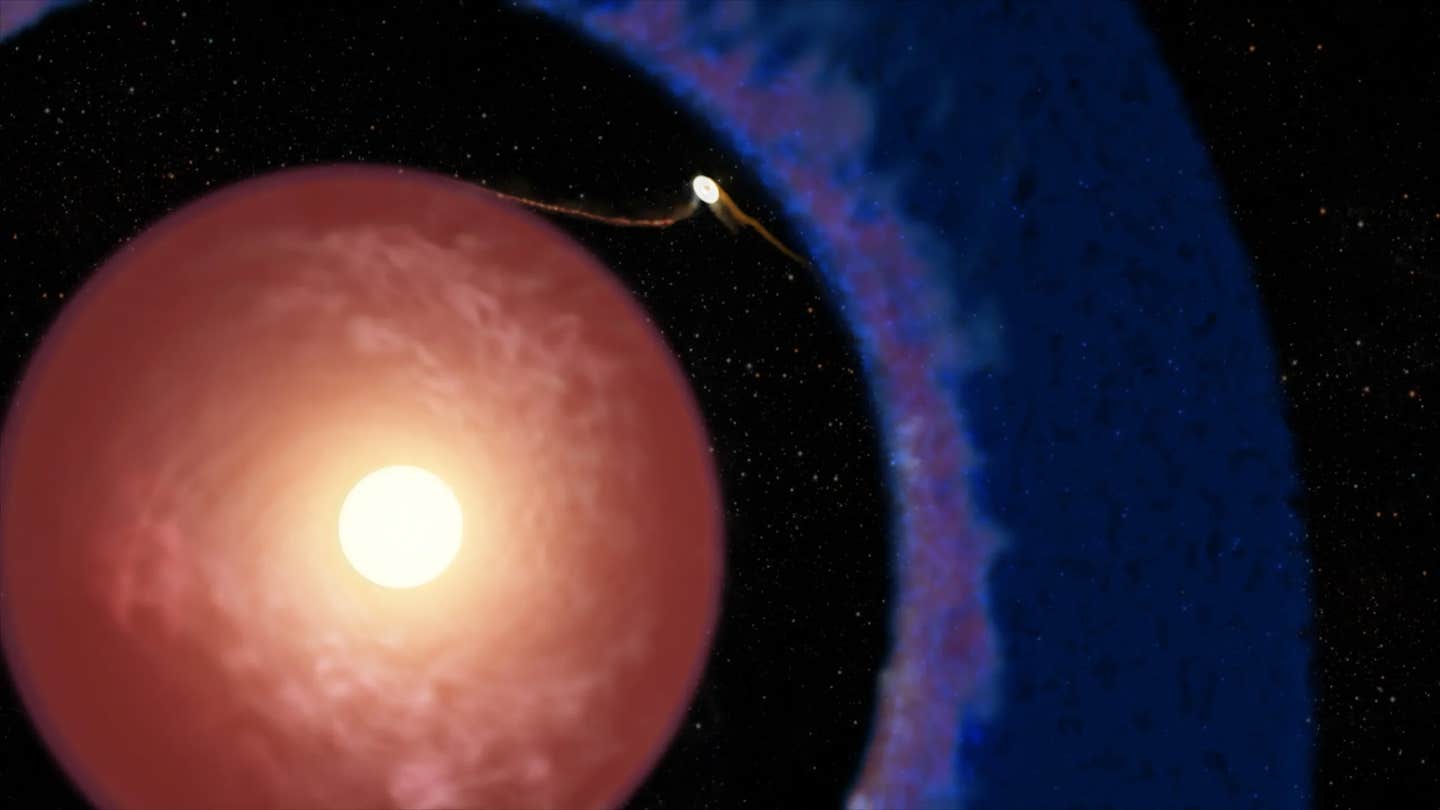
Elias 2-24 b is less than 1 million years old, challenging models of how quickly giant planets can form far from their stars. (CREDIT: W. M. Keck Observatory/Adam Makarenko)
- Astronomers have confirmed Elias 2-24 b as the youngest planet yet detected through high-contrast imaging, in a system no more than about 1 million years old.
- The planet sits roughly 55 astronomical units from its star inside a prominent disk gap, where earlier ALMA and Very Large Telescope observations had already hinted at a growing world.
- Its extreme youth and wide orbit challenge models that struggle to build giant planets so far from their stars within such a short time.
A giant world still buried in the material that built it has become the youngest confirmed planet of its kind.
Elias 2-24 b orbits a star about 450 light-years from Earth and lies within a dusty gap roughly 55 astronomical units from its host. The entire system is no more than about 1 million years old, placing the planet dramatically earlier in planetary evolution than previously imaged newborn worlds.
The confirmation appears in The Astrophysical Journal Letters in work led by Andrea Bernardi of Universidad Diego Portales in Chile. The team combined archival observations from the W. M. Keck Observatory with earlier evidence from the Atacama Large Millimeter/submillimeter Array, or ALMA, and the European Southern Observatory’s Very Large Telescope.
“Our planet-formation models already struggled to explain the previous record holders for the youngest known planet,” co-author Lucas Cieza said. “Elias 2-24 b shows us that even our best planet-formation models are still missing some important processes.”
A planet hiding inside its construction site
Young stars form surrounded by broad disks of gas and dust. Within those protoplanetary disks, material can accumulate into planets while the growing worlds reshape the material around them.
That environment makes newborn planets difficult to see. Dust can obscure their light, while the much brighter host star overwhelms faint planetary signals.
Most known exoplanets therefore come from mature systems. Transit surveys are especially effective when planets orbit close to their stars, but they provide relatively little access to giant planets still embedded far out in their birth disks.
Elias 2-24 offered a tantalizing exception. Earlier ALMA observations revealed a deep gap in its disk, while subsequent Very Large Telescope observations detected a faint point source sitting within that same region.
“The planets should be found within the gaps, since they are carving them,” Bernardi said. “And that’s exactly where we found Elias 2-24 b.”
Old Keck observations provided the confirmation
Bernardi’s team searched archival observations of seven young disk-hosting stars taken with the Keck Observatory’s NIRC2 instrument and vortex coronagraph.
A coronagraph suppresses the overwhelming light from a star so astronomers can search for much fainter objects nearby. In Elias 2-24, the team recovered the suspected planet in observations from June 2018 and again in June 2020.
The 2018 measurement placed the source 394 ± 31 milliarcseconds from its star, corresponding to about 54.9 ± 4.3 astronomical units. The 2020 data recovered it at a compatible location.
Neither Keck detection alone reached the conventional 5-sigma discovery threshold. The strongest 2018 reductions reached about 3.85 sigma, while the 2020 observation peaked at about 2.82 sigma because observing conditions were poorer.
The strength of the case instead comes from combining multiple independent observations. The Keck positions agree with earlier Very Large Telescope measurements and place the source inside the same disk gap identified with ALMA.
Its movement also does not behave like an unrelated stationary background star. The team calculated that the candidate was inconsistent with that explanation and concluded that it is physically associated with Elias 2-24 at high confidence.
Together, the imaging, disk structure and proper-motion analysis allowed the researchers to confirm the object as Elias 2-24 b.
Its age creates a planet-formation problem
Exactly how massive the newborn planet is remains harder to determine.
Earlier estimates have ranged from less than twice Jupiter’s mass to several Jupiter masses depending on assumptions about its atmosphere, formation history and continuing accretion. At such a young age, material falling onto the planet can produce substantial additional light.
That matters because evolutionary models often estimate planetary mass from luminosity. If some of the observed brightness comes from accretion rather than the planet’s internal heat, those models can overestimate its mass.
The new paper therefore treats several evolutionary mass estimates as upper limits rather than definitive measurements. Previous hydrodynamic models of the disk favor a planet near the lower end of the possible range, around Jupiter mass.
Its location presents an even deeper challenge. Elias 2-24 b orbits about 10 times farther from its star than Jupiter orbits the Sun.
Standard core-accretion models build giant planets by first assembling solid material and then rapidly accumulating gas. Building a Jovian world tens of astronomical units from a star in less than 1 million years is difficult because material is spread more thinly at large distances.
The disk around Elias 2-24 nevertheless looks remarkably consistent with a young planet interacting with its surroundings. Its gap and bright outer edge match models in which a growing planet pushes gas and dust aside while creating a pressure maximum that traps larger particles.
A missing stage of planetary evolution comes into view
Until now, directly imaged forming planets such as those around PDS 70 and WISPIT 2 belonged to systems roughly 5 million years old or older.
Elias 2-24 pushes direct observations much closer to the beginning of planet formation. Its youth provides evidence that giant planets can emerge, alter their disks and begin accreting substantial material far earlier than those older systems suggested.
“The galaxy churns out new stars and planets continuously, so there are many in every stage of evolution,” Cieza said. “We are mostly blind to these baby planets right now.”
That observational gap may soon begin shrinking. NASA’s Nancy Grace Roman Space Telescope launched Aug. 30 with a powerful Coronagraph Instrument designed to demonstrate technologies for suppressing starlight and observing faint planetary systems.
Elias 2-24 b sits near the limits of what today’s telescopes can detect. Better coronagraphs could reveal planets at smaller separations and uncover more systems during the short stages when giant planets are still actively growing.
For astronomers trying to explain how planetary systems assemble, Elias 2-24 b offers something unusually valuable: a glimpse of a giant planet before its construction site has disappeared.
Dig deeper into newborn planets and protoplanetary disks
These studies provide additional context on Elias 2-24, its disk structure, and how astronomers identify planets while they are still forming.
ALMA Observations of Elias 2-24: A Protoplanetary Disk with Multiple Gaps in the Ophiuchus Molecular Cloud: Early ALMA observations revealed the prominent gaps that first made Elias 2-24 an important laboratory for studying possible planet formation. (The Astrophysical Journal Letters, 2017)
Kinematic and thermal signatures of the directly imaged protoplanet candidate around Elias 2-24: ALMA observations identified unusual gas motion and heating at the position of the proposed planet, strengthening the planetary interpretation before confirmation. (Monthly Notices of the Royal Astronomical Society: Letters, 2023)
A Dust-Trapping Ring in the Planet-Hosting Disk of Elias 2-24: High-resolution ALMA observations found evidence that larger grains are being trapped in the bright ring outside the planet-associated gap. (The Astrophysical Journal, 2024)
Discovery of a planetary-mass companion within the gap of the transition disk around PDS 70: The discovery of PDS 70 b established one of the clearest earlier examples of a young giant planet forming within a protoplanetary disk. (Astronomy & Astrophysics, 2018)
Observations of Protoplanetary Disk Structures: This review examines the rings, gaps, spirals and other structures that reveal how young disks evolve and potentially interact with forming planets. (Annual Review of Astronomy and Astrophysics, 2020)
Research findings are available online in The Astrophysical Journal Letters.
The original story "Astronomers discover a baby planet less than 1 million years old" is published in The Brighter Side of News.
Related Stories
- JWST reveals how young solar systems may lose the gas needed to build planets
- In a dusty young solar system, two giant planets are taking shape
- Astronomers found the building blocks of new planets swirling around two young stars
Like these kind of feel good stories? Get The Brighter Side of News' newsletter.
Joseph Shavit
Writer, Editor-At-Large and Publisher
Joseph Shavit, based in Los Angeles, is a seasoned science journalist, editor and co-founder of The Brighter Side of News, where he transforms complex discoveries into clear, engaging stories for general readers. With vast experience at major media companies like The Los Angeles Times, Times Mirror and Tribune Publishing, he writes with both authority and curiosity. His writing focuses on space science, planetary science, quantum mechanics, geology. Known for linking breakthroughs to real-world markets, he highlights how research transitions into products and industries that shape daily life.