Superconductivity and magnetism can co-exist in some materials, MIT study finds
MIT physicists propose a new form of superconductivity driven by exotic anyons inside certain magnetic materials.

 Edited By: Joseph Shavit

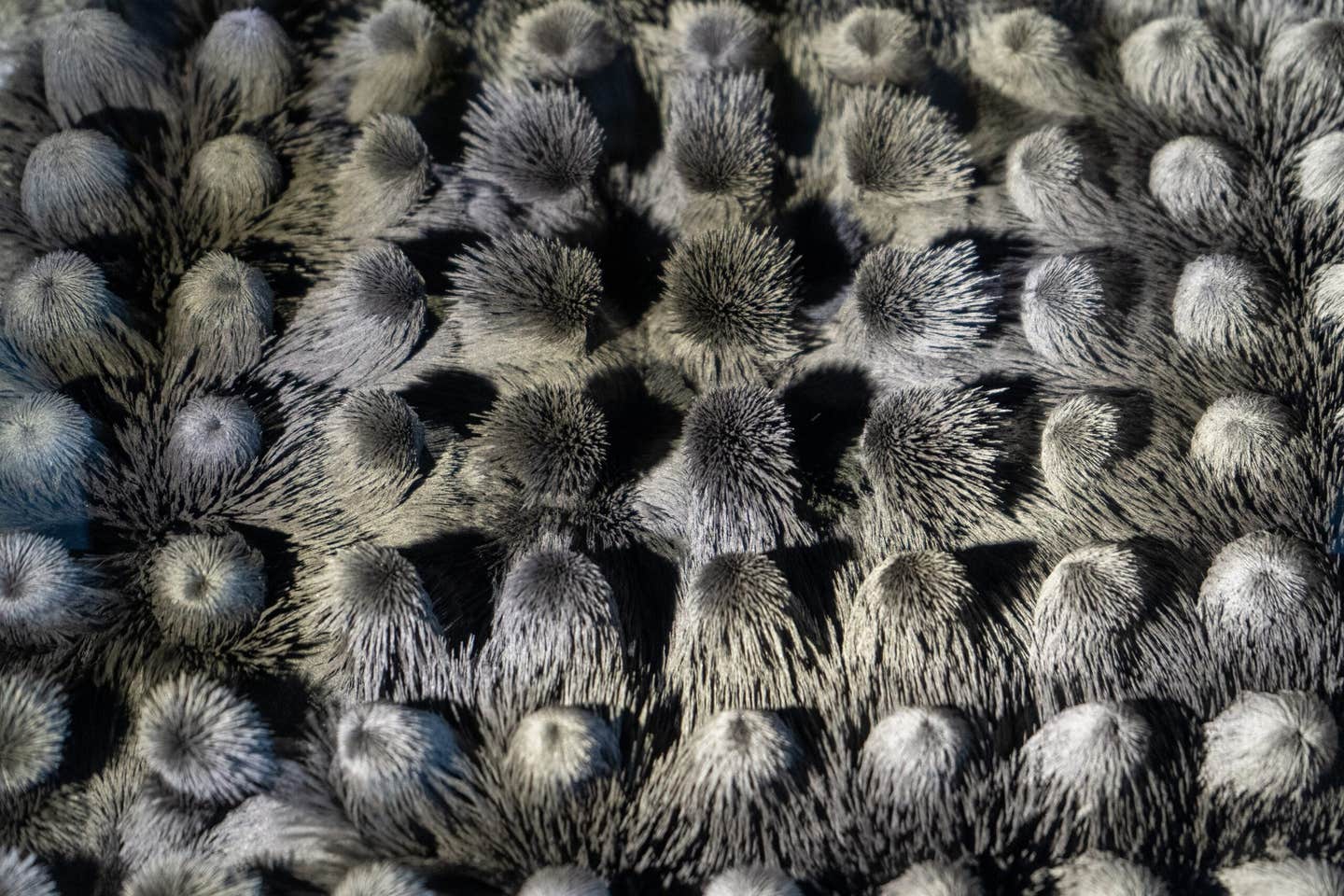
Physicists at MIT have developed a theory showing how superconductivity can emerge inside magnetic materials. (CREDIT: Shutterstock)
For decades, physicists taught that superconductivity and magnetism could not share the same space. One state should destroy the other. Yet in the past year, experiments in two very different materials challenged that rule. Now, theorists at Massachusetts Institute of Technology say they may know why.
In a new study published in Proceedings of the National Academy of Sciences, MIT physicists Senthil Todadri and Zhengyan Darius Shi present a theory that allows both states to coexist. Their work suggests that under special conditions, electrons can split into exotic fragments called anyons. These anyons, rather than ordinary electrons, may carry a supercurrent through a magnetic material.
If confirmed, the idea would point to a new type of superconductivity. It would also revive old theories once dismissed as impossible.
“Many more experiments are needed before one can declare victory,” said Senthil Todadri, the William and Emma Rogers Professor of Physics at MIT. “But this theory is very promising and shows that there can be new ways in which the phenomenon of superconductivity can arise.”
The research builds on discoveries that first surprised experimentalists and left theorists searching for answers.
Experiments That Broke the Rules
Superconductivity allows electric current to flow without resistance. Magnetism arises when electron spins align and create a collective field. For years, physicists believed magnetism would break the fragile electron pairs needed for superconductivity.
That belief cracked earlier this year. At MIT, physicist Long Ju and his colleagues observed both states in rhombohedral graphene, a material made from stacked graphene layers. The result drew intense attention.
“It was electrifying,” Todadri recalled after hearing Ju present the data. “It set the place alive. And it introduced more questions as to how this could be possible.”
Soon after, another group reported a similar pairing in twisted molybdenum ditelluride, known as MoTe₂. This material already showed an unusual behavior called the fractional quantum anomalous Hall effect. Under those conditions, electrons act as if they split into smaller pieces.
That coincidence caught Todadri’s attention.
Enter the Anyons
Those electron fragments are called anyons. They are neither fermions nor bosons, the two familiar particle families. Anyons exist only in two-dimensional systems. They were first proposed in the 1980s and named by MIT physicist Frank Wilczek.
Anyons behave in ways that defy everyday rules. They carry fractional electric charge and remember how they move around one another. Decades ago, theorists including Robert Laughlin and Wilczek suggested that anyons might superconduct in a magnetic environment.
At the time, the idea faded. Magnetism and superconductivity rarely appeared together. The necessary conditions seemed unrealistic.
MoTe₂ changed that view. It showed magnetism, superconductivity, and electron fractionalization at once. Todadri began to wonder whether the old idea had finally found a real home.
A Theory Built on Frustration
Todadri and Shi approached the problem using quantum field theory. Their goal was to explain how anyons could move together instead of getting stuck.
“When you have anyons in the system, what happens is each anyon may try to move, but it’s frustrated by the presence of other anyons,” Todadri said. “This frustration happens even if the anyons are extremely far away from each other. And that’s a purely quantum mechanical effect.”
In MoTe₂, electrons can split into anyons carrying either one third or two thirds of an electron’s charge. The team modeled what happens as more electrons enter the material.
The result depended on which anyon type dominated. When one third charge anyons led the behavior, motion stayed disordered. The material acted like an ordinary metal. When two thirds charge anyons took over, something remarkable happened.
“These anyons break out of their frustration and can move without friction,” Todadri said. “The amazing thing is, this is an entirely different mechanism by which a superconductor can form, but in a way that can be described as Cooper pairs in any other system.”
The supercurrent, in this case, would flow through anyons rather than electrons.
Disorder Shapes the Outcome
The theory also explains why real materials behave so differently from clean textbook systems. Small imperfections, known as disorder, play a decisive role.
"When disorder varies smoothly across the crystal, two thirds charge anyons can suddenly delocalize. The system passes through a sharp transition into a chiral topological superconductor. At that point, resistance peaks at a universal value before falling," Todadri explained to The Brighter Side of News.
Near the transition, the superconducting state looks unusual. Swirling currents form in random spots, even without an external magnetic field. This phase, called an Anomalous Vortex Glass, still shows resistance at nonzero temperatures.
With stronger or sharper disorder, the path changes. Instead of one clean jump, the system moves through several insulating or topological phases. Each step alters the Hall response in a quantized way. Some of these phases hide their order from electrical probes but reveal themselves through heat flow.
If one third charge anyons dominate instead, the outcome shifts again. The material can enter a reentrant integer quantum Hall state before becoming metallic at higher doping.
Matching Theory With Reality
The predictions line up with recent experiments on twisted MoTe₂. Researchers see a narrow fractional Hall plateau. On one side lies superconductivity. On the other sits an integer Hall state. Both sides show sharp resistance peaks near h over e squared.
The theory explains this asymmetry through the different anyons that appear above and below the plateau. It also predicts telltale signs of vortex glass behavior in the first superconducting region.
“If our anyon-based explanation is what is happening in MoTe₂, it opens the door to the study of a new kind of quantum matter which may be called ‘anyonic quantum matter,’” Todadri said. “This will be a new chapter in quantum physics.”
Practical Implications of the Research
This work reshapes how scientists think about superconductivity in magnetic materials. It suggests that exotic quasiparticles, rather than electrons, can carry resistance free currents. That insight could guide the search for new superconductors that work under conditions once thought impossible.
The findings also matter for quantum computing. Anyons are leading candidates for stable qubits because their quantum information resists noise. If superconducting anyons can be controlled, they could support more robust quantum devices. As Todadri noted, “These theoretical ideas, if they pan out, could make this dream one tiny step within reach.”
Beyond applications, the theory offers experimental roadmaps. It predicts measurable signatures, including resistance peaks, vortex patterns, and charge halos around pinned anyons. These tests give researchers clear targets as experiments advance.
Research findings are available online in the journal PNAS.
Related Stories
- A flash of light just redefined what we know about matter
- Penn State scientists found a new way to identify superconducting materials
- Scientists confirm long-theorized idea - discover metallic material displaying 1D magnetism
Like these kind of feel good stories? Get The Brighter Side of News' newsletter.
Shy Cohen
Writer