The dreaming mind doesn’t replay life, it rebuilds it
A new study finds dreams reshape waking life, drawing on personality, sleep, and major events like the pandemic.

 Edited By: Joseph Shavit

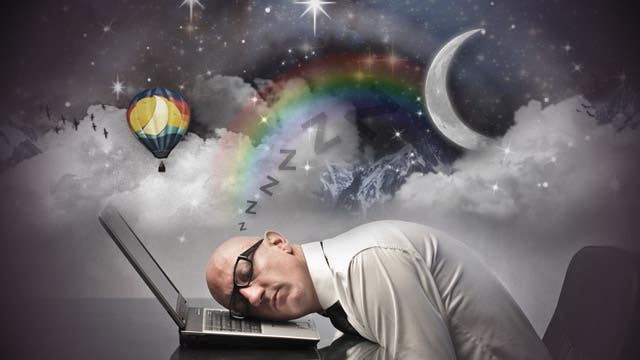
Study finds vivid dreams reflect personal traits, sleep quality, and shared events like the COVID-19 pandemic. (CREDIT: AI-generated image / CC BY-SA 4.0)
Some dreams unfold with the logic and texture of a film. You move through rooms, streets, or strange landscapes that feel complete while they last, even when the story itself makes little sense. Other nights leave behind only scraps, a voice, a flash of color, a feeling you cannot quite place.
A new study from the IMT School for Advanced Studies Lucca suggests that this difference is not random. Dream content, the researchers found, reflects both stable personal traits and the pressures of shared life events. In other words, what you dream about depends partly on who you are, and partly on what the world around you is doing.
The research, published in Communications Psychology, drew on more than 3,700 reports of dream and waking experiences from 287 adults in Italy between ages 18 and 70. Over two weeks, participants recorded daily reports of what they had been experiencing in sleep and wakefulness. The researchers also gathered information on sleep patterns, personality, cognitive abilities, mind-wandering, imagery, anxiety, and attitudes toward dreaming.
Instead of reading the reports only by hand, the team used natural language processing tools and large language models to measure the semantic structure of the narratives. That let them compare dream reports and waking reports at scale, while also testing whether automated scoring matched human judgments.
Valentina Elce, lead author of the paper and a researcher at the IMT School, said the findings point to dreams as something more active than a replay of the day. “Our findings show that dreams are not just a reflection of past experiences, but a dynamic process shaped by who we are and what we live through,” she said. “By combining large-scale data with computational methods, we were able to uncover patterns in dream content that were previously difficult to detect.”
Not a replay, but a remix
The study found clear differences between dreams and waking thoughts. Dream reports contained more visual and spatial detail, more social interaction, more emotional intensity, and far more bizarreness. Waking reports, by contrast, contained more thought and metacognitive reflection, stronger agentivity, greater awareness of time, and more attention to bodily needs.
That pattern matters because it suggests dreams do not simply copy waking life. They reorganize it.
Scenes from work, education, healthcare, and ordinary routines showed up in altered form rather than as straightforward reruns. The researchers found that dreams often blended different settings, shifted perspectives, and stitched together fragments of past experience with imagined or anticipated ones. The result was often immersive, but also unstable.
In the paper, the authors compare this structure to narrative or cinematic description. Dreams, they argue, tend to move scene by scene, with vivid perceptual detail and abrupt setting changes. The dreamer may feel embedded in the scene without fully controlling it.
That may help explain why a dream can feel coherent while you are inside it, yet fragmented when you wake.
The traits that shape the night
Not everyone dreamed in the same way.
One of the clearest patterns involved mind-wandering. People more prone to spontaneous mind-wandering reported dreams with more bizarreness and more frequent shifts in setting. The authors say this supports the idea that dreaming and mind-wandering may share some cognitive foundation, with dreaming acting as a more intense form of internally generated thought during sleep.
Attitude toward dreams also stood out. Participants who placed more value on dreams, and saw them as meaningful, tended to report dream experiences that were richer in visual detail, more spatially elaborate, more emotionally arousing, and more bizarre. That effect appeared in dream reports, not in waking ones.
Sleep quality also played a role, though the study says sleep patterns overall had a weaker link to dream content than some personal traits did. Lower self-reported sleep quality was associated with greater dream bizarreness. In actigraphy data, “long, light sleep” was linked to more frequent shifts in dream settings.
The researchers also found some narrower effects. Better visuo-spatial memory was tied to more object references in dreams. Younger participants reported more job-related material in dreams than in waking reports. An evening chronotype was linked to a stronger focus on communication-related content in waking life than in dreams.
When the outside world enters the dream
The study also looked at dream reports collected during Italy’s COVID-19 lockdown and compared them with reports gathered after restrictions eased.
Those lockdown dreams were more emotionally intense. They contained more references to limitations, social interactions, settings, body-related content, time, and work-related themes. They also showed more fantastical and drama-like elements.
That does not mean the pandemic changed the basic structure of dreaming. The underlying semantic patterns remained consistent across datasets. But it did leave a measurable mark on what people dreamed about.
Over time, those effects faded. In the main dataset, which ran from March 2020 to March 2024, dream bizarreness decreased. Across both dream and waking reports, emotional valence became more positive, while arousal, references to limitations, and references to society declined.
The researchers say this points to a gradual psychological adaptation. Dreams seemed to change alongside people’s responses to a major collective stressor.
What the software could and could not do
A major part of the paper is methodological. The team tested whether AI tools could rate dream reports in ways that resembled human judgment. Across the 16 semantic dimensions they examined, agreement between AI scores and external human ratings was consistently high, with all correlations above 0.60. Comparisons with dreamers’ own ratings produced a mean correlation of 0.65.
That matters because dream research has often relied on smaller samples and manual coding, both of which limit scale. The authors argue that automated tools could make dream analysis more reproducible and allow larger comparisons across people and over time.
Still, the paper is careful about what it cannot claim.
The authors note that the “narrative” or “cinematic” feel of dreams comes from patterns in the language of dream reports, not direct access to the dream-generation process itself. People may reconstruct dreams using familiar storytelling habits when they wake. The study also cannot prove that events such as the pandemic caused the observed changes. The data show correlations, not causation.
The analysis plan, the paper notes, was not preregistered.
Practical implications of the research
This study does not offer a decoder for individual dreams. It does something more useful for science. It suggests that dream content can be studied systematically, with enough precision to track how traits like mind-wandering, sleep quality, and beliefs about dreaming shape the sleeping mind.
It also shows that dream reports may carry traces of broader psychological conditions, including how people adapt to collective stress.
The authors say these methods could eventually help researchers study consciousness, memory, and mental health in a more scalable way. They also raise the possibility that dream features could become useful markers of altered cognition in health and disease.
Research findings are available online in the journal Communications Psychology.
The original story "The dreaming mind doesn’t replay life, it rebuilds it" is published in The Brighter Side of News.
Related Stories
- Vivid dreams can help sleep feel deeper and more restorative
- Guided dreams during REM sleep can boost problem solving
- Strange dreams might help your brain learn better, study finds
Like these kind of feel good stories? Get The Brighter Side of News' newsletter.
Mac Oliveau
Writer
Mac Oliveau is a Los Angeles–based science and technology journalist for The Brighter Side of News, an online publication focused on uplifting, transformative stories from around the globe. Having published articles on MSN, and Yahoo News, Mac covers a broad spectrum of topics including medical breakthroughs, health and green tech. With a talent for making complex science clear and compelling, they connect readers to the advancements shaping a brighter, more hopeful future.