The Milky Way’s core may be dense dark matter, not a black hole
Study suggests a dense dark matter core, not a black hole, may power the Milky Way’s center.

 Edited By: Joshua Shavit

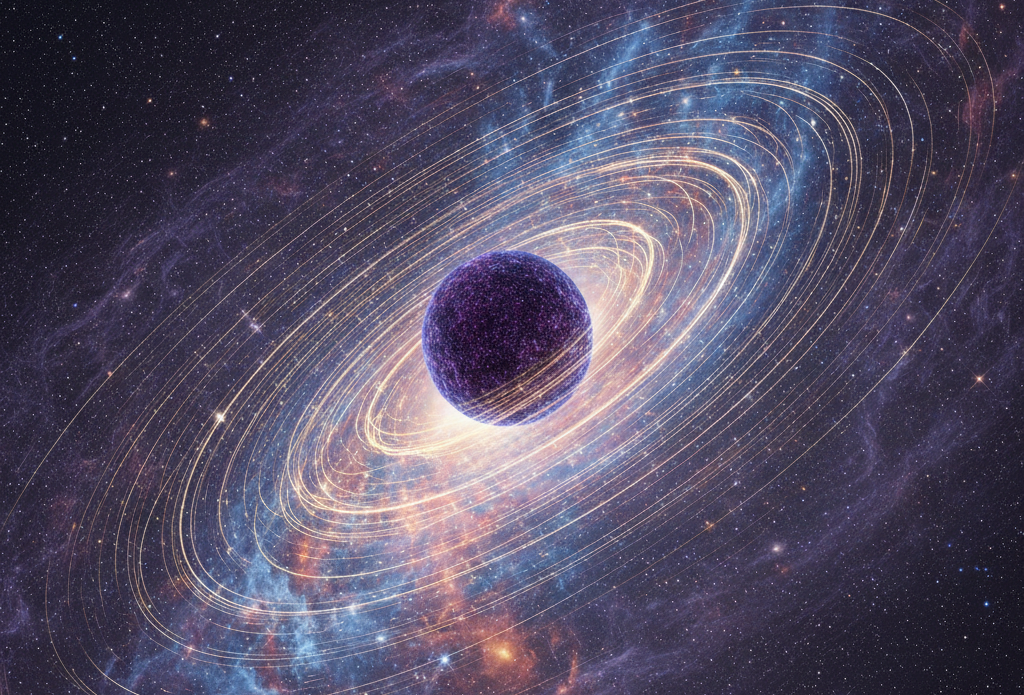
Artistic representation of the Milky Way, where the innermost stars move at near relativistic speeds (defined as velocities that constitute a significant fraction of the speed of light, typically considered to be 10% or more) around a dense core of dark matter, with no black hole at the center. (CREDIT: Wikimedia / CC BY-SA 4.0)
For decades, scientists have theorized that the Milky Way Galaxy's supermassive black hole, known as Sagittarius A* (Sgr A*), is the central anchor point for the galactic disk and its surrounding regions. But now a collaborative research team from multiple countries, including scientists from Argentina, Colombia, Germany, and Italy, believes this model may not feature a black hole but rather a dense cosmological object consisting of dark matter that exerts an equivalent amount of gravitational binding force.
Valentina Crespi and Dr Carlos Argüelles' from the Institute of Astrophysics La Plata, found that a dark matter core could produce an equivalent gravitational pull to that of a black hole. This is not in contradiction to existing observational evidence and may better explain the high speeds with which stars are travelling at thousands of kilometers per second, as well as the accurate tracking of their orbits, thereby determining the exact position of the central mass.
Historically, the S stars track through tight loops surrounding the black hole. Tracking the speeds of the S stars and measuring their distance has provided astronomers with solid proof of the existence of a gravitationally bound black hole at the centre of the Milky Way Galaxy.
In addition to providing an alternative explanation for the existence of black holes, Crespi and Argüelles' model suggests that dark matter itself could form similar types of compact, massive objects with similar gravitational effects to that of black holes. The core would be very dense and compact, having an associated dark matter halo that would progressively disperse outward through space, merging with the broader structure of the galaxy.
A Unified Dark Matter Core
"We're not saying that there is merely a 'dark' object at the center of the galaxy; we are proposing that both the supermassive body at the galaxy's center and the expansive dark matter halo of the galaxy represent different forms of or aspects of a single unified entity," says Argüelles.
The model describes the apparent speed difference between stars that orbit closely and far from the galactic centre. Data from the GAIA Space Mission show how stars move in a dark matter halo surrounding the Milky Way. These findings demonstrate a gradual (Keplerian) decline of the milli-radian per second from the centre to the outer edges of the galaxy.
When measured together with the total mass of the Milky Way's Disk and Bulge, the experimental data supports the idea that the structures of the component particles that make up the fermionic dark matter halo fit the characteristics of a Keplerian decline. However, while current cold dark matter models show a trend of losing momentum as they extend outwards into the universe, with very long tails, the fermionic model predicts a greater concentration of mass at the outer limit of the dark matter halo.
Testing The Orbit Of S2
One particular star has been an important subject in this discussion. It is known as S2, and it revolves around the galactic nucleus in a highly eccentric orbit roughly every 16 years. Astrophysicists have been able to use data collected from 2000 through 2019 to measure it very precisely.
The authors examined data on the orbit of S2 and performed statistical analysis of the orbits based on three different types of models for Sgr A. One of the models assumed Sgr A is a regular black hole. The second model examined Sgr A using a particle mass of 56 keV, and the third model used a particle mass of 300 keV, both of which were fermionic particles.
All models provided very similar orbits for S2, with semimajor axis and eccentricity values differing by less than 1%. The orbit periods were approximately 16 years.
However, there were slight differences in the predicted periapsis precession, the apparent movement of the periapsis due to an orbiting object's gravitational influence.
A mathematical approach called a Bayes factor was used to compare the models and yielded an advantage for the 56 keV model over the 300 keV model using the data set used. While there is currently no definitive evidence to rule out either the black hole or dark matter core models based on the available observations, the results suggest that further analysis is warranted.
Comparing The G Objects
The orbiting G objects around Sgr A include a group of objects known as G objects as well. The most widely known G object is G2. G2 made a very close approach to Sgr A, and there was considerable discussion about whether it is a gas cloud or an object that is encased in dust.
Researchers have compared the models to G2 as well as four other G objects. However, because these G objects have considerably less complete orbit data available, the determination of which model best fits each G object has less statistical certainty than for S2. In a few instances, the black hole model provided better statistical support than the other two models. In other words, the dark matter model does not significantly differ from the standard model of cosmology.
The authors of the study stated that since the measurements were not made with sufficient precision, the results of this study will not yield final answers. Upcoming information obtained from instruments such as the GRAVITY interferometer at the VLT may clarify the data from this study. They also expect that the observation of photon rings would help separate the dark matter model from the standard model.
Future Observations And Implications
Crespi stated: “This is a major milestone; not only does our model explain the motions of stars and the rotation of the Milky Way galaxy, it is also consistent with the well-known black hole shadow image. The central core of dark matter could also produce a shadow because of its strong effect on light, which creates a region of darkness around the center and an outer area of illuminated material.”
In an earlier article published in the same journal, the authors suggested that the presence of a bright disk of gas around such a dark matter core could cast a shadow similar to the shadow of Sgr A* captured by the Event Horizon Telescope.
Using this model to perform more accurate data collection on the stars close to the Milky Way galaxy's core will allow researchers to evaluate whether true event horizons exist for the black holes that anchor the Milky Way's core.
By demonstrating this model's predictive power with good data, this model could ultimately help scientists rethink dark matter and black holes. Rather than two separate mysteries, the galactic centre (interior) and galactic halo (exterior) could represent different forms of the same entity.
Using the same basic idea, researchers may eventually be able to formulate a more complete theory of dark matter and its potential constituents. The model can also be used as a guide for future experiments in both particle physics and astronomy.
These findings illustrate how valuable improved data can be for challenging long-held assumptions. With the continued advancement of telescope technology over the next several decades, researchers will have the capability to answer the question regarding the galaxies' structure and development.
This will provide a deeper understanding of the relationships between gravity, matter, and the universe, thus improving our knowledge of the universe itself.
Research findings are available online in the journal Monthly Notices of the Royal Astronomical Society.
The original story "The Milky Way’s core may be dense dark matter, not a black hole" is published in The Brighter Side of News.
Related Stories
- Distant galaxy’s black hole offers extraordinary glimpse into the Milky Way's future
- Milky Way’s central black hole spins at nearly light speed, study finds
- Milky Way’s central black hole is generating massive bursts of energy
Like these kind of feel good stories? Get The Brighter Side of News' newsletter.
Joseph Shavit
Writer, Editor-At-Large and Publisher
Joseph Shavit, based in Los Angeles, is a seasoned science journalist, editor and co-founder of The Brighter Side of News, where he transforms complex discoveries into clear, engaging stories for general readers. With vast experience at major media groups like Times Mirror and Tribune, he writes with both authority and curiosity. His writing focuses on space science, planetary science, quantum mechanics, geology. Known for linking breakthroughs to real-world markets, he highlights how research transitions into products and industries that shape daily life.