Time moves faster on Mars than on Earth, study finds
NIST physicists show Mars clocks run 477 microseconds faster per day than Earth’s, reshaping timekeeping for future explorers.

 Edited By: Joshua Shavit

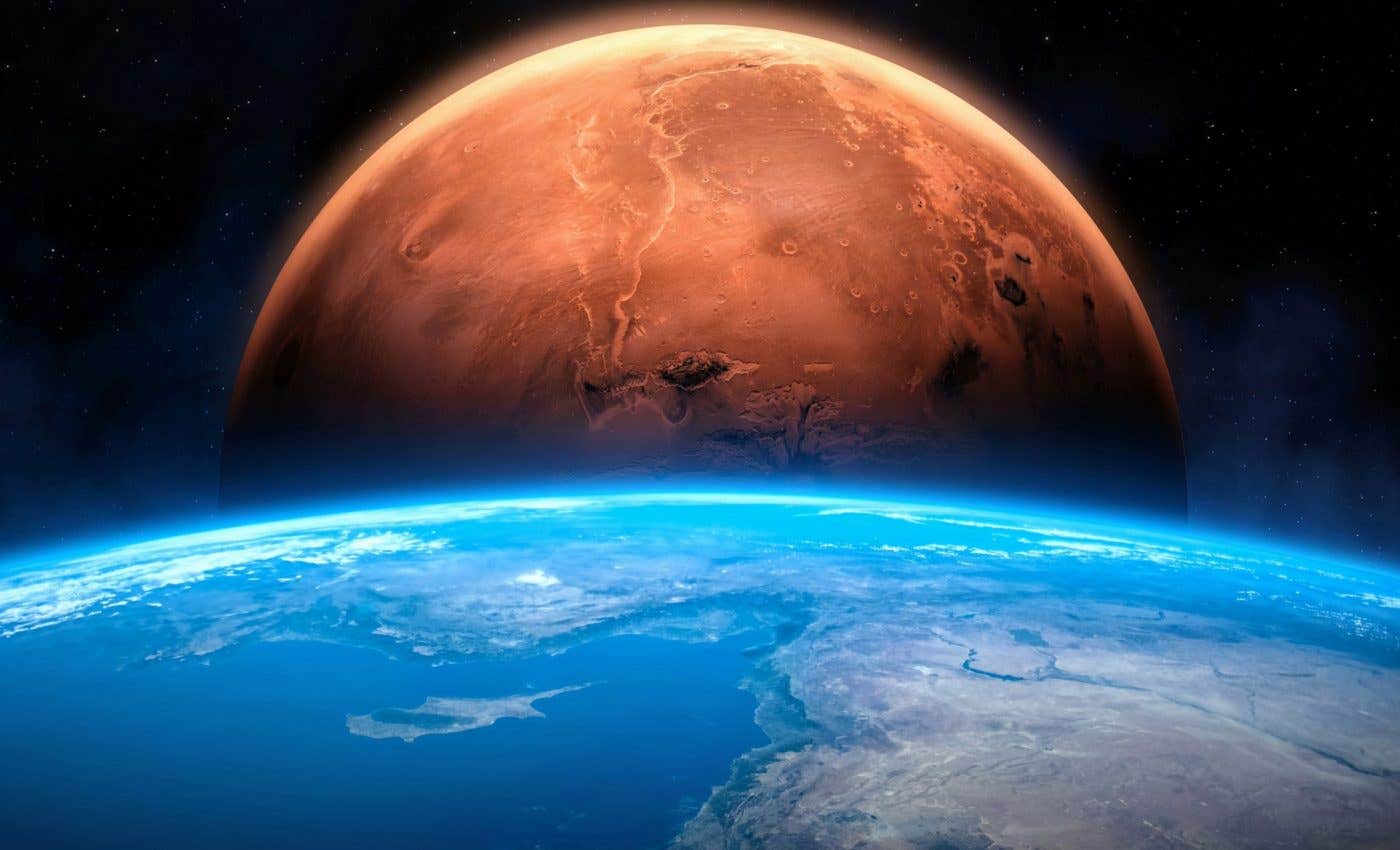
Physicists have worked out exactly how fast time passes on Mars compared with Earth. (CREDIT: Wikimedia / CC BY-SA 4.0)
On Earth, knowing the time feels simple. Your phone pings the same second as a GPS satellite and an atomic clock in a lab. Everything is wired together so well that you rarely think about the machinery behind those steady ticks.
That comfort vanishes the moment you step off the planet. If you carried a perfect atomic watch to Mars and left an identical one on Earth, the two clocks would slowly drift apart, even with no broken parts and no dust storms. They would disagree because gravity, motion and the rules of relativity treat each world differently.
How Fast Does a Second Pass on Mars?
Physicists at the National Institute of Standards and Technology, or NIST, have now worked out exactly how that drift plays out. They calculated how fast time passes on Mars compared with Earth, not in a poetic sense, but in millions of a second.
On average, a clock sitting on the Martian surface gains about 477 microseconds per day compared with one on Earth. That is 0.000477 seconds, a thousandth of the time it takes you to blink. Because Mars follows an elongated orbit and feels tugs from nearby worlds, that lead can grow or shrink by as much as 226 microseconds over the course of a Martian year.
Those numbers might sound tiny, but for scientists and engineers they are huge. Modern 5G networks, for example, need timing accurate to about a tenth of a microsecond. A daily gap of hundreds of microseconds between planets would break navigation and communication systems unless you know exactly how that gap changes.
“The time is just right for the Moon and Mars,” NIST physicist Bijunath Patla said. “This is the closest we have been to realizing the science fiction vision of expanding across the solar system.”
Gravity, Motion and the Shape of Time
Einstein’s theory of relativity says that time does not flow at a single universal rate. Where gravity is stronger, clocks tick more slowly. Where gravity is weaker, they tick faster. Motion has an effect too, because high speeds also slow clocks.
Mars sits farther from the Sun than Earth, at about 1.52 astronomical units instead of 1. That extra distance weakens the Sun’s pull. Its surface gravity is also about one-fifth as strong as Earth’s. Both factors let Martian clocks race ahead.
Orbit shape matters as well. Earth’s path around the Sun is almost circular. Mars follows a stretched oval, so it swings closer to the Sun at some points and much farther away at others. As its speed and solar distance change, the rate of time on the surface changes slightly too.
To keep all of this straight, scientists define special reference surfaces. On Earth, they use the “geoid,” which is like sea level extended under the continents. On Mars, the similar surface is called the “areoid.” You can think of it as the level where an ideal ocean would settle if Mars were covered in water.
NIST physicists used years of Mars gravity data to define a constant, called LM, that describes how fast a perfect clock would tick on the areoid. LM has a value of about 1.40781 × 10⁻¹⁰, which translates to roughly 12.2 microseconds per day. That number links the abstract coordinate time used in equations to the proper time you would actually measure on the ground.
Crunching the Numbers for a Martian Time Standard
To get LM and the day-by-day differences between planets, Patla and co-author Neil Ashby drew on high-resolution gravity maps of Mars built from tracking spacecraft such as Mars Reconnaissance Orbiter and Mars Global Surveyor. They expanded those maps into hundreds of spherical harmonic terms so they could capture small bumps and dips in the gravity field.
They then placed Mars in its real solar system neighborhood. The Sun holds more than 99% of the mass of the system and shapes the main gravitational background. Earth, the Moon, Jupiter and Saturn all tug on Mars as well, shifting its orbit in complex ways. The team used a detailed solar system model known as the DE440 ephemeris to describe the positions and speeds of all these bodies.
For Earth and the Moon, earlier work had already set up similar constants and timing rules. Time on the Moon runs about 56 microseconds faster per day than on Earth, and that offset stays fairly steady. Mars turned out to be more unruly.
“But for Mars, that’s not the case. Its distance from the Sun and its eccentric orbit make the variations in time larger. A three-body problem is extremely complicated. Now we’re dealing with four: the Sun, Earth, the Moon and Mars,” Patla explained. “The heavy lifting was more challenging than I initially thought.”
Sun Tides and Chasing Nanoseconds
One of the trickiest pieces involves solar tides on the Earth–Moon system. Because the Sun pulls a bit harder on the near side of Earth than the far side, and the Moon orbits at a distance, the pair does not move like a single solid object. That unequal pull changes their motion slightly, which in turn affects precise clock comparisons.
To handle that, the researchers wrote down a full Lagrangian description of the Sun, Earth and Moon system. They shifted into center-of-mass and relative coordinates, then used a careful numerical method, known as the Störmer–Verlet algorithm, to integrate the motion. That work reduced the remaining timing errors for the Earth–Moon system to just a few nanoseconds over about 100 days.
When they pushed the same ideas out to Mars, they reached similar levels of accuracy. After accounting for gravity fields, orbital speeds and solar tides, the leftover mismatch between Earth and Mars clock rates stayed within about ±100 nanoseconds per day over long stretches.
To track how those tiny errors behave over different time spans, the team used a statistical measure called the modified Allan deviation. It is a way of asking how stable a clock comparison is when you average over days or weeks. For Earth and Mars, the researchers found that averaging over 10 days holds the fractional frequency difference near 5 × 10⁻¹³. Stretch the average to 100 days and the uncertainty shrinks to about 1 × 10⁻¹³, which matches the ±100 nanoseconds per day target.
Ashby sees this as necessary groundwork for whatever comes next. “It may be decades before the surface of Mars is covered by the tracks of wandering rovers, but it is useful now to study the issues involved in establishing navigation systems on other planets and moons,” he said. “Like current global navigation systems like GPS, these systems will depend on accurate clocks, and the effects on clock rates can be analyzed with the help of Einstein’s general theory of relativity.”
Patla views the project as a new test of Einstein’s ideas. “It's good to know for the first time what is happening on Mars timewise. Nobody knew that before. It improves our knowledge of the theory itself, the theory of how clocks tick and relativity,” he said. “The passage of time is fundamental to the theory of relativity: how you realize it, how you calculate it, and what influences it. These may seem like simple concepts, but they can be quite complicated to calculate.”
The team reported its findings in The Astronomical Journal, following a 2024 paper that laid out a similar plan for precise timekeeping on the Moon.
Practical Implications of the Research
Knowing how fast time passes on Mars may sound abstract, but it has very real stakes for you and for anyone who may one day live off-world.
First, future crews will rely on tight synchronization between clocks on Earth, the Moon and Mars. Navigation systems, like a Martian version of GPS, can only guide spacecraft and rovers if they know exactly when signals were sent and received. A daily offset of hundreds of microseconds, if left uncorrected, would translate into large position errors.
Second, communication networks will need this level of precision to avoid data loss. Right now, messages between Earth and Mars already face delays of four to 24 minutes, depending on distance. You cannot remove that light travel time, but synchronized clocks can make the exchange feel almost live, with clean handoffs between satellites, surface stations and control rooms. As Patla put it, “If you get synchronization, it will be almost like real-time communication without any loss of information. You don’t have to wait to see what happens.”
Third, this framework is a step toward a kind of “solar system internet.” Once engineers know exactly how clocks behave across different planets, they can design networks that route information through orbiters, landers and habitats with confidence. Those systems could support medical care, education, science and daily life for settlers in ways that resemble what you take for granted on Earth.
Finally, the work feeds back into basic physics. By testing relativity under new conditions, scientists can search for tiny mismatches between theory and reality. Any discrepancy could hint at new physics, which might one day change how you understand gravity, space and time itself.
In that sense, learning “what time it is on Mars” does more than help explorers keep a schedule. It opens a path toward safer missions, richer science and a more connected human presence across the solar system.
Research findings are available online in The Astronomical Journal.
Related Stories
- The unexpected consequence of time travel: complete memory loss
- For the first time ever, researchers made a photon travel back in time
- Scientists discover 16 giant river networks on ancient Mars where life could have thrived
Like these kind of feel good stories? Get The Brighter Side of News' newsletter.
Joseph Shavit
Writer, Editor-At-Large and Publisher
Joseph Shavit, based in Los Angeles, is a seasoned science journalist, editor and co-founder of The Brighter Side of News, where he transforms complex discoveries into clear, engaging stories for general readers. With vast experience at major media groups like Times Mirror and Tribune, he writes with both authority and curiosity. His writing focuses on space science, planetary science, quantum mechanics, geology. Known for linking breakthroughs to real-world markets, he highlights how research transitions into products and industries that shape daily life.