Treasure-hunt game offers a new window into perception across the autism spectrum
An instruction-free game let adolescents across the autism spectrum show researchers how they combine visual evidence.
 Boston University Writer: Andrew Thurston

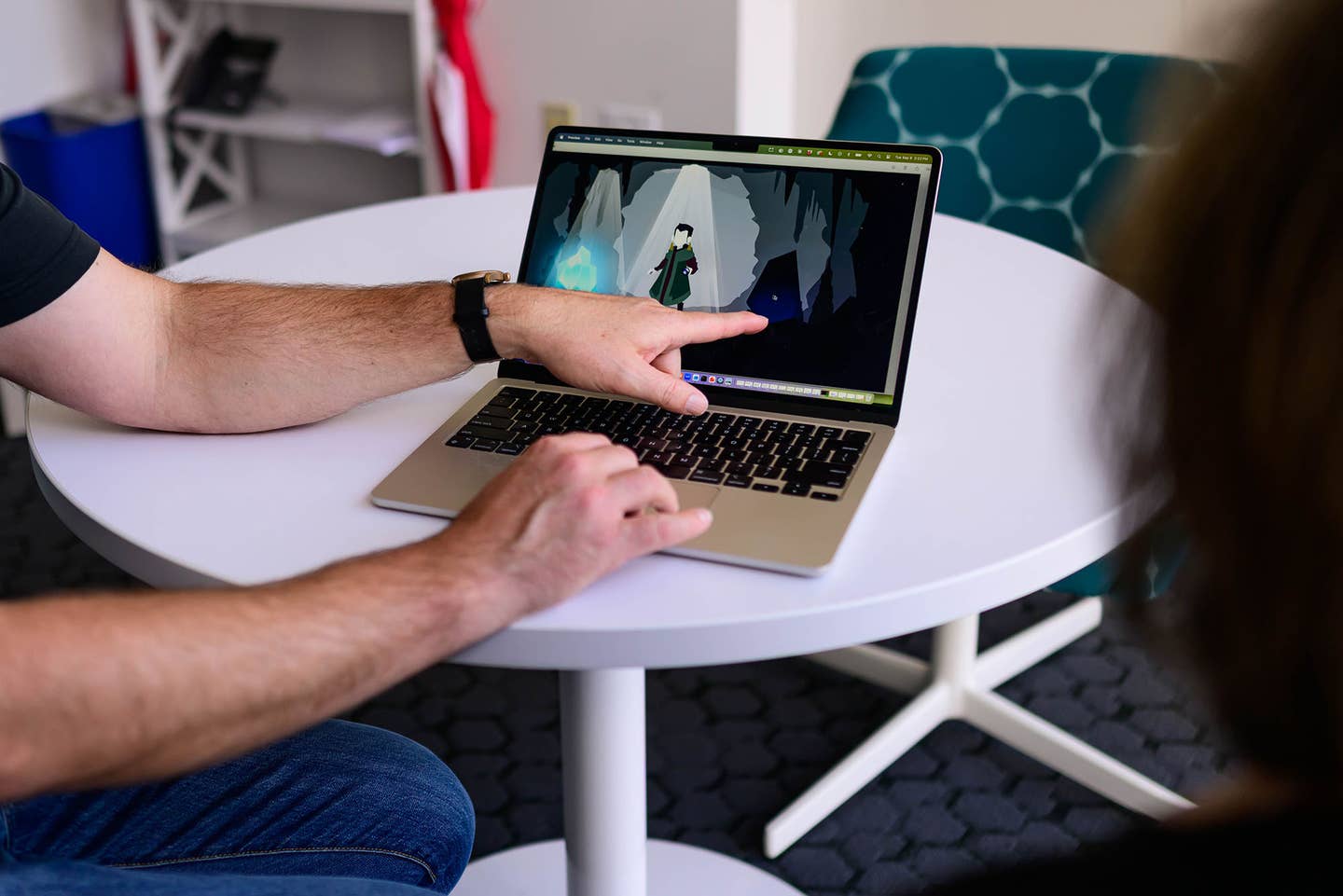
An instruction-free game let adolescents across the autism spectrum show researchers how they combine visual evidence. (CREDIT: Boston University)
- A no-instructions video game allowed researchers to measure visual decision-making in autistic adolescents across a much wider range of adaptive abilities than many traditional experiments.
- Autistic participants generally accumulated visual evidence over time, but computational modeling found that uncertainty increased more sharply as additional information arrived.
- The pattern was strongest in adolescents with lower adaptive-functioning scores, suggesting the measurement may reflect broader functional differences rather than something unique to autism itself.
A treasure hunt filled with flashing gems is giving scientists a new way to investigate how autistic people combine information from the world around them.
The online game, called GEODE, requires no initial verbal instructions. Players learn what to do through feedback while deciding which side of a screen contains more flashes. That simple setup allowed adolescents across a broad range of autism severity and communication abilities to participate.
Researchers from Boston University conducted a study with more than 300 adolescents ages 11 to 17 took part, including 212 autistic participants and 96 typically developing siblings in the final analyzed group.
Their analysis points toward a particular computational difference. As autistic participants accumulated more visual evidence, uncertainty in that information appeared to increase more strongly, a phenomenon the researchers call integration noise.
A game built to remove a research barrier
Many perception experiments depend on detailed instructions or require participants to respond in specific ways. Those demands can exclude autistic people with limited language, intellectual disabilities or high support needs.
GEODE was designed differently.
Players choose a character and follow a treasure map while collecting gems. On each trial, flashes appear on both sides of the screen. Players choose the side with more flashes and receive feedback about whether they were correct.
No one initially tells them that rule.
The first 10 trials make the pattern relatively easy to discover, using differences such as 10 flashes versus none. The next 190 trials become harder, with flashes varying in number and timing.
Each flash lasts 50 milliseconds and occurs within 250-millisecond time intervals. That precision allows researchers to calculate how strongly information arriving at different moments contributes to a player's eventual choice.
Most adolescents learned the task, including many participants with substantial adaptive difficulties. More than 75% of the 99 autistic adolescents in the lower-adaptive group met the study's success criterion, including some with Vineland Adaptive Behavior Scales scores below 50.
The differences appear when decisions become harder
During the first 10 easy trials, researchers found no significant pairwise differences in learning between groups.
That changed after the task became more difficult.
Accuracy initially declined for everyone before gradually improving. Autistic participants, on average, began the harder portion with lower accuracy, learned more slowly and reached a lower final performance level than typically developing participants.
The differences were especially pronounced among autistic adolescents with lower adaptive-functioning scores.
Yet the results did not suggest that autistic participants simply failed to use information accumulating across a trial. All groups showed broadly similar evidence-accumulation patterns.
Instead, the accumulated evidence had less effective influence over the final choices made by the autistic groups.
An additional clue came from trials containing many flashes. More information might normally be expected to make a decision easier. But autistic participants became relatively less accurate as the total amount of visual evidence increased.
More evidence appears to bring more noise
The researchers used signal detection theory to investigate what could produce that pattern.
Their models separated two types of uncertainty. One represented baseline noise that existed regardless of how much information had accumulated. The other, called integration noise, increased as the brain combined more evidence over time.
The groups did not differ significantly in baseline noise.
Integration noise did differ.
Its modeled value was 0.0724 among typically developing participants, 0.101 among autistic adolescents with higher adaptive functioning and 0.138 among those with lower adaptive functioning.
That pattern suggests that the challenge was not simply perceiving individual flashes. Instead, uncertainty accumulated along with the sensory evidence.
Benjamin Scott, a Boston University assistant professor of psychological and brain sciences, described the process as “perceptual integration,” in which information arriving over time is combined to form a larger interpretation of what is happening.
Adaptive functioning complicates the autism connection
The findings also resist a simple division between autistic and non-autistic perception.
Individual autistic participants varied widely. Measures of integration noise and several other GEODE results were most strongly associated with scores on the Vineland Adaptive Behavior Scales, which assess areas such as communication, socialization and daily living skills.
When researchers analyzed the diagnostic groups separately, however, the relationships between integration noise and those survey measures became weak and statistically nonsignificant.
Another analysis compared 31 autistic participants with 30 typically developing adolescents who had similar adaptive-functioning scores. That smaller comparison found no significant differences in GEODE measurements, although its limited sample produced substantial uncertainty.
The researchers therefore caution that increased integration noise may reflect a broader dimension of functional impairment rather than an autism-specific perceptual mechanism.
GEODE is not intended to diagnose autism.
Artificial networks recreate part of the pattern
A computer simulation gave researchers another way to test the noise hypothesis.
Artificial neural-network agents played the same 200-trial task and learned from feedback after each decision. Without added noise, an agent learned rapidly, reaching 85.53% accuracy by the 11th trial.
Researchers then introduced controlled amounts of noise either into sensory input or into the stage that integrated information over time.
Increasing that noise systematically slowed learning and reduced final accuracy. With appropriate noise levels, the artificial agents reproduced several features observed among autistic participants.
That does not identify the biological cause of the human results.
Integration noise is a computational description, not a specific brain mechanism. The observed pattern could potentially arise from several processes, including differences in sensory representations, sustained attention or short-term memory. The experiment could not distinguish among them.
A broader way to study autistic perception
That limitation is also part of GEODE's potential value.
The researchers can now modify the game to test different components of perception and learning while retaining a design that more participants can complete. Because it runs remotely and works on computers or touchscreens, studies can also reach families outside conventional research centers.
The approach could eventually serve as an outcome measure in clinical trials, allowing researchers to test whether an intervention changes measurable perceptual or learning processes before and after treatment.
Similar tasks can also be given to animals, creating a way to compare behavior across humans and experimental models while investigating underlying neural circuits.
For now, GEODE offers something more basic but important: a way to measure perception directly in autistic adolescents whose experiences have often been represented mainly through caregiver reports.
The game does not suggest that every autistic person perceives the world the same way. Instead, it exposes substantial variation while pointing toward one measurable pattern: for some participants, adding more sensory evidence also adds disproportionately more uncertainty.
Dig deeper into autism, sensory processing and perceptual decision-making
These resources examine sensory differences, computational theories of autistic perception, adaptive functioning and evidence accumulation from several complementary perspectives.
Sensory Perception in Autism: What Can We Learn?: This review evaluates major theories of autistic perception and argues for rigorous psychophysical approaches that account for attention, learning, context and development. (Neuroscience & Biobehavioral Reviews, 2022)
A Systematic Review and Meta-analysis of Empirical Evidence for the Simple Bayesian Model of Autism: This meta-analysis found a small-to-moderate overall effect consistent with Bayesian accounts of autistic perception, but also substantial heterogeneity that cautions against a single universal explanation. (Neuroscience & Biobehavioral Reviews, 2025)
Suboptimal but intact integration of Bayesian components during perceptual decision-making in autism: This study found autistic participants could integrate sensory uncertainty and prior information, illustrating why computational differences in autism may be subtle and task-dependent rather than simple failures of integration. (Molecular Autism, 2025)
Using Adaptive Behavior Scores to Convey Level of Functioning in Children with Autism Spectrum Disorder: Evidence from the Study to Explore Early Development: Analysis of 1,458 autistic children showed that adaptive behavior captures substantial variation not explained by cognitive ability or autism symptom severity alone. (Autism Research, 2024)
Developing a consensus research definition for profound autism using a modified Delphi method: Researchers, clinicians, caregivers and autistic participants developed a research definition emphasizing severe adaptive limitations, communication or cognitive impairment and substantial support needs. (Molecular Autism, 2026)
Research findings are available online in the journal Science Advances.
The original story "Treasure-hunt game offers a new window into perception across the autism spectrum" is published in The Brighter Side of News.
Related Stories
- Researchers develop new video-based AI tool for autism assessment
- Yale researchers use zebrafish to identify autism drug candidates
- New gene therapy fixes brain disorders related to autism and epilepsy
Like these kind of feel good stories? Get The Brighter Side of News' newsletter.
Joseph Shavit
Writer, Editor-At-Large and Publisher
Joseph Shavit, based in Los Angeles, is a seasoned science journalist, editor and co-founder of The Brighter Side of News, where he transforms complex discoveries into clear, engaging stories for general readers. With vast experience at major media companies like The Los Angeles Times, Times Mirror and Tribune Publishing, he writes with both authority and curiosity. His writing focuses on space science, planetary science, quantum mechanics, geology. Known for linking breakthroughs to real-world markets, he highlights how research transitions into products and industries that shape daily life.