A tropical ocean hot spot helped Antarctica gain 695 billion tons of ice
A distant tropical warm pool triggered atmospheric waves that sent extraordinary snowfall toward East Antarctica for nearly two years.
 CAS Writer: ZHANG Yiyi

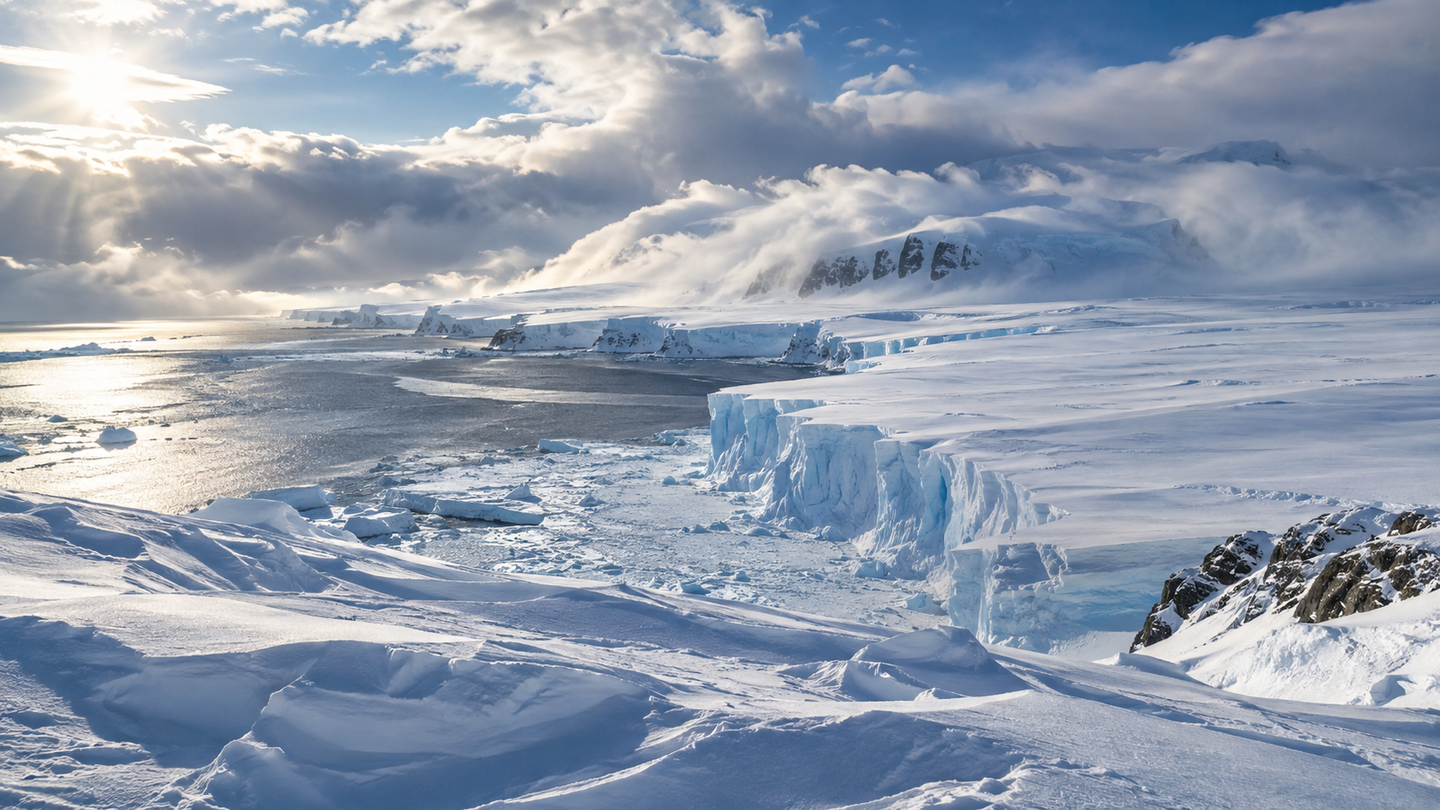
Tropical ocean warming redirected moisture toward East Antarctica, helping drive a temporary 695-billion-ton ice mass gain. (CREDIT: Shutterstock)
- Antarctica gained about 695 billion metric tons of ice between July 2021 and April 2023, the largest 22-month mass increase in the GRACE satellite record.
- Researchers traced much of the gain to persistent warming in the tropical warm pool, which reorganized atmospheric circulation and funneled Indian Ocean moisture toward East Antarctica.
- The episode was temporary and does not overturn Antarctica’s long-term ice-loss trend, with West Antarctica and vulnerable East Antarctic outlet glaciers still losing ice.
For nearly two years, Antarctica briefly interrupted one of the clearest trends in the modern climate record.
Between July 2021 and April 2023, the Antarctic Ice Sheet gained about 695 billion metric tons of mass. It was the largest 22-month increase observed during the satellite era, despite an average Antarctic loss of about 140.5 billion tons per year from 2003 through 2024.
The cause was not a sudden recovery of shrinking glaciers. Instead, an unusually persistent atmospheric pattern dumped enormous amounts of snow across parts of East Antarctica.
A study published in Nature traces that pattern back thousands of miles to unusually warm ocean water in the tropical western Pacific and eastern Indian Ocean. Researchers led by the Institute of Oceanology of the Chinese Academy of Sciences found that this tropical warm pool helped rearrange atmospheric circulation all the way to Antarctica.
The resulting chain of events redirected moisture-rich air toward Queen Mary Land and Wilkes Land, producing enough snowfall to temporarily offset continuing losses elsewhere on the continent.
East Antarctica received an extraordinary amount of snow
Satellite measurements from the GRACE and GRACE Follow-On missions revealed the scale of the temporary reversal. Instead of continuing its long decline, total Antarctic ice mass rose sharply during the 2021–2023 period.
The strongest change occurred across Queen Mary Land and Wilkes Land in East Antarctica. That sector gained about 470.3 ± 29.1 billion tons, accounting for roughly 68% of the continent-wide increase.
Several independent precipitation and surface-mass-balance datasets showed a similar jump. ERA5 reanalysis estimated a cumulative precipitation anomaly of about 351.2 ± 26.2 billion tons over the region, while two regional climate models produced comparable surface accumulation estimates.
Ice-core evidence from Law Dome also supported the unusual snowfall pattern. Together, those observations indicated that increased precipitation rather than a sudden slowdown in glacier flow drove much of the gain.
The distinction matters because snowfall can change rapidly with atmospheric circulation. Dynamic ice loss caused by glaciers accelerating into the ocean operates differently and can continue even during unusually snowy periods.
The trigger appeared thousands of miles to the north
The researchers identified a persistent ocean anomaly in the tropical warm pool, a region spanning parts of the western Pacific and eastern Indian Ocean.
Sea surface temperatures there remained unusually warm from 2021 through 2023. During the event, the average tropical warm-pool anomaly reached roughly 0.5 degrees Celsius.
That warming affected the atmosphere above it and helped launch a Rossby wave train toward the Southern Hemisphere’s high latitudes. Rossby waves are enormous atmospheric disturbances created partly by Earth’s rotation and large temperature contrasts.
Rather than behaving like ordinary storms, they can transmit the effects of tropical heating over thousands of miles.
The wave pattern eventually helped establish a north-south atmospheric pressure dipole near East Antarctica. Lower-than-normal pressure developed south of Australia, while higher pressure formed closer to the East Antarctic coast.
That high-pressure anomaly became especially important because it altered the direction from which moisture approached the continent.
Indian Ocean moisture was steered onto the ice sheet
Atmospheric rivers carried much of that moisture.
These narrow corridors of concentrated water vapor can transport enormous quantities of moisture across the atmosphere. When they reach Antarctica, they can produce exceptional snowfall during relatively short periods.
Water-tracing simulations showed that nearly half of the region’s normal precipitation originates from several parts of the mid-southern Indian Ocean. During the 2021–2023 anomaly, changes in circulation increased the contribution from those distant moisture sources.
Three source regions accounted for about 45% of the additional snowfall. The important change was not that vastly more water evaporated from the ocean, but that atmospheric circulation delivered existing moisture more efficiently toward Antarctica.
The high-pressure pattern encouraged poleward transport and increased atmospheric-river activity along its western side. More moisture therefore reached Queen Mary Land and Wilkes Land and fell as snow.
This prolonged delivery helped create the step-like mass increase recorded by gravity satellites.
Computer experiments traced the pattern back to the tropics
Observations alone could show that tropical warming and Antarctic snowfall occurred together, but they could not demonstrate what caused the atmospheric pattern.
The team therefore tested the connection using two atmospheric circulation models. In controlled experiments, researchers imposed warm sea-surface temperatures over the tropical warm pool while holding other conditions more stable.
The warming reproduced key features of the observed response. A low-pressure anomaly developed south of Australia, followed by a high-pressure anomaly extending toward East Antarctica.
The simulated circulation also increased precipitation across the same general region affected during 2021–2023.
Additional experiments tested whether La Niña conditions, Indian Ocean Dipole-related cooling or warming near the South Pacific Convergence Zone could produce the same result independently. None reproduced the East Antarctic dipole and snowfall response as effectively as warming centered on the tropical warm pool.
The researchers therefore identify the local tropical temperature anomaly as the more direct driver, while other climate patterns may have strengthened or modified it.
Global warming explains only part of the snowfall surge
A warmer atmosphere can hold more moisture, so researchers also examined whether long-term human-driven warming could directly explain the snowfall increase.
Climate-model ensembles did show a gradual rise in Antarctic precipitation under anthropogenic forcing. But that contribution was comparatively small during this particular episode.
Over Queen Mary Land and Wilkes Land, the modeled forced increase amounted to about 32.3 ± 2.4 billion tons. That represents only around 9% of the roughly 351 billion-ton precipitation anomaly estimated from ERA5.
The finding does not imply that climate change is irrelevant to Antarctic snowfall. Long-term warming can increase atmospheric moisture and shift storm tracks, potentially raising Antarctic precipitation over time.
Instead, the study indicates that internal climate variability and the tropical teleconnection were the dominant immediate causes of the extraordinary 2021–2023 event.
The Antarctic recovery was only temporary
Similar prolonged tropical warm-pool events appear roughly once per decade in observations and historical simulations.
That recurrence suggests East Antarctic snowfall can experience substantial multiyear swings driven by conditions far outside the polar region. It also gives scientists another mechanism to include when interpreting short-term changes in Antarctic ice mass.
“We found a previously underrecognized ‘tropical warm pool–East Antarctic Ice Sheet’ teleconnection pathway,” first author Yunhe Wang said.
The result should not be interpreted as evidence that Antarctica has stopped losing ice. West Antarctica continued losing mass during the snowfall event, while East Antarctic glaciers including Totten and Denman remain vulnerable to warm ocean water melting their ice shelves from below.
The 695-billion-ton gain therefore represents a temporary atmospheric interruption rather than a reversal of the long-term trend.
Its larger significance lies in showing how quickly conditions in the tropics can alter snowfall at the bottom of the world. Better representing that link in climate models could improve estimates of future Antarctic mass balance and, ultimately, projections of global sea-level rise.
Dig deeper into Antarctic ice and atmospheric connections
These resources provide broader context on Antarctic ice loss, snowfall variability, atmospheric rivers and tropical influences on polar climate.
Mass balance of the Greenland and Antarctic ice sheets from 1992 to 2020: This major satellite synthesis documents long-term ice-sheet losses and the contrasting behavior of West and East Antarctica. (Earth System Science Data, 2023)
Atmospheric rivers in Antarctica: This review examines how narrow corridors of moisture affect Antarctic snowfall, melt and surface mass balance. (Nature Reviews Earth & Environment, 2025)
Increased snowfall over the Antarctic Ice Sheet mitigated twentieth-century sea-level rise: Ice-core and reanalysis data show how increased Antarctic snow accumulation has partly offset sea-level rise over the past century. (Nature Climate Change, 2019)
Tropical teleconnection impacts on Antarctic climate changes: This review explains how tropical ocean temperatures can influence Antarctic weather through Rossby waves and other long-distance atmospheric connections. (Nature Reviews Earth & Environment, 2021)
Partitioning the drivers of Antarctic glacier mass balance (2003–2020) using satellite observations and a regional climate model: Researchers separate the roles of snowfall, ice discharge and regional climate in Antarctic glacier mass changes. (Proceedings of the National Academy of Sciences, 2024)
Research findings are available online in the journal Nature.
The original story "A tropical ocean hot spot helped Antarctica gain 695 billion tons of ice" is published in The Brighter Side of News.
Related Stories
- Greenland and Antarctica have lost more than 11 trillion tons of ice since 1979
- Why Antarctica turned into an ice world millions of years before the Arctic
- Antarctic meltwater is driving faster ice loss than climate models predict
Like these kind of feel good stories? Get The Brighter Side of News' newsletter.
Joshua Shavit
Writer and Editor
Joshua Shavit is a NorCal-based science and technology writer with a passion for exploring the breakthroughs shaping the future. As a co-founder of The Brighter Side of News, he focuses on positive and transformative advancements in technology, physics, engineering, robotics, and astronomy. Having published articles on AOL.com, MSN, Yahoo News, and Ground News, Joshua's work highlights the innovators behind the ideas, bringing readers closer to the people driving progress.