UPenn engineers created a flexible, durable insulator out of mylar to protect future lunar habitats
UPenn engineers found that coated Mylar stacks can retain vacuum insulation after repeated compression, a promising step toward durable lunar habitat materials.
 UPenn Writer: Ian Scheffler

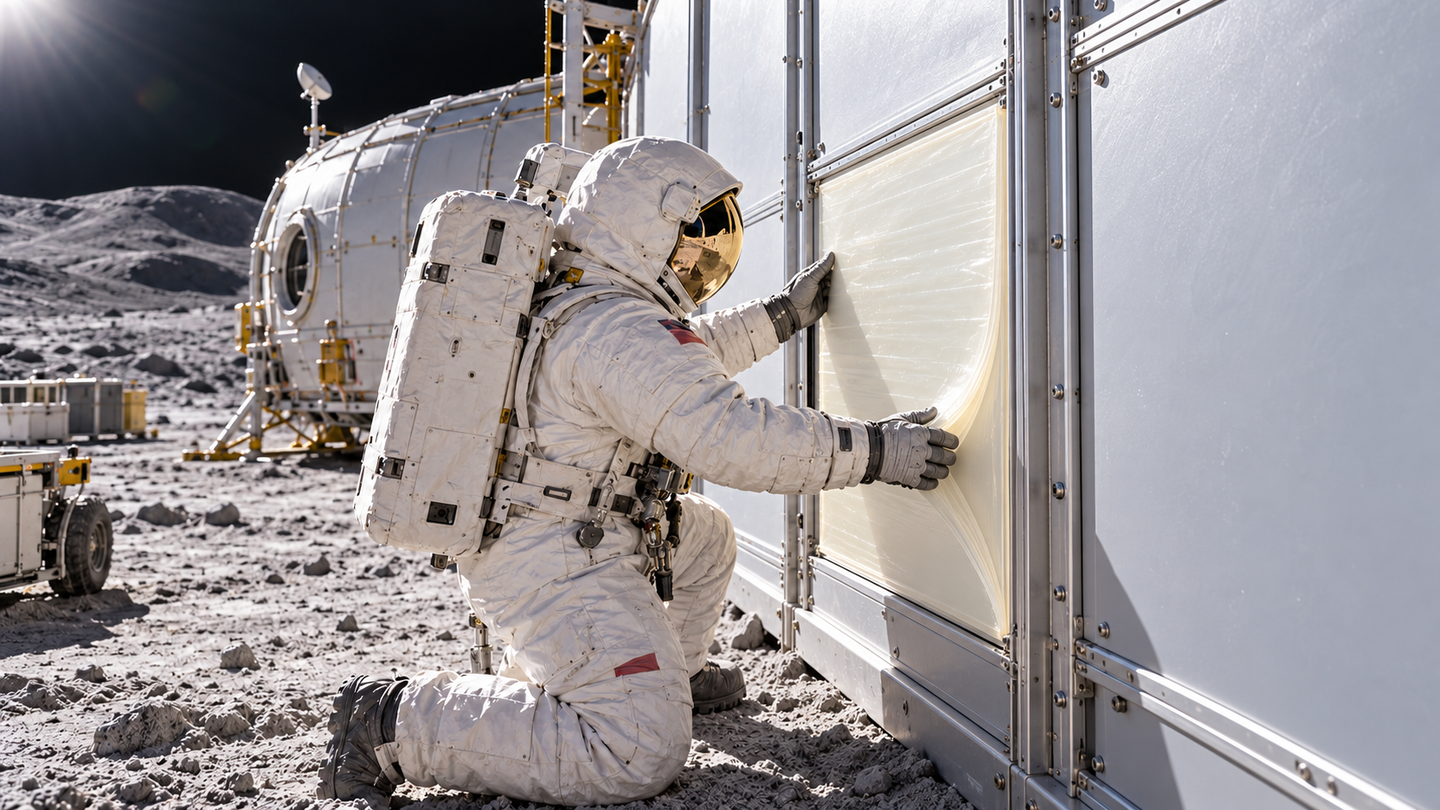
UPenn engineers tested layered Mylar that retained vacuum insulation after repeated compression, suggesting possible lunar uses. (CREDIT: The Brighter Side of News)
- Thin stacks of Mylar combined strong vacuum insulation with resistance to repeated compression in laboratory tests.
- Alumina coatings and microscopic contact points between sheets helped control heat transfer through the layered material.
- Lunar habitats are a potential application, but larger samples and testing under broader conditions are still needed.
Insulation for a lunar home would need to survive more than extreme temperatures. Packing, installation and repeated handling could damage materials that otherwise block heat effectively. A stack of familiar plastic film may offer a way to preserve insulation after substantial compression.
Engineers at the University of Pennsylvania tested hundreds of thin Mylar sheets, including versions stiffened with a ceramic coating. Their study, published in ACS Applied Materials & Interfaces, describes hybrid layered insulating film stacks, or HyLIFS. Small laboratory samples combined low heat transfer in a vacuum with flexibility and resistance to repeated squeezing.
The findings suggest a possible material for lunar infrastructure, rather than a finished product ready for space. The samples covered about one square centimeter, and assembling them took hours. Their performance across the moon’s full temperature range remains to be established.
A demanding job for familiar plastic
Lunar habitats face a difficult combination of thermal and mechanical demands. Temperatures on the surface can swing from intense heat in sunlight to deep cold in darkness. Insulation must help maintain suitable interior conditions while tolerating transportation and installation.
Some highly insulating materials have delicate structures that make handling difficult. Aerogels, for example, contain extensive empty space, although reinforced versions can improve their durability. Conventional multilayer space insulation uses reflective sheets and spacers to reduce radiative heat transfer, but significant compression can compromise its performance.
The Penn team investigated whether closely stacked polymer films could offer a useful combination of properties. Mylar is a form of polyethylene terephthalate, a plastic processed into thin, strong sheets. The material already appears in packaging and aerospace equipment, making it a familiar starting point for experiments. Its availability also allowed the researchers to investigate a simple arrangement before considering more elaborate manufacturing methods.
Senior author Igor Bargatin, an associate professor of mechanical engineering and applied mechanics at Penn, emphasized the paired requirements. “For lunar infrastructure, we would ideally like both,” he said. “The ideal material is both resistant to damage and to the loss of heat.”
Building hundreds of tiny barriers
The researchers compared films measuring 2.5, 5 and 12.5 micrometers thick, each far thinner than a millimeter. Some received an extremely thin coating of aluminum oxide, also called alumina. This ceramic layer increased the sheets’ stiffness and helped limit contact between neighboring surfaces.
That coating differs from the metallic aluminum used on shiny emergency blankets. Metallic coatings can reflect infrared radiation, whereas the alumina in these experiments primarily changed the films’ mechanical properties. Understanding that distinction matters because heat moving through solid contact points was central to the study.
Depending on film thickness, the stacks contained roughly 80 to 400 layers per millimeter. Each interface between sheets created another obstacle to heat moving through the assembly. The challenge was to preserve those obstacles when pressure pushed the layers together. Increasing contact between sheets gives heat more opportunities to cross the stack, potentially weakening the benefit of adding layers.
First author Danielle R. Levin, a recent Penn chemistry doctoral graduate who also earned a mechanical engineering master’s degree, described delicate assembly work. “We use two pairs of tweezers and small weights to handle and stack the delicate films,” she said. “Even breathing near the stack can send the layers flying.”
Measuring insulation and resistance to compression
The team measured thermal performance in a high vacuum, with one side heated to 120 degrees Celsius and the other held near 35 degrees. The best result came from five-micrometer films coated on both sides. At a compressive stress of 0.1 megapascals, their thermal conductivity reached 2.2 milliwatts per meter-kelvin.
Thermal conductivity describes how readily heat passes through a material; lower values indicate better insulation. The applied stress was roughly equivalent to one atmosphere of pressure, a relevant scale for pressurized habitats. Those measurements showed promising insulation under compression, without establishing performance for an entire habitat wall.
Separate durability experiments repeatedly compressed stacks to 20 megapascals, far above the loads used for the thermal measurements. These mechanical tests took place in air at room temperature. Researchers then compared the samples’ vacuum insulation performance before and after compression.
Coated stacks retained their thermal performance within experimental uncertainty after 10 compression cycles. Uncoated stacks suffered substantially greater losses, supporting the value of stiffening the sheets. The experiment did not measure thermal conductivity while the samples were simultaneously under the maximum 20-megapascal stress. Its result instead shows how well the coated material recovered its insulating behavior after repeated exposure to those loads.
Small particles control the contact points
An ordinary manufacturing ingredient helped explain the results. Commercial films contain microscopic antiblocking particles that protrude slightly from their surfaces. Manufacturers add them to keep thin plastic sheets from sticking together, making the films easier to produce and handle.
Within a stack, those protrusions also help determine where neighboring sheets touch. Heat can pass through these tiny connections even when vacuum suppresses heat transfer through surrounding gas. Their dimensions and distribution therefore influence how well the assembly insulates.
The researchers compared measurements with models of heat transfer across those interfaces. Their results suggest that contact between protruding particles and adjacent films dominates heat flow under the tested vacuum conditions. Stiffer coatings can restrict the contact areas that develop as the layers press together. The particles themselves were already known; the investigation focused on their previously underexamined role in conducting heat between stacked films.
The models also helped interpret a surprising result: coated 2.5-micrometer and five-micrometer films performed similarly within experimental uncertainty. Thinner sheets provide more interfaces in the same thickness, which might seem advantageous. However, differences in particle density can create additional contact pathways, complicating that simple expectation.
Scaling a laboratory stack for lunar use
The findings make thickness only one part of the design problem. Coating stiffness, particle size, particle distribution and deformation under pressure also matter. Better insulation could come from engineering those features together, rather than simply making sheets thinner.
Manufacturing remains an immediate obstacle because manually stacking tiny samples cannot supply a habitat. The researchers point to coating continuous rolls of film and winding them into larger assemblies as possible approaches. Producing meter-scale material would still require demonstrating consistent performance across much larger areas. The study therefore establishes a material concept, while leaving production speed, cost and practical installation for future development.
Flexibility also needs a broader assessment. Samples could bend and recover their shape, but that demonstration does not establish years of repeated folding or handling. Lunar applications would require further evaluation of cold temperatures, repeated bending and damage from bumps and scuffs.
Potential uses include insulation for habitats, rovers and electronic systems operating in a vacuum. Whether the material can serve those roles will depend on preserving its microscopic contact structure during manufacture and service. The next practical question is whether a hand-built stack’s performance can survive the move to large, repeatedly handled sheets.
Dig deeper into space insulation
These resources explain spacecraft thermal control, alternative insulation materials and the lunar environment.
State-of-the-Art of Small Spacecraft Technology
NASA’s technology report includes a thermal-control chapter explaining insulation options and spacecraft design considerations. (NASA, May 2026)
Aerogel Insulations Save Millions in Industrial Applications
This account traces the development of reinforced aerogel blankets and their use in demanding industrial settings. (NASA, 2020)
Thin Aerogel as a Spacer in Multilayer Insulation
This technical project summary describes another approach to combining durability and vacuum insulation for cryogenic propellant storage. (NASA, August 2015)
Pathfinder Rover Will Be Insulated with Novel Substance
This historical mission announcement explains why aerogel was selected to protect the Mars Pathfinder rover’s electronics. (NASA Jet Propulsion Laboratory, February 1995)
Moon Facts
NASA’s overview describes the lunar surface, its thin atmosphere and the temperature extremes that challenge equipment and habitats. (NASA)
Research findings are available online in the journal ACS Applied Materials & Interfaces.
The original story "UPenn engineers created a flexible, durable insulator out of mylar to protect future lunar habitats" is published in The Brighter Side of News.
Related Stories
- ISS test finds that moon dust could be effective as a lunar building material
- 3D printed moon dust structures could be the future of lunar construction
- Innovative habitat enables astronauts to safely live on the Moon
Like these kind of feel good stories? Get The Brighter Side of News' newsletter.
Joshua Shavit
Writer and Editor
Joshua Shavit is a NorCal-based science and technology writer with a passion for exploring the breakthroughs shaping the future. As a co-founder of The Brighter Side of News, he focuses on positive and transformative advancements in technology, physics, engineering, robotics, and astronomy. Having published articles on AOL.com, MSN, Yahoo News, and Ground News, Joshua's work highlights the innovators behind the ideas, bringing readers closer to the people driving progress.