Virginia Tech researchers find that some cancers are worse than others
Smaller tetraploid cancer cells grew faster, spread more easily, and in some cancers tracked with poorer patient survival.

 Edited By: Joseph Shavit

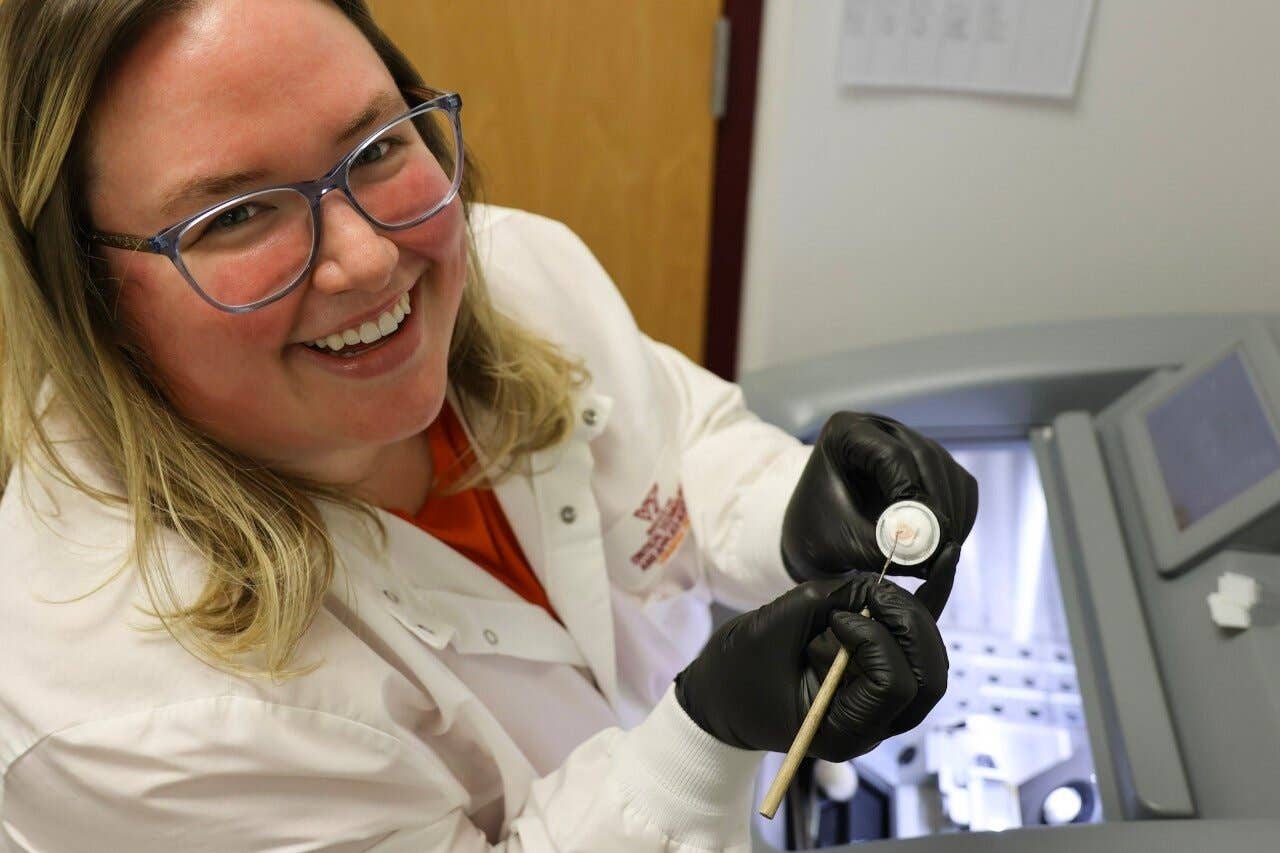
Megan Sweet, biological sciences graduate student at Virginia Tech. (CREDIT: Kelly Izlar / Virginia Tech)
Whole-genome-doubled cancer cells carry extra DNA, but their size may matter as much as their genetics. Virginia Tech researchers found that smaller tetraploid cells often grow more aggressively and, in some human cancers, are linked to poorer survival.
Tumors do not all grow under the same rules, even when they share one of cancer’s most common genetic changes. At Virginia Tech, researchers studying cells with doubled genomes found that some of the most dangerous ones were not the biggest or most obviously distorted. They were smaller.
That finding grew out of years of close work in the lab, where graduate student Megan Sweet slices mouse-grown tumors into thin, nearly translucent sections, stains them, and studies their structure under a microscope. Those repeated steps helped reveal a pattern that could sharpen how researchers think about cancer progression.
The work, published in Cancer Research, focused on what happens after whole-genome doubling, an event in which a cell ends up with four complete sets of chromosomes instead of the usual two. Such cells are known as tetraploid cells, and they are common in cancer. They have long been linked to drug resistance, metastasis, and poor outcomes.
But the Virginia Tech team found that tetraploid cells are not all alike, and one overlooked feature, cell size, may help explain why some are more dangerous than others.
When extra DNA does not make cells behave the same
Most healthy human cells are diploid, carrying two copies of each chromosome. When a cell divides properly, that balance is maintained. But division can fail. If a cell duplicates its chromosomes and then skips the final split, it becomes tetraploid.
That kind of whole-genome doubling is not just a laboratory curiosity. In cancer, it is one of the most common genomic alterations. Researchers have known that it can help tumors evolve by giving cells extra genetic material, which may buffer harmful mutations and allow chromosome errors to accumulate.
Working with cell biologist Daniela Cimini, graduate students Megan Sweet and Mat Bloomfield spent years studying how these doubled cells behave.
In one line of work, they compared tumors formed from ordinary diploid cancer cells with tumors formed from tetraploid cancer cells. Even when tetraploid cells made up only a small fraction of the tumor, they appeared to change the tumor’s surroundings.
“The presence of even a small fraction of these tetraploid cells can promote the recruitment of extra non-cancerous cells that support further tumor progression,” Sweet said.
Those recruited stromal cells are not cancer cells themselves. They are connective tissue cells that help form the tumor’s supporting structure. But their arrival can help tumors grow.
That helped explain how tetraploid cells could drive tumor progression even when their own numbers declined during tumor formation in mice.
A smaller-than-expected cell turned out to be more dangerous
The team’s second investigation began with a different question. They wanted to understand the basic physiology of tetraploid cells. But when Bloomfield generated tetraploid cancer cell clones from human-derived breast and colon cancer lines, something unexpected appeared.
Not all of the tetraploid cells were the same size.
Because tetraploid cells contain twice the DNA of diploid cells, the researchers expected them to be roughly twice as large. Some were. But some were 25 to 30 percent smaller than expected.
Those smaller tetraploid clones turned out to be the more aggressive ones.
“The smaller clones are more aggressive,” Bloomfield said. “They grow faster, are more invasive, and more tolerant of common anti-cancer and stress-inducing drugs.”
The pattern held up across multiple tests. In cell culture, the smaller tetraploid clones divided faster, invaded more readily, and formed more and larger colonies in soft agar, a classic sign of tumor-forming potential. In mice, tumors formed from smaller tetraploid cells often grew more quickly than those formed from larger tetraploid cells.
The result was seen in both colorectal and breast cancer models.
The larger tetraploid cells, by contrast, were less fit. They showed more chromosome missegregation, more lagging chromosomes during cell division, and more micronuclei, all signs of chromosomal instability. They also appeared less able to keep up with their own size.
Bigger cells carried extra strain
One reason may be that large tetraploid cells do not scale their internal machinery efficiently.
The researchers found that protein synthesis and mitochondrial content rose after whole-genome doubling, but not in proportion to the larger size of the biggest tetraploid cells. In effect, the large cells seemed to carry more bulk without gaining enough internal capacity to support it.
That may leave them vulnerable.
Large tetraploid clones were more sensitive to proteotoxic stress, which disrupts protein handling, and to oxidative stress. Smaller tetraploid clones were more tolerant of those conditions.
The team also found that artificially making small tetraploid cells larger reduced their fitness. When researchers enlarged selected small clones, those cells became less proliferative, less invasive, and less able to grow independently.
That result strengthened the case that size itself matters, not just the extra DNA.
“We already knew that tetraploidy can make cells more tumorigenic, but now we know that if you incorporate the size of the cells, it can be more predictive of tumorigenic potential,” Cimini said.
The human data pointed in the same direction
The researchers then turned to human tumor data from The Cancer Genome Atlas, analyzing more than 17 million neoplastic cells from 1,095 patient samples across six tumor types with high rates of whole-genome doubling.
In most of those cancers, tumors with genome doubling had larger cancer cell nuclei than tumors without it. But there was also substantial variation among the genome-doubled cancers themselves. Some had relatively small nuclei, others much larger ones.
That variation mattered.
In several cancer types, including luminal B breast cancer, lung adenocarcinoma, and esophageal adenocarcinoma, smaller nuclear size within whole-genome-doubled tumors was associated with worse outcomes or poorer survival trends. The pattern did not hold in every subtype, but it was strong enough to suggest that nuclear size may add prognostic value.
The team also found gene-expression differences between small and large genome-doubled tumors, including pathways tied to cell cycle activity, metabolism, biosynthesis, DNA repair, ion transport, and immune response.
Taken together, the work suggests that once a tumor acquires a doubled genome, the story does not end there. The physical consequences of that event, especially how large the resulting cells become, may shape how threatening the cancer turns out to be.
Practical implications of the research
The findings suggest that whole-genome doubling alone may not be enough to judge how risky a tumor is. Measuring cell or nuclear size could help identify which genome-doubled cancers are more likely to behave aggressively.
The work also points to possible treatment angles. Larger tetraploid cells appeared more vulnerable to proteotoxic and oxidative stress, which raises the possibility that some tumors with large nuclei could be more sensitive to drugs that disrupt protein handling or related stress pathways.
Smaller tetraploid cells, meanwhile, may represent a fitter, harder-to-control population that deserves closer attention in prognosis and treatment planning.
Research findings are available online in the journal Cancer Research.
The original story "Virginia Tech researchers find that some cancers are worse than others" is published in The Brighter Side of News.
Related Stories
- Study finds low-dose CAR T therapy can drive complete cancer remission
- Previously irrelevant organ could be key to longer life and better cancer outcomes
- UPenn researchers develop bioengineered chewing gum to fight head and neck cancers
Like these kind of feel good stories? Get The Brighter Side of News' newsletter.
Hannah Shavit-Weiner
Medical & Health Writer
Hannah Shavit-Weiner is a Los Angeles–based medical and health journalist for The Brighter Side of News, an online publication focused on uplifting, transformative stories from around the globe. Having published articles on AOL.com, MSN and Yahoo News, Hannah covers a broad spectrum of topics—from medical breakthroughs and health information to animal science. With a talent for making complex science clear and compelling, she connects readers to the advancements shaping a brighter, more hopeful future.