1.4 million-year-old footprints reveal an ancient group of human-sized hominins
Ancient footprints beside Kenya’s Lake Turkana capture eight large hominins moving together 1.43 million years ago.

 Edited By: Joseph Shavit

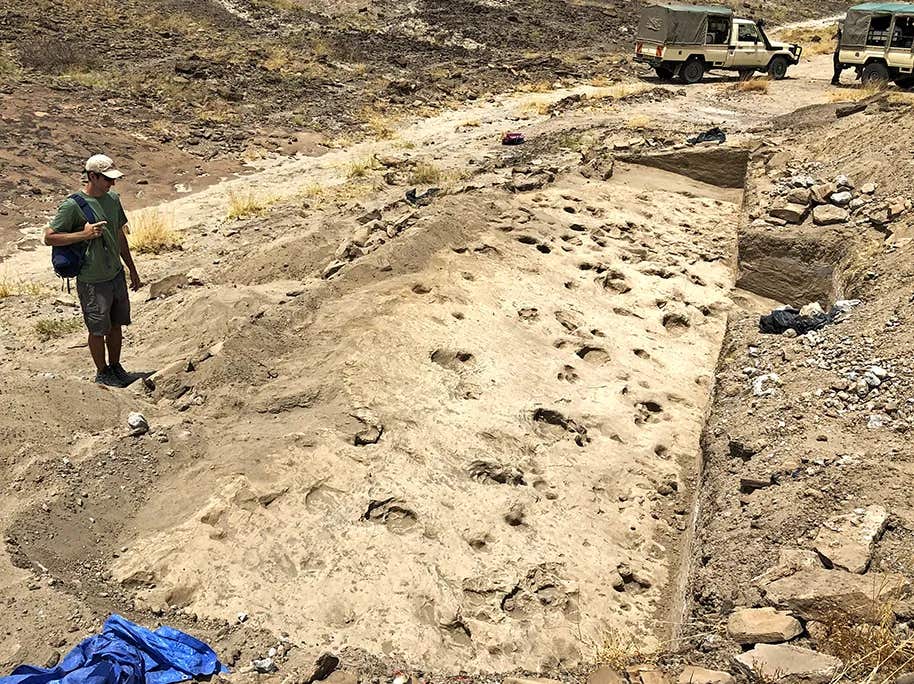
The excavated site preserves the movements of multiple species, with massive hippo tracks, smaller antelope prints, and a trail of human ancestor footprints captured together. (CREDIT: Kay Behrensmeyer)
- Eight large ancient human relatives crossed the same lakeshore about 1.43 million years ago.
- Their foot shape resembles Paranthropus boisei, but their large body size also fits Homo erectus.
- The tracks suggest that several adult males moved together, offering rare evidence of early group behavior.
Eight ancient human relatives crossed a muddy lakeshore in northern Kenya about 1.43 million years ago. Their footprints survived together, preserving a rare moment of group movement that now challenges old ideas about their bodies and social lives.
The 21 tracks were left by eight individuals at a site called GaJi10 near Lake Turkana. Their foot shapes resemble prints previously linked to Paranthropus boisei, a heavily built hominin known for its powerful jaws and large teeth.
Yet the track-makers were unexpectedly large. Some may have stood close to 6 feet tall and weighed around 165 pounds, dimensions more often associated with Homo erectus.
That tension makes the footprints difficult to assign with complete certainty. Their anatomy points toward Paranthropus, while their body size looks more like Homo.
A moment preserved in lakeshore mud
The findings appear in the Proceedings of the National Academy of Sciences. Kevin Hatala of Chatham University and the Max Planck Institute for Evolutionary Anthropology led the international research team.
“Each site represents a snapshot of our past, and we are quickly building a photo album with several different windows to hominin anatomy, locomotion, behavior and environments during the Early Pleistocene,” Hatala said.
The first signs of the trackway appeared in 1978. Kay Behrensmeyer, now a senior research geologist at the Smithsonian’s National Museum of Natural History, was working with Kenyan colleagues near Lake Turkana.
Workers had cut a trench through layers of ancient sediment when Behrensmeyer noticed a deep, rounded depression. It was a hippopotamus footprint.
The crew brushed away more sediment and uncovered two hominin tracks on the same surface. After studying them, the team covered the site with sand to protect it.
“The special thing about footprints scientifically is that they preserve an instant in time,” Behrensmeyer said. “They also allow people to relate to these fossils much more easily than an isolated piece of bone or jaw.”
Researchers returned in 2016 and 2023. Those excavations revealed the trackway’s full scale, including footprints from hippos, antelope, and other animals.
Volcanic ash in nearby rock helped date the surface to about 1.43 million years ago, during the Early Pleistocene.
Two hominins shared the same landscape
At that time, the Lake Turkana region supported crocodiles, elephants, and at least two hominin species. One was P. boisei. The other was H. erectus, a possible direct ancestor of living humans.
A separate trackway described in 2024 preserved footprints from both forms. That discovery showed that the two hominins used the same lakeshore habitats across hundreds of thousands of years.
“We can’t say how the two different hominins interacted on the mudflats, but we know they were both here at this time,” Behrensmeyer said.
The GaJi10 tracks add another layer to that picture. Their internal shapes and movement patterns differ from those of modern humans. Instead, they resemble footprints attributed to P. boisei and show similarities to earlier australopithecines.
However, few postcranial fossils, meaning bones below the skull, can be confidently assigned to P. boisei. That shortage makes it difficult to compare the footprints with known skeletons.
The tracks exceed the largest body-size estimates based on attributed P. boisei fossils. This leaves two possibilities.
The species may have grown larger and shown more body-size variation than previously recognized. Alternatively, the footprints may belong to H. erectus, which would mean that species had much greater variation in foot anatomy and walking style than scientists have documented.
Large males may have moved together
Whatever their exact identity, the footprints came from unusually large hominins. The researchers argue that the group probably included several adult males.
“The sizes of the footprints indicate human-like body sizes, up to 6 feet tall and around 165 pounds,” Hatala said.
The preserved arrangement also suggests that the individuals moved across the same surface within a limited period. Most appear to have been adult males, with no clear evidence of females or children traveling beside them.
“The fact that eight, mostly adult male, P. boisei individuals seemingly traveled together as a group, without females or children, hints at a complex social structure in this species,” said Neil Roach of Harvard University, a co-author of the paper.
“They may have lived in large groups, where males competed for mates, but also tolerated each other at times for safety in a dangerous environment.”
That interpretation remains cautious because footprints cannot reveal every detail about relationships or intentions. They do, however, provide direct evidence that several large hominins crossed the same lakeshore together.
The surrounding animal tracks place them in a delta-like environment along the lake margin. The authors suggest that hominins may have visited the area to reach local resources.
Hundreds of tracks remain to be studied
The eastern shore of Lake Turkana has yielded hundreds of fossil footprints deposited over more than 100,000 years.
Scientists are now studying the geology that preserved so many track surfaces. Better knowledge of those sediments could reveal how often hominins visited the lake edge and what conditions drew them there.
“The discovery of these fossil footprints along the margins of Lake Turkana reinforces the region’s global importance in understanding human evolution, preserving remarkable evidence of how our ancient relatives lived 1.4 million years ago,” said Purity Kiura of the National Museums of Kenya.
“It further strengthens Kenya’s position as one of the world’s leading paleoanthropological landscapes and highlights our responsibility to protect this irreplaceable heritage.”
The team plans to return to Kenya later this year to investigate additional footprint sites.
Practical implications of the research
The GaJi10 trackway gives scientists evidence that bones alone rarely preserve. It records body size, foot anatomy, walking patterns, group composition, and habitat use on one ancient surface.
The findings may force researchers to reconsider how large P. boisei could grow. They may also broaden estimates of variation within H. erectus if future evidence points toward that species instead.
Most importantly, the tracks provide a direct record of several hominins moving together. That evidence can help researchers test ideas about group structure, male behavior, habitat use, and coexistence among different human relatives.
For Behrensmeyer, the expanding footprint record has gone far beyond the two prints uncovered nearly five decades ago.
“I never dreamed when we found these in 1978 that it would develop into such a large assemblage and provide such widespread insights into the ecology of these hominins,” she said.
Key facts about Paranthropus boisei
Paranthropus boisei lived in East Africa between about 2.3 million and 1.2 million years ago. Fossils of the species have been found in Tanzania, Kenya, Ethiopia, and Malawi. It lived during a period when African environments were changing, with forests giving way to more open grasslands and wetlands.
The species had a large skull, wide cheekbones, and extremely powerful chewing muscles. Its broad face created space for large jaw muscles, while a ridge along the top of the skull helped anchor those muscles. These features gave Paranthropus boisei one of the strongest chewing systems among known early human relatives.
Its massive molars and thick tooth enamel were adapted for processing tough or abrasive foods. The species had relatively small front teeth but exceptionally large back teeth. These teeth could withstand repeated chewing and exposure to gritty foods, including grasses, roots, sedges, and underground plant parts.
The first recognized fossil of Paranthropus boisei was discovered by Mary Leakey in Tanzania in 1959. She found the nearly complete skull at Olduvai Gorge, one of the world’s most important archaeological sites. The discovery helped scientists better understand the diversity of human relatives that once lived in Africa.
The species became known as “Nutcracker Man,” although it probably did not mainly eat nuts. Its powerful jaws initially led researchers to believe it specialized in cracking hard foods. Later chemical studies of its teeth suggested that grasses, sedges, and other plants made up a large part of its diet.
Research findings are available online in the journal PNAS.
The original story "1.4 million-year-old footprints reveal an ancient group of human-sized hominins" is published in The Brighter Side of News.
Related Stories
- Early hominins walked on two legs 7 million-years-ago, study finds
- New research finds early humans first used fire over one million years ago
- 773,000-year-old Moroccan cave fossils reveal human and neandertal evolutionary split
Like these kind of feel good stories? Get The Brighter Side of News' newsletter.
Hannah Shavit-Weiner
Medical & Health Writer
Hannah Shavit-Weiner is a Los Angeles–based medical and health journalist for The Brighter Side of News, an online publication focused on uplifting, transformative stories from around the globe. Having published articles on AOL.com, MSN and Yahoo News, Hannah covers a broad spectrum of topics—from medical breakthroughs and health information to animal science. With a talent for making complex science clear and compelling, she connects readers to the advancements shaping a brighter, more hopeful future.