Wandering black hole found 30,000 light-years from its galaxy’s center
An AI tool built to scan the whole sky helped researchers catch a black hole flaring far from where one was expected.

 Edited By: Joshua Shavit

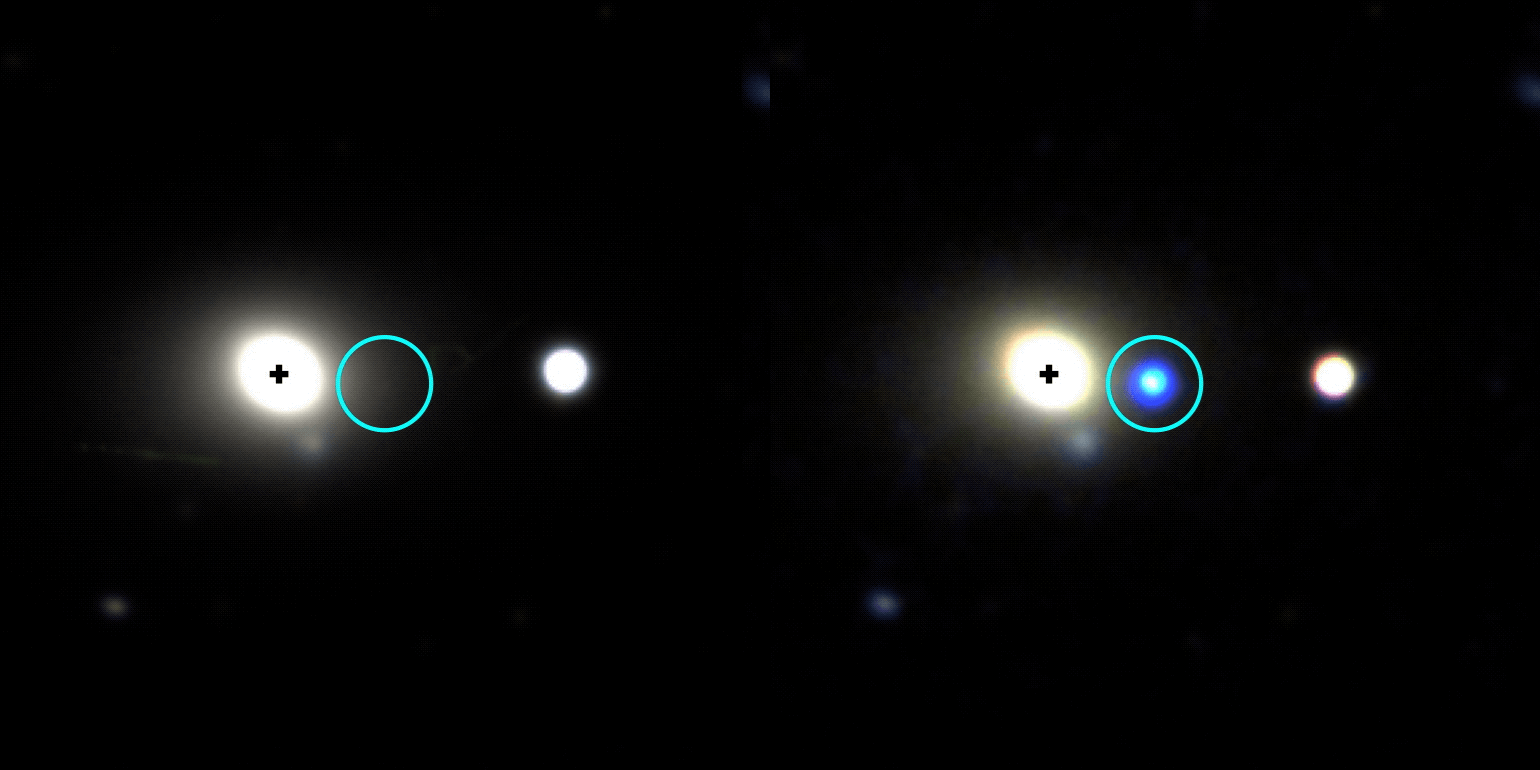
Galaxy WISEA J014656.04-152214.7, located about 750 million light-years away in the constellation Cetus, before and after a tidal disruption event was spotted on its outer edge in November 2025. (CREDIT: DESI/Lowell Discovery Telescope/Legacy Survey/Robert Stein)
- Astronomers spotted a black hole feeding on a star far from the center of its galaxy, something scientists had rarely seen before.
- They found it using an AI tool that scans the whole sky for the telltale flash of a black hole tearing a star apart, instead of only checking galaxy centers.
- The black hole weighs about a million times as much as our sun and may have been flung out of its galaxy's center or left behind after a smaller galaxy was swallowed by a bigger one.
A flash of light near the edge of a massive galaxy, far from its glowing center, turned out to be a black hole tearing a star apart. Astronomers had assumed the biggest black holes always sit at a galaxy's heart. This one didn't.
The discovery marks the first time scientists have caught a dormant black hole so far out on a galaxy's outskirts. The black hole itself gives off no light. It only became visible for a moment, when it shredded a passing star in an event astronomers call a tidal disruption.
The team behind the find spans the University of Maryland and the University of North Carolina at Chapel Hill, working together with NASA's Goddard Space Flight Center. "This is a novel result," said Suvi Gezari, an associate professor of astronomy at UMD and a co-author of the study. "What's new is that, until now, we've started with the assumption that supermassive black holes reside in the centers of massive galaxies."
An AI built to look where no one expected a black hole
Tidal disruption events themselves are rare, happening in a given galaxy roughly once every 100,000 years. Astronomers have documented more than a hundred of them over the past decade, and nearly all showed up at galaxy centers, right where the largest black holes are expected to live.
This one, cataloged as TDE 2025abcr, was different. Researchers measured it at about 9.3 kiloparsecs, or roughly 30,000 light-years, from the center of its host galaxy, the farthest offset ever recorded for a tidal disruption event found through visible light.
"Almost every tidal disruption event we've ever observed has occurred at the center of a galaxy, right where we expect the biggest black holes to be," said Jonathan Carney, a co-author and physics and astronomy PhD student at UNC-Chapel Hill. "We know that wandering black holes exist in massive galaxies, but they are difficult to study because, with the exception of when they briefly disrupt a star, they produce no light."
Catching a flare that lasts only weeks
Finding one required more than luck. The Zwicky Transient Facility, a pair of telescopes at California's Palomar Observatory, scans the entire northern sky every two days and logs hundreds of thousands of events each night, far too many for astronomers to check by hand.
So the team built an AI tool called tdescore, developed by lead author Robert Stein of UMD and NASA Goddard, that hunts for the light pattern of a shredded star anywhere in the sky, not only at galaxy centers.
"This event was identified as a strong candidate tidal disruption event by an AI classifier that we specifically adapted to search for tidal disruption events away from galaxy centers," said Akash Anumarlapudi, a postdoctoral researcher at UNC-Chapel Hill. "By removing the assumption that these events only happen in the galactic center, we were able to find a black hole that might have otherwise been missed."
The AI flagged the event in November 2025, just months after it launched. "I remember the moment we discovered it very clearly," Stein said. "It was a Saturday, and everyone was very excited to be messaging. We dropped everything and started triggering all kinds of other instruments to get more data. We weren't really sure we would be successful so quickly, so it's amazing that we found one so fast."
Researchers confirmed the discovery using telescopes around the world, including the Southern Astrophysical Research Telescope in Chile. "We confirmed the nature of this event using the SOAR telescope in Chile, which UNC is a founding partner of," said Benjamin C. Kaiser, a UNC-Chapel Hill postdoctoral researcher.
A black hole with no galaxy of its own
The black hole is estimated to weigh roughly a million times as much as the sun. Yet unlike most black holes, it doesn't appear to sit inside a smaller galaxy or star cluster of its own.
"To have such a big black hole outside of a galaxy is surprising to me," said UMD astronomy professor Sylvain Veilleux, a co-author. "There should be a Milky Way-like object around it—and that's definitely not the case."
Researchers see two likely explanations. The black hole may be the leftover core of a smaller galaxy that a larger one slowly swallowed, stripping away its stars over time. Or it may once have orbited near the center of its galaxy as part of a black hole pair, until a third black hole arrived during another merger and flung it outward in a chaotic three-way gravitational tussle. Continued observations may help astronomers favor one explanation over the other.
What comes next
"These events are essentially cosmic billboards," said Igor Andreoni, an assistant professor of physics and astronomy at UNC-Chapel Hill. "They allow us to find black holes that would otherwise remain completely invisible."
Astronomers had long predicted that wandering black holes should exist, scattered near the edges of galaxies after mergers, but quiescent ones rarely give themselves away. This discovery shows they can be found using ordinary optical telescopes and machine learning, without specialized or costly equipment.
"This is the strongest case of a wandering black hole that we know," Veilleux said. "This is going to set the standard."
Practical implications of the research
The AI tool behind this discovery can now be pointed at any part of the sky, not just galaxy centers, giving astronomers a practical way to search for other wandering black holes hiding in plain sight. Researchers expect that number to grow quickly once the Vera C. Rubin Observatory in Chile, which uses the world's largest digital camera, ramps up its surveys.
Finding more of these objects would let scientists test the two competing explanations for how black holes end up adrift, refining models of how galaxies merge and grow over time.
It would also help astronomers estimate how many dormant, invisible black holes are quietly drifting through galaxies across the universe, including possibly our own.
Research findings are available online in The Astrophysical Journal Letters.
The original story "Wandering black hole found 30,000 light-years from its galaxy’s center" is published in The Brighter Side of News.
Related Stories
- Alien civilizations could be using Dyson spheres to collect energy from black holes
- Black Hole “ringing” could put Einstein’s theory to its toughest test
- JWST reveals how a supermassive black hole keeps feeding itself
Like these kind of feel good stories? Get The Brighter Side of News' newsletter.
Joseph Shavit
Writer, Editor-At-Large and Publisher
Joseph Shavit, based in Los Angeles, is a seasoned science journalist, editor and co-founder of The Brighter Side of News, where he transforms complex discoveries into clear, engaging stories for general readers. With vast experience at major media companies like The Los Angeles Times, Times Mirror and Tribune Publishing, he writes with both authority and curiosity. His writing focuses on space science, planetary science, quantum mechanics, geology. Known for linking breakthroughs to real-world markets, he highlights how research transitions into products and industries that shape daily life.