150-year-old Greenland shark washed ashore in Ireland, offering new clues to healthy aging
Ireland’s first stranded Greenland shark had lived for 150 years, yet scientists believe it had only just reached adulthood.

 Edited By: Joseph Shavit

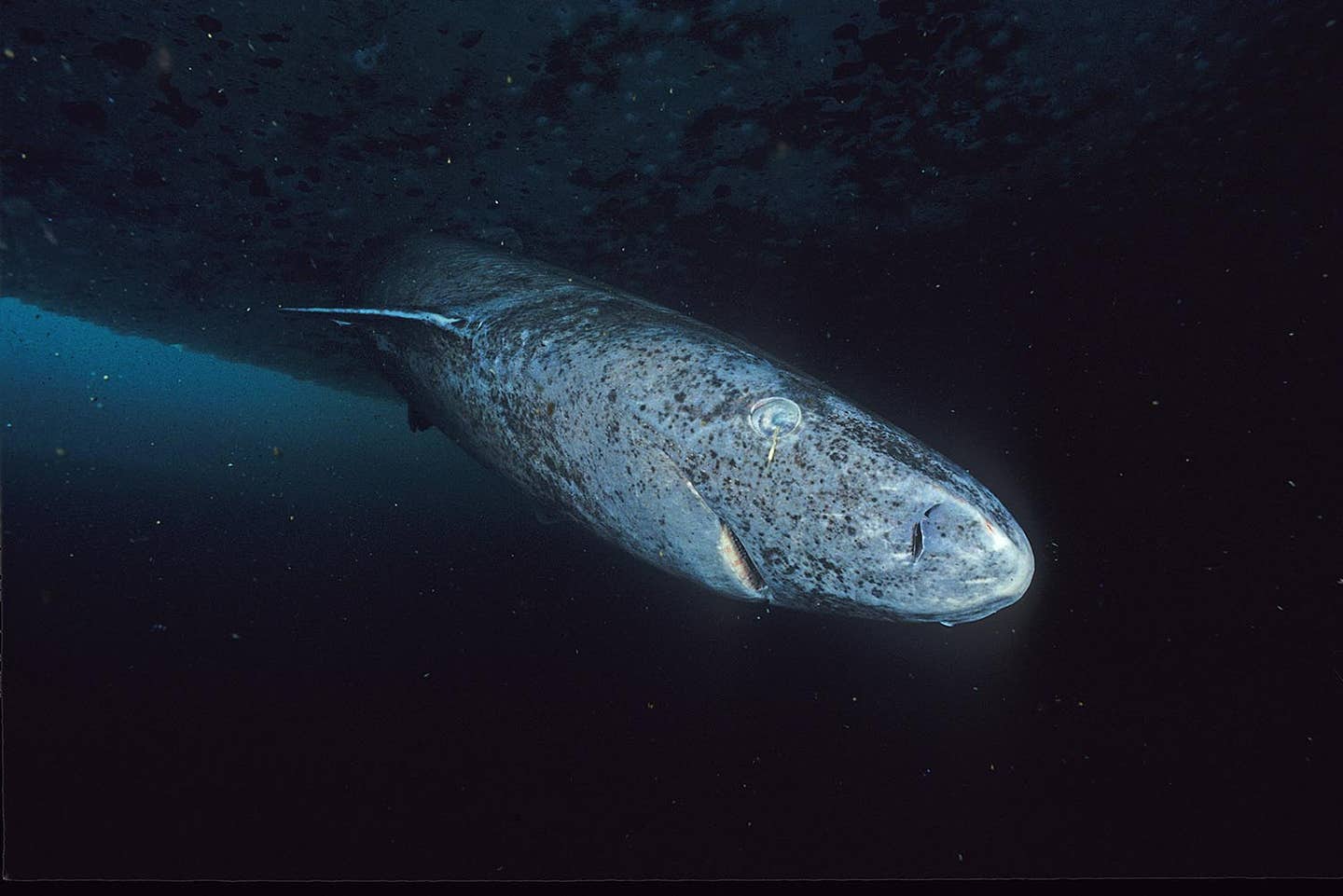
Close up image of a greenland shark taken at the floe edge of the Admiralty Inlet, Nunavut. (CREDIT: Wikimedia / CC BY-SA 4.0)
- A Greenland shark stranded in Ireland was more than 150 years old but may have only just reached reproductive age.
- Its eyes, DNA-repair systems and scarred 34-kilogram heart offer clues to how the species remains functional for centuries.
- Scientists found no clear cause of death, but preserved tissues may improve ageing research and conservation of the poorly understood shark.
A three-metre Greenland shark lay on tidal flats in County Sligo in April 2026, far from the deep northern waters where its species usually lives. Its arrival marked Ireland’s first recorded stranding of a Greenland shark and opened an unusual window into one of the ocean’s least understood giants.
The shark weighed more than 200 kilograms and was estimated to be over 150 years old. For humans, that age seems extraordinary. For a Greenland shark, it may represent only the beginning of adulthood.
“It’s such a pity. This guy – it took him 150 years to get to the point where he could have reproduced, could have contributed to get the population on track, and may not have had the chance,” said Emilie De Loose, a marine biologist at the Irish Whale and Dolphin Group.
Greenland sharks are considered the world’s longest-living vertebrates. Estimates place their lifespan between roughly 300 and 500 years. Some animals alive today may have been born during Shakespeare’s lifetime.
“We were all just in awe,” De Loose said. “It’s so mind-boggling to think how long that animal lived, and what it might have seen.”
A rare visitor reaches the laboratory
Volunteers covered the body with seaweed to protect it from birds and other scavengers. The next day, a crane lifted the shark onto a lorry under the supervision of the National Museum of Ireland.
At a regional veterinary laboratory, researchers wore masks, gloves and protective clothing while working in a ventilated space. The precautions reflected the uncertainty surrounding an animal that had survived for more than a century.
The team examined the shark’s organs, searched for wounds and collected tissue samples. Researchers also removed its eye lenses for radiocarbon dating, which may produce a more accurate age estimate.
“There is something very intimate about working with dead animals, because you really get to know the species,” said Jasmine Stavenow Jerremalm, a marine ecology PhD researcher at University College Cork. “Dead animals can tell us a lot about the living ones.”
A predator built for cold and darkness
Greenland sharks live across North Atlantic and Arctic waters near Greenland, Canada and Iceland. They move slowly and feed on carcasses, but they can also catch live prey, including seals.
Powerful suction helps them draw animals into their mouths and swallow them whole. Lily Fogg, a postdoctoral researcher at the University of Basel, said they may ambush sleeping seals or take injured animals.
Their bodies contain high concentrations of chemicals that act like antifreeze in cold water. Those same chemicals make their flesh poisonous.
Yet scientists still do not know where the sharks mate or give birth. Only one pregnant female has ever been documented.
“For such a large shark with a broad distribution, that is not really a rare species throughout most of its range, it’s amazing how little we know about these sharks,” said Brynn Devine, an Arctic fisheries scientist at Oceans North.
Centuries of life, but few reproductive clues
The lack of reproductive information complicates conservation. Scientists cannot accurately estimate population size or identify habitats that matter most for mating and pupping.
“Even basic aspects of their biology and ecology are unknown,” Devine said. “For example, we still do not know where their mating and pupping grounds are, and only one pregnant female has ever been observed so we don’t even know for certain how many pups they have per pregnancy or how often they reproduce.”
That uncertainty makes accidental capture in fisheries harder to manage. A species that takes roughly 150 years to mature may recover slowly when adults die before reproducing.
“It’s difficult to protect a species effectively if you aren’t sure what areas or habitats are most important for them for key behaviours like mating and pupping, as well as not knowing how often they reproduce or how many pups they have,” Devine said. “There are lots of big mysteries that still need to be solved beyond how they live so long.”
The stranded shark showed no clear injuries from fishing gear or trauma. Researchers found abnormalities in one testicle and the spleen, but no clear evidence that either caused its death.
“It makes you wonder, what happened?” De Loose said. “It’s sad because it’s old by our standards, but it really had much of its life ahead.”
Eyes and organs that appear built to last
Greenland sharks were long described as nearly blind because parasites often attach to their eyes. Recent work instead indicates that their eyes and retinas remain intact and adapted to extremely dim conditions.
“Their eyes and retinas are actually intact and highly specialized for life in very dim light,” Fogg said. “Even in individuals over a century old, the cells and molecular machinery needed for vision are still there and still look healthy.”
Fogg compared the visual system to a low-light camera designed for the dark Arctic depths. She said the complex tissue appears capable of working for centuries.
Researchers have also found unusually strong activity in genes linked to DNA repair. Because DNA damage and repair are closely connected to ageing in animals, the pattern may help explain the shark’s longevity.
The animal’s 34-kilogram heart carried some scarring associated with age, yet it appeared to have functioned normally. Its stomach, liver, digestive tract, skin and other tissues were preserved for later analysis.
Practical implications of the research
The preserved specimen gives scientists a rare biological record from a species that is difficult to observe alive. Future work may clarify how Greenland sharks maintain vision, repair cellular damage and preserve heart function across extraordinary lifespans.
The findings may also improve conservation planning. Better age estimates, reproductive data and habitat information could help identify where the sharks face the greatest risk from fishing bycatch.
The National Museum of Ireland hopes to display the specimen for education, showing why one stranding matters for a species that matures so slowly.
A shark that appeared built to endure reached shore without an obvious fatal injury. Its preserved body may continue supplying clues long after its death.
The original story "150-year-old Greenland shark washed ashore in Ireland, offering new clues to healthy aging" is published in The Brighter Side of News.
Related Stories
- Greenland sharks reveal that extreme longevity does not have to mean failing vision
- Greenland sharks may hold key to humans living for centuries
- Secrets of the Greenland Shark’s Longevity Revealed in New Study
Like these kind of feel good stories? Get The Brighter Side of News' newsletter.
Hannah Shavit-Weiner
Medical & Health Writer
Hannah Shavit-Weiner is a Los Angeles–based medical and health journalist for The Brighter Side of News, an online publication focused on uplifting, transformative stories from around the globe. Having published articles on AOL.com, MSN and Yahoo News, Hannah covers a broad spectrum of topics—from medical breakthroughs and health information to animal science. With a talent for making complex science clear and compelling, she connects readers to the advancements shaping a brighter, more hopeful future.