Researchers analyze 25 billion neutrons and find that they don’t disappear into a mirror world
An ultraprecise neutron search found no sign that ordinary particles vanish into a proposed parallel mirror world.

 Edited By: Joseph Shavit

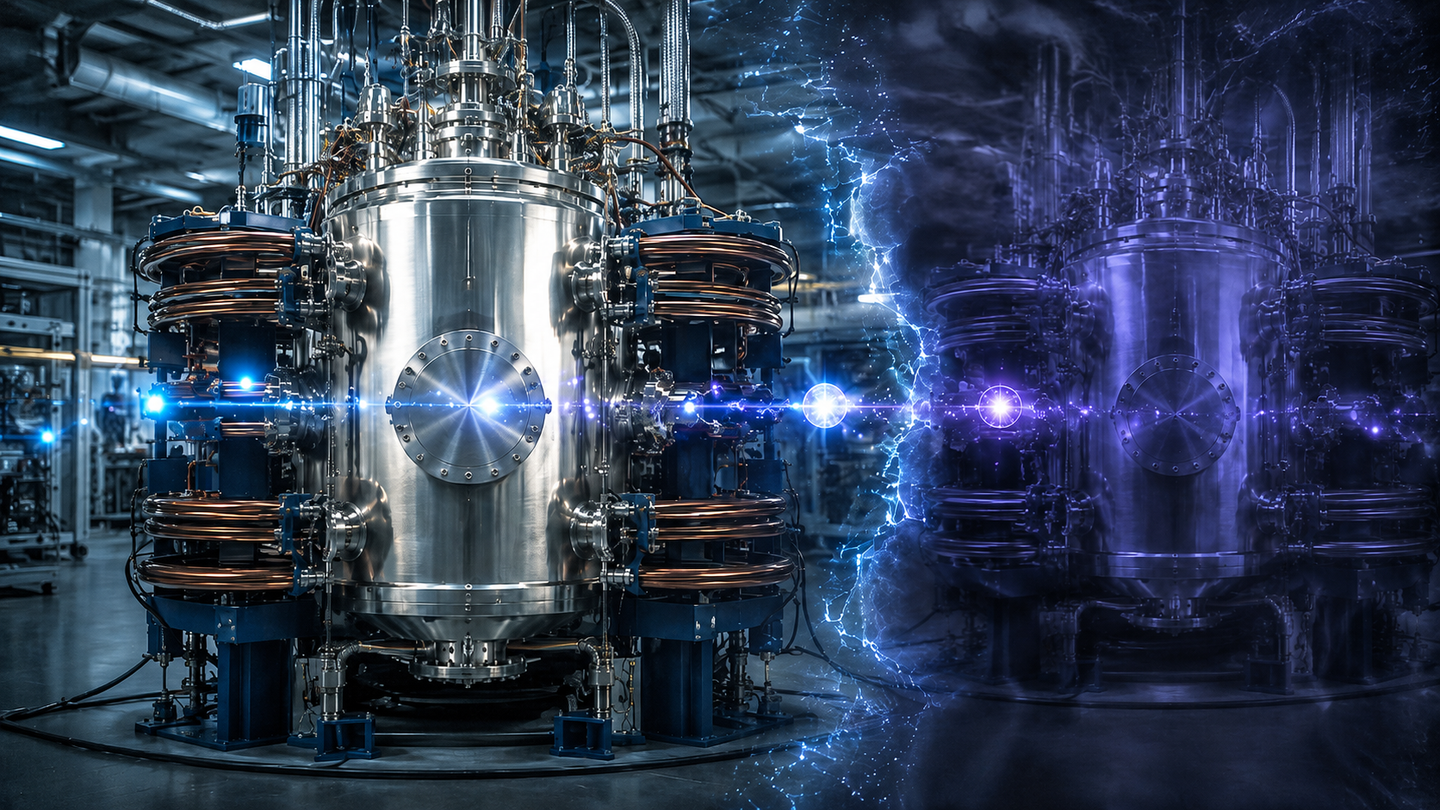
A mirror neutron experiment involving 25 billion particles rules out earlier signals across nearly all tested field directions. (CREDIT: Wikimedia / AI-Generated / CC BY-SA 4.0)
- A high-precision experiment found no evidence that neutrons can transform into mirror versions and disappear into a parallel particle world.
- Researchers tested about 25 billion ultracold neutrons while carefully changing magnetic fields that could influence the proposed transformation.
- The result rules out earlier mirror-neutron signals across 99.98 percent of possible field directions, although it cannot disprove every form of mirror matter.
A mirror copy of the particle world could exist beside ordinary matter, yet one of the most precise neutron experiments ever attempted has found no sign that neutrons slip into it.
Theoretical physicists have proposed a parallel sector containing mirror electrons, protons, neutrons, and counterparts to every known elementary particle. These particles would be nearly invisible because they would not respond to the standard forces governing ordinary matter.
“Essentially, the two types of particle sense each other’s presence through the force of gravity,” says Geza Zsigmond, a researcher at the PSI Center for Neutron and Muon Sciences.
That weak connection makes mirror matter difficult to detect. It also makes the idea relevant to dark matter, the unknown substance that accounts for far more mass in the universe than visible matter. Mirror particles could fit that role because they would barely interact with atoms, light, or detectors.
A neutron that vanishes and returns
Gravity alone cannot provide a practical laboratory test. Instead, physicists have focused on a second possibility: neutral particles might rarely switch between ordinary and mirror forms.
“There is no way of proving the existence of mirror particles using gravitational interaction alone,” says Bernhard Lauss, leader of the research group for ultracold neutron physics at the PSI Center for Neutron and Muon Sciences. “Because of this, we focused on the other property of mirror particles, namely that, based on this hypothesis, neutral particles might oscillate to and fro between our normal matter world and the mirror world.”
A neutron could briefly become a mirror neutron and vanish from ordinary matter. It might later change back and reappear.
“Neutrons are ideal for this experiment because, firstly, they are electrically neutral and, secondly, they possess a strange property,” Zsigmond says. “Neutrons appear to have different lifetimes, depending on how this is measured.”
Some physicists have suggested that the neutron lifetime discrepancy could partly reflect neutrons disappearing into a mirror sector. Earlier ultracold-neutron experiments also produced anomalies, including reported deviations of 3 sigma, 5.2 sigma, and 2.5 sigma from the expectation of no oscillation.
Billions of neutrons inside a steel tank
PSI researchers worked with colleagues from ETH Zurich and Jagiellonian University in Kraków. They used ultracold neutrons produced at PSI’s high-intensity proton accelerator.
The neutrons entered an evacuated stainless-steel vessel about 1 meter high, with a volume of 1.5 cubic meters. Eight large coils surrounded the tank and generated carefully controlled magnetic fields. A detector counted the particles after storage.
Each cycle began when a proton pulse struck the source target. Neutrons filled the vessel for 48 seconds, remained stored for 180 seconds, and were then released and counted for 95 seconds. The team alternated the magnetic field’s direction from one cycle to the next.
The field mattered because any transition would depend strongly on the strength and direction of ordinary and mirror magnetic fields. The team scanned ordinary fields from more than 5 to 109 microteslas.
Researchers also mapped the field inside the vessel and monitored disturbances around it. Nearby superconducting magnets sometimes changed local conditions by several tens of microteslas. Data collected during poorly controlled periods were rejected.
No asymmetry appeared in the counts
A mirror neutron would not interact with the vessel walls. It would escape and appear as an unexplained loss. The team looked for differences in counts when the magnetic field pointed in opposite directions.
Every five minutes, the experiment stored about 1.5 million neutrons. After roughly 200 seconds, the tank was emptied and the survivors were counted. Repeating the process over several months produced measurements involving about 25 billion neutrons.
“Over time, we gradually varied the strength and direction of the magnetic field so as to scan all the relevant regions in which one might expect oscillations between neutrons and mirror neutrons to occur,” Lauss says. “But we saw no evidence at all of such oscillations.”
The differences between opposite field directions matched random variation around zero. After accounting for the many field settings tested, the results still excluded oscillations at a 95 percent confidence level across the tested settings.
The analysis combined neutron counts with Monte Carlo simulations that modeled particle paths, wall collisions, magnetic-field variations, and possible oscillations. This allowed the team to test different mirror-field strengths and almost every possible direction.
Earlier anomalies lose nearly all their room
The experiment covered mirror magnetic fields from 1 to 100 microteslas. Within that range, it excluded the earlier anomaly signals at a 95 percent confidence level across 99.98 percent of all possible mirror-field directions.
A tiny region remained where the apparatus had its lowest sensitivity. That region represents less than 0.02 percent of the full directional space and lies extremely close to one field orientation.
The result does not prove that no mirror world exists. It rules out the specific neutron oscillations proposed to explain earlier anomalies across nearly all the tested parameter space.
The PSI experiment is now the most sensitive storage test of its kind. Major improvements would require a far more elaborate setup. The project also supported two doctoral theses completed with ETH Zurich and involved many students.
“We are also proud that many young people were able to participate in this experiment,” Lauss says.
Practical implications of the research
The strongest impact is not a new particle detection, but a tighter boundary around where mirror-neutron physics can still hide. The result removes nearly all the parameter space that supported earlier anomaly claims and weakens the case that missing neutrons explain the neutron lifetime discrepancy.
It also gives theoretical physicists a clearer target. Models involving mirror matter must now avoid the field strengths, directions, and oscillation times ruled out by the experiment, or propose effects this method could not test.
“By restricting the scope for certain speculations, we are showing researchers in theoretical physics that they need to explore new avenues,” Zsigmond says. “Physics needs that kind of impetus if it is to continue to evolve.”
Research findings are available online in the journal Physical Review Letters.
The original story "Researchers analyze 25 billion neutrons and find that they don’t disappear into a mirror world" is published in The Brighter Side of News.
Related Stories
- First-of-its-kind achromatic neutron lens brings the world into sharper focus
- Physicists capture historic first look at the internal structure of a neutron
- The astonishing amount of energy locked inside ordinary matter
Like these kind of feel good stories? Get The Brighter Side of News' newsletter.
Joshua Shavit
Writer and Editor
Joshua Shavit is a NorCal-based science and technology writer with a passion for exploring the breakthroughs shaping the future. As a co-founder of The Brighter Side of News, he focuses on positive and transformative advancements in technology, physics, engineering, robotics, and astronomy. Having published articles on AOL.com, MSN, Yahoo News, and Ground News, Joshua's work highlights the innovators behind the ideas, bringing readers closer to the people driving progress.