Powerful black hole pushes quasar’s winds across 300,000 light-years
XRISM detected violent gas motion around a distant quasar, revealing a black hole’s influence far beyond its host galaxy.

 Edited By: Joshua Shavit

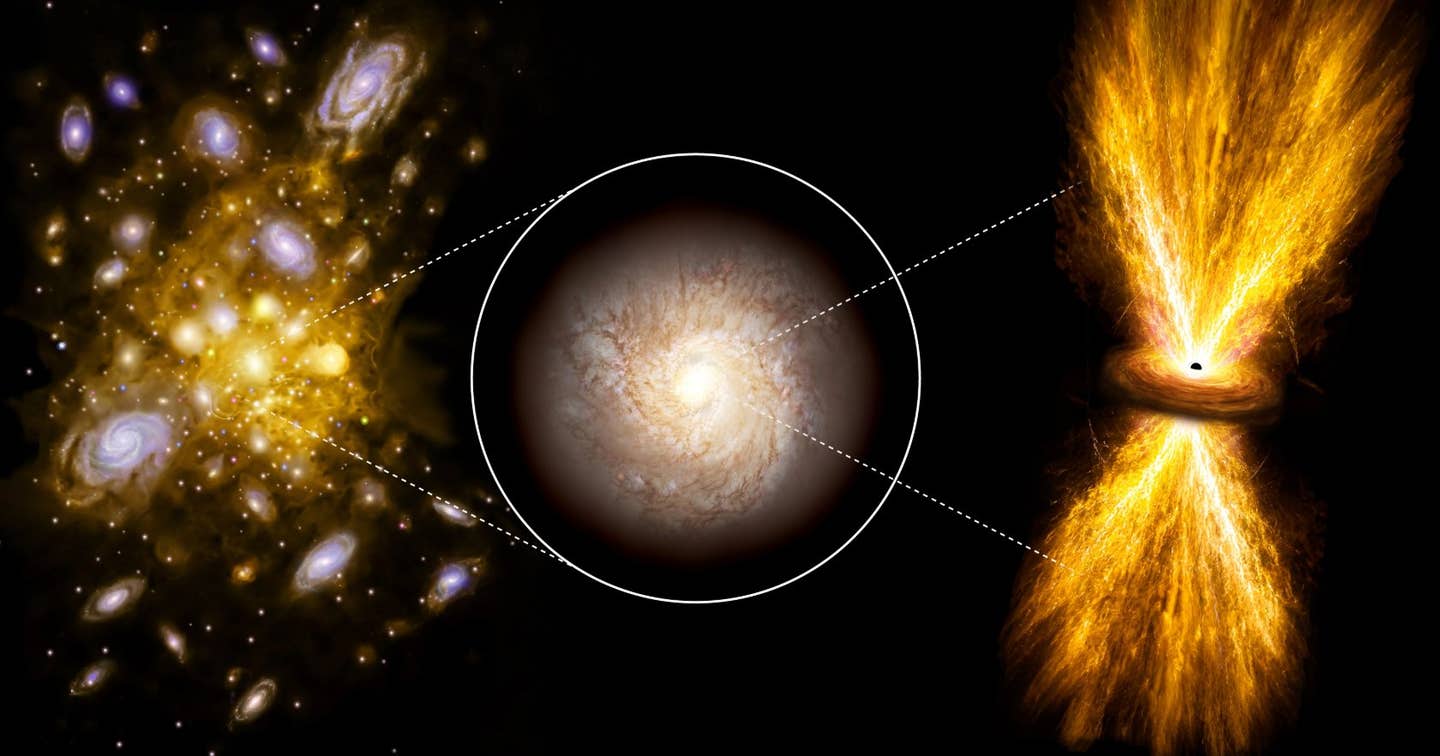
Schematic illustration of the hierarchical structure of the Universe, from a galaxy group (a collection of galaxies) to an individual galaxy and the supermassive black hole at its center. (CREDIT: Tohoku University)
- A quasar 3.4 billion light-years away is stirring hot gas across roughly 300,000 light-years, far beyond the galaxy that contains it.
- XRISM detected unusually fast gas motions carrying about 100 times more energy than earlier estimates for similar black-hole winds.
- The observations may help astronomers improve models of how black holes influence galaxy clusters, though turbulence, gas flows and sloshing remain difficult to separate.
A quasar 3.4 billion light-years away is stirring hot gas far beyond its home galaxy, sending energy through a region 300,000 light-years wide. The disturbance is forcing astronomers to rethink how far black-hole winds can reach.
The source is H1821+643, a bright quasar in the constellation Draco. At its center sits a supermassive black hole about 2.6 billion times the mass of the sun. It shines far more powerfully than most nearby quasars despite weak radio jets.
“Black holes are largely known for sucking matter in, but they also eject gas in the form of powerful winds,” said Satoshi Yamada, an assistant professor at Tohoku University’s Frontier Institute for Interdisciplinary Sciences. “These winds were thought to be contained within the galaxy, but our study revealed that the force is immensely more powerful than previously understood.”
Published in Nature Astronomy, the results came from the X-Ray Imaging and Spectroscopy Mission, or XRISM. Yamada worked with colleagues from Tohoku University, Kanazawa University, Tokyo Metropolitan University and other institutions.
Iron lines reveal violent motion
XRISM observed H1821+643 for 283.7 kiloseconds between Sept. 4 and Sept. 10, 2024. Its Resolve instrument measured X-rays from the hot intracluster medium, the thin plasma filling the space between galaxies in a cluster.
Resolve can separate X-ray energies with exceptional precision. That allowed the team to examine iron emission lines and measure the surrounding gas.
The iron lines were much broader than those seen in the Perseus cluster, where gas motions are more moderate. After accounting for possible resonance scattering, the team measured a line-of-sight velocity dispersion of about 280 kilometers per second. Without that correction, the estimate was about 300 kilometers per second.
Nearby cluster cores observed by XRISM and Hitomi generally show dispersions of 160 kilometers per second or less. In Perseus, the measured value is about 164 kilometers per second.
The gas also showed little net motion toward or away from Earth. Its bulk velocity was only 51 kilometers per second, with an uncertainty of 46 kilometers per second. That combination points to vigorous turbulence, velocity shear or several overlapping flows.
The disturbance extends beyond the galaxy
The broad iron emission came mainly from gas 20 to 100 kiloparsecs from the quasar, or roughly 65,000 to 326,000 light-years. More than 90 percent of the measured iron-line flux originated in that zone.
The innermost region, within about 18 kiloparsecs, contributed little to those iron lines. That helped rule out major contamination from gas immediately surrounding the quasar.
The energy tied to the gas motions was about 100 times larger than earlier estimates for comparable quasar-driven winds. It was equivalent to the energy released by several billion supernova explosions.
“For the first time, we have shown that black holes influence the broader cosmic environment through a shock wave of astonishing power,” Yamada said. “Black holes are key drivers of gas flows and motion in space, transporting vast amounts of energy to different regions of the cosmos.”
The disturbance appears too energetic to come from the quasar’s weak jets alone. Mechanical energy linked to X-ray cavities from those jets is estimated at 3 × 10^59 ergs. The non-thermal energy associated with the gas motions is about an order of magnitude larger.
A weak shock may leave a strong imprint
The team argues that quasar-driven winds offer a plausible explanation. As the winds expand, they may push a shock wave through plasma heated to about 6 kiloelectronvolts. The sound speed in that gas is roughly 1,260 kilometers per second.
Because the plasma is extremely hot, the shock would probably weaken quickly. A faint shock front beyond 100 kiloparsecs could also escape detection in existing Chandra images. Simulations suggest that weak shocks with Mach numbers near 1.1 would have very low surface brightness.
XRISM did not measure the shock speed itself. Instead, it recorded the velocity dispersion of gas behind the possible shock.
Within 20 to 100 kiloparsecs, the intracluster gas has an estimated mass of about 1.6 trillion suns. Stirring such a large reservoir requires enormous energy.
If the shock reaches about 100 kiloparsecs, the thermal energy enclosed within it would be about 4 × 10^61 ergs. The central black hole could, in principle, supply that amount. The researchers estimated a feedback efficiency of at least 1 percent and possibly 10 percent or more, depending heavily on the assumed shock radius.
Those values exceed previous estimates of 0.01 percent or less for similar-scale ionized winds in other quasars. They also broadly match the energy ranges used in major cosmological simulations, though the comparison remains qualitative.
Other explanations remain possible
The team could not fully separate turbulence from velocity shear, radial winds or sloshing within the cluster gas. Chandra images show a cold front and other asymmetries that may indicate sloshing.
Still, reproducing a dispersion near 300 kilometers per second through sloshing alone would require several gas components spread across about 600 kilometers per second. The authors consider such a symmetric arrangement unlikely, especially because the overall bulk velocity remains close to zero.
A radio halo extending about 1.1 megaparsecs surrounds H1821+643. Minor mergers may have produced that halo, but those events may be unrelated to the violent motion near the quasar.
The system is also unusual. Simulations often predict that jets dominate the heating of massive cluster cores at low redshift. H1821+643 instead appears shaped by radiative winds and expanding bubbles from a luminous black hole.
Practical implications of the research
The observations let astronomers test how quasars transfer energy into hot gas around galaxy clusters. That process influences how gas moves, cools and circulates across large cosmic regions.
Future XRISM observations could show whether similar winds surround other bright quasars. They may also clarify how matter and chemical elements travel through clusters and into the wider intergalactic environment.
H1821+643 offers a rare nearby example of quasar activity thought to have been more common earlier in cosmic history. Measuring its reach may improve models of galaxy growth, cluster heating and black-hole feedback.
Research findings are available online in the journal Nature Astronomy.
The original story "Powerful black hole pushes quasar's winds across 300,000 light-years" is published in The Brighter Side of News.
Related Stories
- The surprising link between quasars, black holes and the universe's cosmic dawn
- Black Hole “ringing” could put Einstein’s theory to its toughest test
- Strange gravitational waves may reveal dark matter near merging black holes
Like these kind of feel good stories? Get The Brighter Side of News' newsletter.
Joseph Shavit
Writer, Editor-At-Large and Publisher
Joseph Shavit, based in Los Angeles, is a seasoned science journalist, editor and co-founder of The Brighter Side of News, where he transforms complex discoveries into clear, engaging stories for general readers. With vast experience at major media companies like The Los Angeles Times, Times Mirror and Tribune Publishing, he writes with both authority and curiosity. His writing focuses on space science, planetary science, quantum mechanics, geology. Known for linking breakthroughs to real-world markets, he highlights how research transitions into products and industries that shape daily life.