Ancient fossil may reveal first-ever ‘right-handedness’ in the animal kingdom
A strange Ediacaran fossil may reveal the earliest known sign of handedness in the animal kingdom.

 Edited By: Joseph Shavit

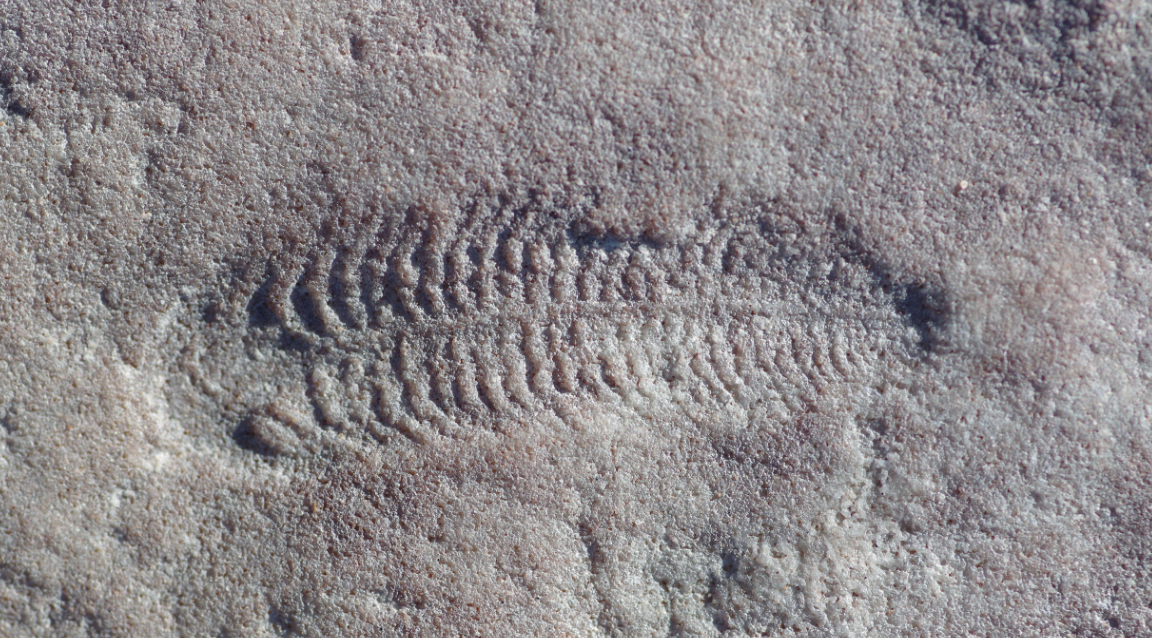
Fossils of Spriggina floundersi from South Australia. Because the fossils preserve mirror-image impressions of the animals, a leftward bend in the rock indicates the animal turned right in life. (CREDIT: Scott Evans / AMNH)
Spriggina floundersi was only a few centimeters long and lived on the seafloor of what is now South Australia. It had no hands or feet, yet its fossils reveal a surprisingly familiar trait: a preference for turning right.
A study published in Scientific Reports suggests this may be the oldest known evidence of population-wide handedness in animals. Spriggina lived about 550 million years ago during the Ediacaran Period, long before the Cambrian explosion transformed marine life.
Researchers examined more than 100 fossils from Nilpena Ediacara National Park and the South Australia Museum in Adelaide. Many specimens were curved, with bends in one direction appearing about twice as often as bends in the other.
Because the fossils preserve mirror images of the original animals, a leftward curve in the rock indicates the animal bent to the right while alive.
“When we talk about being right-or-left-handed, most people likely think about how they hold a pencil or kick a soccer ball,” said lead author Scott Evans, assistant curator of invertebrate paleontology at the American Museum of Natural History. “But our research shows that an animal without hands or feet, living over 500 million years ago, may have had its own version of handedness.”
A crooked body, but not by chance
Spriggina is one of the better-known members of the Ediacara biota, a collection of enigmatic early macroscopic organisms preserved in rocks dating from about 635 million to 538 million years ago. These fossils record a turning point in life on Earth, when multicellular organisms became larger, more complex, and in some cases capable of moving across or above the seafloor.
The team examined 75 fossils from the Ediacara Member and additional material from museum collections. About 70 percent of the specimens were bent along the body axis. The bend angles ranged from 5 degrees to 81 degrees, and the preference for one direction was statistically significant, with a reported p-value of 0.0017.
That mattered because the researchers were testing a basic question: did Spriggina actively move and manipulate its body, or were its odd shapes simply the result of outside forces such as currents?
The study argues for active movement. On individual fossil beds, neighboring specimens showed different body orientations and different bend directions. Some even bent in multiple places. If water flow alone had twisted the bodies, the team reasoned, nearby fossils should have lined up more consistently.
The same bedding planes also failed to show a match between Spriggina’s bends and other signs of current direction. That weakened the case for passive distortion and strengthened the idea that each animal was changing shape on its own.
What a right turn can say about an ancient body
Spriggina’s body was elongated, with a broader undivided front region and a narrower rear. Repeated units ran off a central midline, giving it a segmented look, though the study stops short of claiming clear membership in any modern animal group.
The fossils also preserve irregular outer margins and occasional missing sections, features the authors interpret as parts of the body lifting off the seafloor during life rather than being ripped away after death. They suggest the organism could bend laterally, raise part of its front end, and move portions of its body margin in a coordinated way.
Together, those motions paint a more animated picture of an organism long known mostly as a flattened imprint in stone.
“It’s a reminder that some of the traits we take for granted today have incredibly ancient origins,” said coauthor Mary Droser, a paleontologist at the University of California, Riverside.
Right-handed in the human sense
The new work does not claim Spriggina was right-handed in the human sense. Instead, it points to behavioral lateralization, a population-level bias in movement. Similar turning preferences occur in living animals, from insects to birds to mammals. In modern species, such biases are often tied to nervous system asymmetry or other forms of biological organization.
That is one reason the finding matters. If the pattern in Spriggina truly reflects behavior rather than anatomy or preservation, it hints that some early animals already had nervous systems capable of coordinated, asymmetric activity.
“We know that living animals with this sort of handedness, from insects to octopi to birds and mammals, have complex sensory abilities,” Evans said. “So this may be telling us that the nervous system of Spriggina was relatively complex and more similar to those of animals that we know today.”
A fossil that keeps resisting easy labels
Spriggina has long been difficult to classify. Over the years, researchers have compared it to annelids, arthropods, flatworms, and other bilaterian animals, while others have urged caution. This study does not settle that debate. It does, however, argue that the creature was a free-living, actively motile organism rather than a sessile form anchored to the seafloor.
The authors also suggest that its repeated body units may represent an early form of segmentation, which, if confirmed, would push that trait very deep into animal history. Even so, they note that not every specimen preserves the needed detail, and they avoid drawing stronger taxonomic conclusions than the fossils can support.
What emerges instead is a portrait of a seafloor animal that may have crawled or glided in ways not entirely unlike some modern marine worms or flat-bodied invertebrates. It may have been benthic, living mainly on the seafloor, or nektobenthic, occasionally lifting off it. Its feeding style remains unclear because, unlike some Ediacaran organisms, it left no obvious trace fossils showing how it interacted with the microbial mats beneath it.
That uncertainty is part of the story. Spriggina still sits in a murky zone between the strange Ediacaran world and the animal-dominated ecosystems that followed.
Practical implications of the research
The study pushes a familiar biological pattern, left-right behavioral bias, much farther back in time than previously documented.
It suggests that coordinated movement, body control, and perhaps relatively advanced sensory or nervous-system organization were already emerging in animals before the Cambrian explosion.
It also gives paleontologists a new way to probe the lives of mysterious fossil organisms: not just by what they looked like, but by whether repeated body shapes across populations preserve traces of behavior.
Research findings are available online in the journal Scientific Reports.
The original story "Ancient fossil may reveal first-ever 'right-handedness' in the animal kingdom" is published in The Brighter Side of News.
Related Stories
- The strange reason nearly all humans are right-handed
- Scientists solve the evolutionary mystery of how humans came to walk upright
- New study finds your dominant hand may not be set at birth
Like these kind of feel good stories? Get The Brighter Side of News' newsletter.
Joshua Shavit
Writer and Editor
Joshua Shavit is a NorCal-based science and technology writer with a passion for exploring the breakthroughs shaping the future. As a co-founder of The Brighter Side of News, he focuses on positive and transformative advancements in technology, physics, engineering, robotics, and astronomy. Having published articles on AOL.com, MSN, Yahoo News, and Ground News, Joshua's work highlights the innovators behind the ideas, bringing readers closer to the people driving progress.