8-year-old’s backyard discovery upends a century of plant-insect science
Ants carry oak galls much like seeds, and the finding may reshape a classic idea about plant-insect evolution.

 Edited By: Joseph Shavit

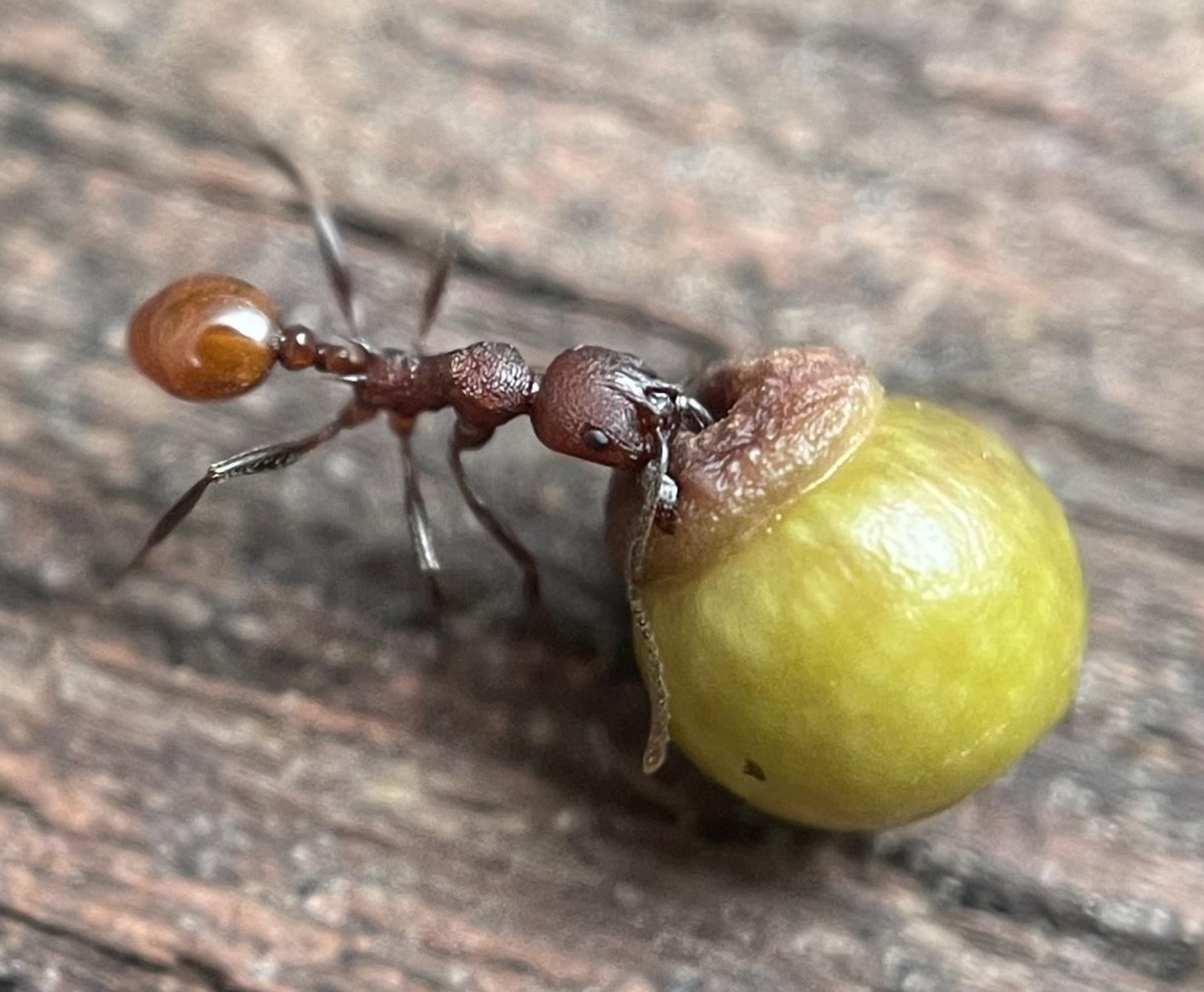
An ant holds an oak gall containing wasp larvae. Researchers discovered an elaborate relationship among ants, wasps and oak trees. (CREDIT: Andrew Deans, Penn State)
What looked like a few seeds beside an ant nest in a backyard turned out to be something stranger, and far more consequential.
When 8-year-old Hugo Deans spotted several BB-sized objects under a log near an ant nest, he assumed the ants had gathered seeds. His father, Penn State entomologist Andrew Deans, recognized them as oak galls, the small plant growths made when certain wasps trigger an oak tree to build a protective structure around their larvae. That much fit with established biology. What did not fit was why ants were hauling them around.
That question led researchers to a layered ecological story involving oak trees, gall wasps and ants, one that may force a rethink of a classic example from biology textbooks.
“For myrmecochory, ants get a little bit of nutrition when they eat the elaiosomes, and the plants get their seeds dispersed to an enemy-free space,” Deans said, referring to the well-known process in which ants carry seeds fitted with edible appendages. “The phenomenon was first documented over 100 years ago and is commonly taught to biology students as an example of a plant-insect interaction.”
A familiar lesson starts to wobble
In the standard version of that lesson, some plants, including bloodroot, produce seeds with fleshy attachments called elaiosomes. Ants carry those seeds back to their nests, eat the nutrient-rich appendage, and leave the seed intact. The plant gets dispersal. The ants get food.
The new research points to a similar system involving not seeds, but galls made by cynipid wasps on oak leaves. According to the team, two gall wasp species, Kokkocynips rileyi and Kokkocynips decidua, induce oak trees to produce galls topped by a fleshy cap. The researchers named that cap kapéllo, Greek for “cap.”
The implication is unusual. These are not plant seeds enticing ants directly. Instead, the wasps appear to be manipulating oaks into making a structure that then lures ants into carrying the gall, and the wasp larva inside it, back to the nest.
“Ultimately, this led us to discover that gall wasps are manipulating oaks to produce galls, and then taking another step and manipulating ants to retrieve the galls to their nests, where the wasp larvae may be protected from gall predators or receive other benefits,” Deans said. “This multi-layered interaction is mind blowing; it’s almost hard to wrap your mind around it.”
The findings were published in American Naturalist.
What the ants actually did
To test what was going on, the researchers ran field and lab experiments in central Pennsylvania and Western New York, focusing on Aphaenogaster ants, an abundant group in eastern deciduous forests and one already known as an effective seed disperser.
In the wild, they watched ants carry the oak galls to their nests. Inside those nests, the galls stayed intact, but the fleshy caps were gone.
That missing cap mattered.
In field bait stations, ants removed the same number of oak galls as bloodroot seeds, suggesting the galls were just as attractive as a classic ant-dispersed seed. In the lab, ants showed similar interest in both. When they interacted with the galls, they focused on the kapéllo 64% of the time. With seeds, they focused on the elaiosome 42% of the time.
Then came the cleaner test. The team offered ants several choices: whole galls, gall bodies with the kapéllo removed, kapéllos by themselves, and control galls from another species that lacked any edible appendage. Ants showed little interest in the kapéllo-free galls or the control galls. Their interest rose sharply when the kapéllo was present, and the caps by themselves were attractive too.
“We showed that galls with caps were far more attractive to ants than galls without caps and that the caps by themselves were also attractive to the ants,” said John Tooker, a Penn State professor of entomology. “This suggested that the caps must have evolved as a way to entice ants.”
The chemistry looked familiar
The next question was why.
The answer, at least in part, seems to lie in fats. Elaiosomes are known to contain fatty acids that attract ants. When the team compared the chemistry of kapéllos to the chemistry of elaiosomes from two ant-dispersed plant species, they found overlap. Both contained notable amounts of lauric, palmitic, oleic and stearic acids. The latter three are already known to play a role in ant attraction.
Tooker offered a blunt explanation for why that chemical similarity may matter.
“The fatty acids that are abundant in gall caps and eliosomes seem to be mimicking dead insects,” he said. “Ants are scavengers that are out trying to find and grab anything that’s suitable to bring back to their colony, so it’s not an accident that the gall caps and the elaiosomes both have fatty acids typical of dead insects.”
Microscopic sections added another parallel. The boundary between the cap and the rest of the gall became heavily lignified as the gall matured, a structural split that resembles the separation between an elaiosome and a seed.
So the resemblance is not just behavioral. It is chemical and anatomical as well.
A bigger evolutionary question
That raised the most provocative issue in the study: which interaction came first?
It is easy to assume ant-mediated seed dispersal came first because it has been described since 1906 and taught for generations. But Robert J. Warren II of SUNY Buffalo State argued that the better-known system may not be the older one.
“Given that myrmecochory was described more than a century ago and has been well-researched and taught in schools, one might assume that the elaiosome interaction came first, but that assumption may be wrong for several reasons,” Warren said.
One reason is abundance. Myrmecochorous plants make up only about 4.5% of plant species. Oak galls, by contrast, can be extremely common. Warren pointed to historical accounts describing K. decidua galls as so plentiful they were called “black oak wheat” and used to fatten livestock.
“If these galls were so abundant and evolved this tactic of growing this cap thousands of years ago, that could have been a strong driver of natural selection in ants,” Warren said. “It could be that ants were long used to picking up galls with caps, and then when spring wildflowers began to produce seeds that happened to have an edible appendage, ants were already predisposed to picking up things with a fatty acid appendage.”
That idea remains unresolved. Deans said the team has received funding for phylogenetic work to examine the order of events more closely.
What the study still does not settle
The work leaves several important questions open.
The researchers argue that carrying galls into ant nests may protect the larvae from predators, parasitoids or pathogens, but they did not directly show that ant nests serve as a safe harbor. They also note that ants often remove edible appendages from seeds and later move the seeds back out of the nest, so any protection for galls may be temporary. Seasonal timing complicates things further, since these galls become available in autumn, when ant colonies are slowing down before winter.
Direct observations of adult wasps emerging from active ant nests are also lacking.
Still, the pattern itself appears robust: ants retrieve the galls, target the cap, leave the gall body intact and respond to the same kind of fatty acids that make seed appendages attractive.
That is a lot to reconsider from one backyard observation.
Hugo, now 10, still sounds startled by where it led.
“I bet other kids have made similar discoveries but never knew how important they might be,” he said. “I feel really happy and proud to know I was part of an important scientific discovery. It’s weird to think just some ants collecting what I thought were seeds was actually an important scientific breakthrough.”
Practical implications of the research
The study broadens a classic ecological concept by suggesting that ant-mediated transport is not just a plant strategy. In this case, an insect may be using a plant-built structure to tap into the same ant behavior.
That could push scientists to revisit how often ants move non-seed objects for similar reasons and whether those interactions shaped the evolution of seed dispersal itself.
It also points to a more tangled view of forests, where a single small object on the ground can carry the influence of a tree, an insect larva and an ant colony all at once.
Research findings are available online in the University of Chicago Press Journals.
The original story "8-year-old's backyard discovery upends a century of plant-insect science" is published in The Brighter Side of News.
Related Stories
- Why don't giant prehistoric insects still exist?
- Scientists reveal the staggering number of insects flying in the sky above the US
- Scientist discovers seven never-before-seen species of a distinctive frog-like insect
Like these kind of feel good stories? Get The Brighter Side of News' newsletter.
Joshua Shavit
Writer and Editor
Joshua Shavit is a NorCal-based science and technology writer with a passion for exploring the breakthroughs shaping the future. As a co-founder of The Brighter Side of News, he focuses on positive and transformative advancements in technology, physics, engineering, robotics, and astronomy. Having published articles on AOL.com, MSN, Yahoo News, and Ground News, Joshua's work highlights the innovators behind the ideas, bringing readers closer to the people driving progress.