Strange atmosphere detected on small icy world beyond Pluto
A rare stellar occultation hints that tiny trans-Neptunian object 2002 XV93 may carry a short-lived atmosphere.

 Edited By: Joshua Shavit

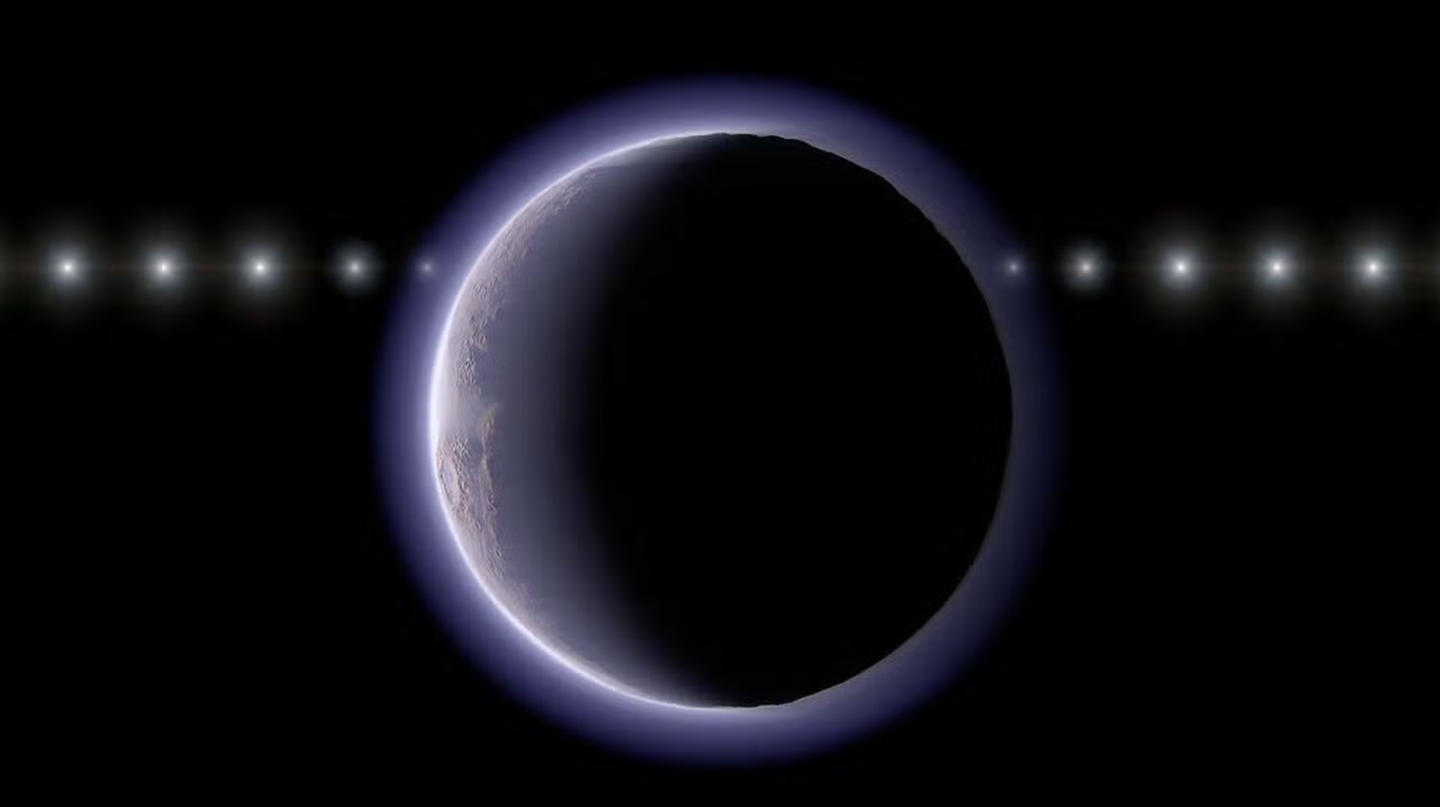
Artist’s conception of this research showing an imagined time sequence as a star passes behind a TNO with an atmosphere. (CREDIT: NAOJ)
A star blinked in a strange way over Japan last January, and that flicker may have exposed something the outer Solar System was not supposed to have.
A small icy body called 2002 XV93 passed in front of a distant star on January 10, 2024. For a moment, the star’s light dimmed as expected. But at two observing sites, the light did not simply switch off at the object’s edge. It faded more gradually, the kind of signal astronomers would expect if the starlight had first passed through a thin atmosphere.
That is the surprising claim from an observing campaign led by Ko Arimatsu at the National Astronomical Observatory of Japan’s Ishigakijima Astronomical Observatory. If the interpretation holds up, 2002 XV93 would join a very short list of outer Solar System bodies known to carry even a whisper of gas around them.
It would also raise a harder question. How does an object this small manage it at all?
2002 XV93 is a trans-Neptunian object, one of the frozen worlds that orbit beyond Neptune. More specifically, it is a plutino, meaning it shares a 2:3 orbital resonance with Neptune and circles the Sun on a path similar in size to Pluto’s. But the resemblance mostly ends there. Pluto spans 2,377 kilometers. The new object measures only about 500 kilometers across, with a mean radius near 275 kilometers.
That matters because small worlds have weak gravity. In the deep cold of the Kuiper Belt, scientists expect only the most volatile ices, such as methane, nitrogen, and carbon monoxide, to feed an atmosphere. On a body the size of 2002 XV93, those gases should escape too quickly for any long-term atmosphere to survive.
A lucky alignment over Japan
The evidence came from a stellar occultation, one of planetary astronomy’s most useful tricks. When a distant object passes in front of a background star, observers can measure exactly how the starlight changes. A solid, airless body should make the star wink out sharply. A body wrapped in gas can bend and dim the light before the full occultation begins.
Arimatsu’s team organized observations at four stations along the predicted shadow path as part of the TABASCO campaign, short for Trans-Neptunian Atmospheres and Belts Analysis through Stellar-occultation Coordinated Observations. Three sites collected usable data: Kyoto, Kiso, and Fukushima. The Kyoto station used a portable 20-centimeter telescope, Kiso used a 1.05-meter Schmidt telescope with a Tomo-e Gozen CMOS camera module, and Fukushima relied on a 25-centimeter telescope run by a citizen astronomer.
Two of those stations, Kyoto and Kiso, captured positive occultation chords, which allowed the team to estimate the body’s apparent radius at about 235 kilometers from the shadow geometry. The more intriguing result came from the light curves themselves, especially at Kiso.
There, the starlight dimmed gradually at both ingress and egress, each event lasting about 1.5 seconds. The authors argue that neither diffraction nor the finite size of the occulted star can explain such a long transition. At Fukushima, observers did not see a sharp drop from the main body, but they did record a possible gradual dimming lasting about 10 seconds at roughly 4.0 sigma significance near the time of closest approach.
That pattern did not look like a routine occultation by a bare rock-and-ice world.
Why dust and rings do not fully fit
The team considered another explanation first. Occultation light curves can show odd dips when rings or other material orbit a body. That has happened before around some small outer Solar System objects.
But fitting both the Kiso and Fukushima signals with dust or ring material would require matter packed into a very narrow zone only a few tens of kilometers above the surface, with notable opacity. According to the analysis, that would be unusually extreme compared with the ring systems already known around Centaurs and trans-Neptunian objects, which sit several body radii away.
The geometry also works against such a structure. Around an aspherical body, the innermost region can be rapidly cleared by uneven gravity. The authors add that activity-driven dust shells are expected to favor bodies nearer a critical size where jet speeds match escape speed, and 2002 XV93 appears too large for that to be the simplest explanation.
So they turned to atmospheric modeling.
Using ray-tracing calculations, the researchers tested simplified atmospheres dominated by methane, nitrogen, or carbon monoxide. Each model reproduced the Kiso light curve far better than an atmosphere-free case. The best-fit surface pressures came out to 124 nanobars for a pure methane atmosphere, 177 nanobars for nitrogen-dominant gas, and 159 nanobars for carbon monoxide-dominant gas. In all three cases, the fits sharply improved over a no-atmosphere model.
Those pressures remain tiny, about 50 to 100 times lower than Pluto’s present surface pressure, but they are still remarkable. They are also far above previous upper limits reported for other trans-Neptunian objects.
An atmosphere that should not last
This is where the finding becomes more interesting than the detection itself.
Bodies in the temperature range of 40 to 50 kelvin can only sustain atmospheres if hypervolatile ices keep feeding them. Yet recent low-resolution observations with the James Webb Space Telescope showed no prominent absorption features from hypervolatile surface ices on 2002 XV93. That fits a picture in which most of those surface volatiles have already been lost.
The escape problem is severe. For an object with a radius near 250 kilometers and a Charon-like density, the analysis says methane, nitrogen, or carbon monoxide would leak away quickly. Even under the conservative case of purely thermal Jeans escape, an atmosphere with a pressure around 100 to 200 nanobars would survive only about 100 to 1,000 years unless something replenished it.
That makes a permanent atmosphere unlikely. It also means the gas, if real, must be recent.
Two main possibilities
The research points to two main possibilities. One is outgassing tied to cryovolcanic activity, where material from inside the body reaches the surface. The authors note that larger trans-Neptunian objects such as Sedna, Gonggong, and Quaoar have shown signs consistent with recent or ongoing geochemical evolution, and isotopic work on methane ice on Eris and Makemake has hinted that some surface methane may come from warm-interior processing.
Still, 2002 XV93 is small for that kind of long-lived activity. Its limited heat budget should favor a thick, cold outer shell. The study says cryovolcanic-like seepage might still occur under special conditions, such as unusual amounts of ammonia or methanol, or tidal forcing from a satellite that current occultation data could not firmly confirm or rule out.
The second possibility is a recent impact. A small Kuiper Belt or Oort Cloud object slamming into 2002 XV93 could release gas directly from the impactor or excavate buried volatiles from below the surface. The paper notes that a comet-like object a few hundred meters across could carry enough methane, nitrogen, or carbon monoxide to account for a global atmosphere on the scale inferred here.
That explanation has its own difficulty. Based on impact rates scaled from Pluto, the chance of a roughly 250-kilometer-radius TNO being struck by a projectile at least that size over 100 years is only about 10^-5, though the authors stress that estimate is uncertain by orders of magnitude.
Practical implications of the research
The finding suggests that the outer Solar System may be more active, and less settled, than simple size rules imply.
If 2002 XV93 truly has an atmosphere, then global gas envelopes are not limited to large planets, dwarf planets, and their big moons. Some smaller icy bodies may briefly acquire atmospheres through interior activity or chance collisions, then lose them on timescales short enough to make them hard to catch.
That makes repeat observations especially important. The team argues that a steady decline in pressure over the next few years would favor an impact origin. Persistent or seasonal changes would point more toward internal outgassing. James Webb spectroscopy could also help identify which molecules are present.
Just as important, this result grew out of a coordinated campaign involving both professionals and citizen astronomers using small telescopes and fast CMOS cameras. That means future monitoring does not depend on a single giant facility. It depends on catching the next shadow, at the right moment, with enough eyes on the sky.
Research findings are available online in the journal Nature Astronomy.
The original story "Unexpected atmosphere found on small icy world beyond Pluto" is published in The Brighter Side of News.
Related Stories
- 3I/ATLAS had a far colder birthplace than our Solar System
- In a dusty young solar system, two giant planets are taking shape
- Asteroid Ryugu fragments carry a magnetic record from the birth of the solar system
Like these kind of feel good stories? Get The Brighter Side of News' newsletter.
Joseph Shavit
Writer, Editor-At-Large and Publisher
Joseph Shavit, based in Los Angeles, is a seasoned science journalist, editor and co-founder of The Brighter Side of News, where he transforms complex discoveries into clear, engaging stories for general readers. With vast experience at major media companies like The Los Angeles Times, Times Mirror and Tribune Publishing, he writes with both authority and curiosity. His writing focuses on space science, planetary science, quantum mechanics, geology. Known for linking breakthroughs to real-world markets, he highlights how research transitions into products and industries that shape daily life.