A dead galaxy from the early universe is forcing astronomers to rethink galactic evolution
A massive galaxy seen just 1.8 billion years after the Big Bang already looks like a slow rotator from the modern universe.

 Edited By: Joshua Shavit

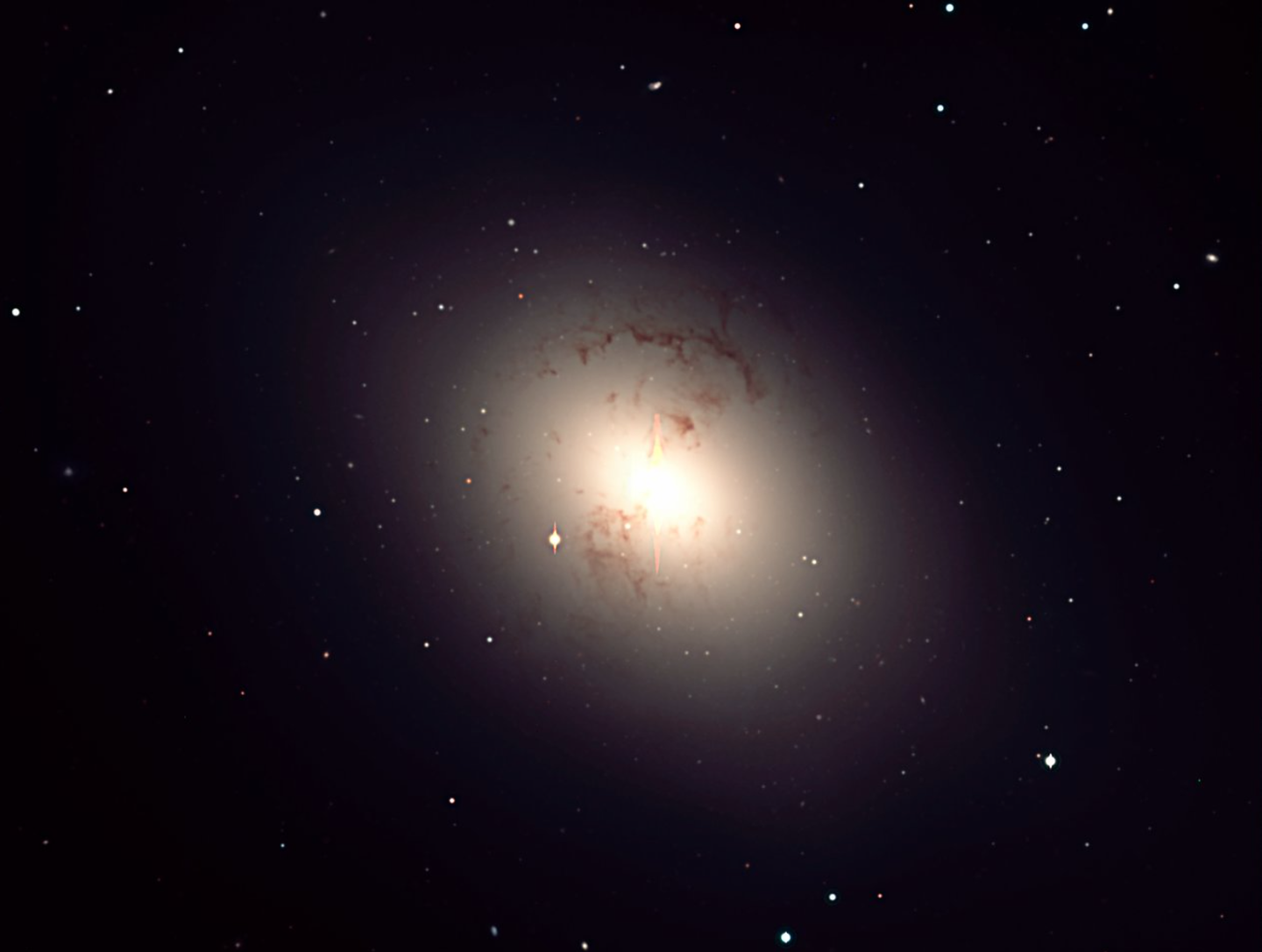
JWST found a massive early galaxy with almost no rotation, challenging standard ideas of how giant ellipticals form. Image is actually Giant elliptical galaxy NGC 1316 in Fornax Cluster, used for illustrative purposes only. (CREDIT: ESO)
Space tends to reward expectations. Young galaxies should spin. Gas falls in, gravity takes hold, angular momentum builds, and the whole system settles into motion. That is why one faraway object spotted by the James Webb Space Telescope stands out so sharply: despite its huge mass, it barely seems to rotate at all.
The galaxy, called XMM-VID1-2075, appears at a time when the universe was only 1.8 billion years old. Yet its behavior looks more like that of the giant, quiescent galaxies seen much closer to Earth, systems that spent billions of years colliding and reshaping themselves before losing much of their orderly spin.
“This one in particular did not show any evidence of rotation, which was surprising and very interesting,” said Ben Forrest, a research scientist in the Department of Physics and Astronomy at the University of California, Davis, and first author of the new study published in Nature Astronomy.
That makes XMM-VID1-2075 more than an oddball. It may be an early example of a “slow rotator,” a kind of massive galaxy supported less by coherent spinning motion and more by the random movement of its stars.
A galaxy that seems older than its age
Astronomers have long linked slow rotators to a drawn-out history. In the nearby universe, they are usually very massive, no longer forming stars, and often found in crowded environments such as galaxy clusters. The standard picture says they get that way through repeated mergers that chip away at angular momentum over vast stretches of time.
That is why this case is so striking. According to the new analysis, XMM-VID1-2075 had already reached that state when the cosmos was still young. The object had previously been identified through the MAGAZ3NE survey and confirmed with Keck/MOSFIRE observations as one of the early universe’s most massive galaxies, with several times as many stars as the Milky Way and a star formation rate below 1 solar mass per year.
“Previous MAGAZ3NE observations had confirmed this was one of the most massive galaxies in the early universe, with already several times as many stars as our Milky Way, and also confirmed that it was no longer forming new stars, making it a compelling target for follow-up observations,” Forrest said.
The new work pushed beyond simply weighing the galaxy or confirming that it had shut down star formation. Using JWST’s Near Infrared Spectrograph integral-field unit, the team could measure how material inside the galaxy moves across space.
“This type of work has been done a lot with nearby galaxies because they're closer and larger and so you can do these kinds of studies from the ground, but it's very difficult to do with high redshift galaxies because they appear a lot smaller in the sky,” Forrest said. “(James Webb Space Telescope) is really pushing the frontier for these kinds of studies.”
Looking inside the motion
The researchers observed XMM-VID1-2075 along with two other similarly old, massive, quenched galaxies at about the same redshift. The contrast was immediate. One galaxy clearly rotates. Another looked, in Forrest’s words, “kind of messy.” XMM-VID1-2075 was different from both. It showed little sign of ordered rotation and instead appeared dominated by random stellar motion.
The team found stellar velocity dispersions around 500 kilometers per second at the center, with velocity offsets in all measured regions staying below 100 kilometers per second. That lack of a clear velocity gradient matters. In a rotating system, astronomers expect one side to move toward us and the other away from us in a more organized way. Here, that pattern did not appear.
The galaxy’s structure added to the case. JWST imaging and modeling showed a compact object with a half-light radius of about 2 kiloparsecs and a Sérsic index of 3.72, consistent with an elliptical galaxy. Both the collapsed data cube and separate NIRCam imaging also showed low-surface-brightness asymmetries and extra light to the northeast of the center, features consistent with some kind of interaction or merger activity.
The data also hinted at an active galactic nucleus. Weak emission lines, including [N II] and [Ne III], suggest an AGN may sit in the core, although the lack of [O III] emission is unusual.
How do you stop a galaxy from spinning so soon?
That question sits at the center of the study. Existing models generally predict that pronounced slow rotators should be rare at redshifts above about 3 because galaxies at such early times should have had fewer mergers. Observations at high redshift have also tended to find massive galaxies with substantial rotational support, not systems like this one.
So the authors explored several possible paths.
One is a major merger between two galaxies with roughly opposite angular momentum. If two progenitors were spinning in nearly opposite directions, their motions could largely cancel out after collision, leaving behind a compact, quenched remnant with little net rotation. XMM-VID1-2075 does fit part of that picture. It has disturbed morphology, it has stopped making stars, and it may show a faint leftover feature from a past interaction.
“For this particular galaxy, we see a large excess of light off to the side. And so that's suggestive of some other object which has come in and is interacting with the system and potentially changing its dynamics,” Forrest said.
But that explanation has a catch. Such carefully anti-aligned mergers are not expected to be common, and the bright central galaxy outweighs the off-center structure by more than 10 to 1, making the interpretation uncertain.
Another possibility comes from simulations in which isotropic gas infall strips away rotation early, before or during a starburst, and feedback from an AGN or supernovae then helps quench the system. In the Magneticum simulation, 3 of 35 quiescent galaxies at z = 3.42 became slow rotators this way. Under that scenario, the apparent merger feature in XMM-VID1-2075 might be unrelated to the original kinematic transformation.
The more traditional route, repeated minor mergers, seems less convincing here. The object is so young and still so compact that the team argues it is hard to explain its state through enough minor mergers within the universe’s first 1.8 billion years.
What comes next
The study does not claim to have solved the galaxy’s past. It identifies a rare case and narrows the options. The authors note that deeper observations will be needed to study higher-order kinematic signatures, and larger samples will be needed to tell whether XMM-VID1-2075 is a freak event or part of a broader early population.
That is one of the paper’s clearest limitations. This is still a small sample, just three galaxies in the JWST program, and the formation pathway for XMM-VID1-2075 remains uncertain. The researchers cannot yet distinguish cleanly between a counterrotating major merger, early gas-driven transformation, or a more complicated sequence that includes later minor accretion.
Still, the result shifts the timeline.
“There are some simulations that predict that there will be a very small number of these non-rotating galaxies very early in the universe, but they expect them to be quite rare. And so this is one way in which we can test these simulations and really figure out how common they are, and that can then give us information about whether our theories of this evolution are correct,” Forrest said.
Practical implications of the research
This finding gives astronomers a new way to test how giant “dead” galaxies formed. If more early slow rotators turn up, theorists may need to give a bigger role to fast, efficient processes in the first few billion years of cosmic history.
That could reshape ideas about mergers, gas inflow, quenching, and the role of black holes in shutting galaxies down.
JWST now makes it possible to build the larger samples needed to find out whether XMM-VID1-2075 is a rare exception or evidence that some massive galaxies grew up much faster than expected.
Research findings are available online in the journal Nature Astronomy.
The original story "A dead galaxy from the early universe is forcing astronomers to rethink galactic evolution" is published in The Brighter Side of News.
Related Stories
- Astronomers discover interstellar processes that drive galactic evolution
- Scientists crack the mystery of galactic filaments and magnetic fields at the heart of the Milky Way
- JWST detected a supernova from the dawn of the universe
Like these kind of feel good stories? Get The Brighter Side of News' newsletter.
Joseph Shavit
Writer, Editor-At-Large and Publisher
Joseph Shavit, based in Los Angeles, is a seasoned science journalist, editor and co-founder of The Brighter Side of News, where he transforms complex discoveries into clear, engaging stories for general readers. With vast experience at major media companies like The Los Angeles Times, Times Mirror and Tribune Publishing, he writes with both authority and curiosity. His writing focuses on space science, planetary science, quantum mechanics, geology. Known for linking breakthroughs to real-world markets, he highlights how research transitions into products and industries that shape daily life.