A missing super-Earth may have been swallowed up by the Sun billions of years ago
A lost planet 5 to 10 times Earth’s mass may have fallen into the young Sun and left clues detectable billions of years later.
 RAS Writer: Sam Tonkin

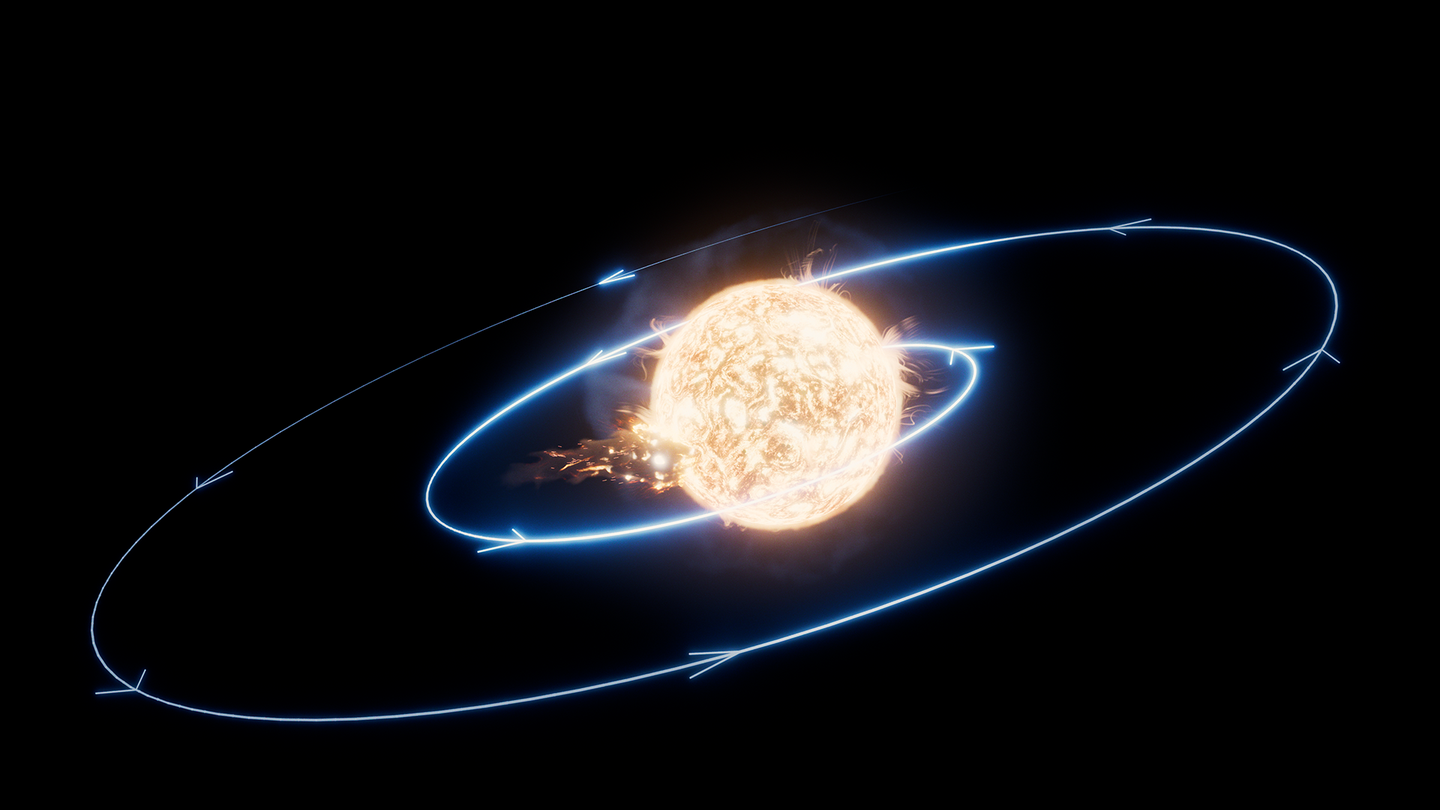
Solar models suggest the young Sun may have swallowed a super-Earth whose chemical fingerprint could remain inside it today. (CREDIT: NASA, ESA, CSA, Ralf Crawford (STScI))
- New solar-evolution models suggest the young Sun may have swallowed a rocky super-Earth, leaving a chemical fingerprint beneath its convection zone that could still affect the Sun’s internal structure today.
- The best-fitting models favor an engulfed planet in the super-Earth range, with several solutions pointing to roughly 5 to 10 Earth masses while simultaneously improving agreement with helioseismic measurements and the Sun’s unusually low lithium abundance.
- The scenario remains a hypothesis rather than evidence that a lost planet definitely existed, but calculations indicate a compact rocky world could penetrate deeply into the young Sun without being destroyed by ordinary aerodynamic ablation alone.
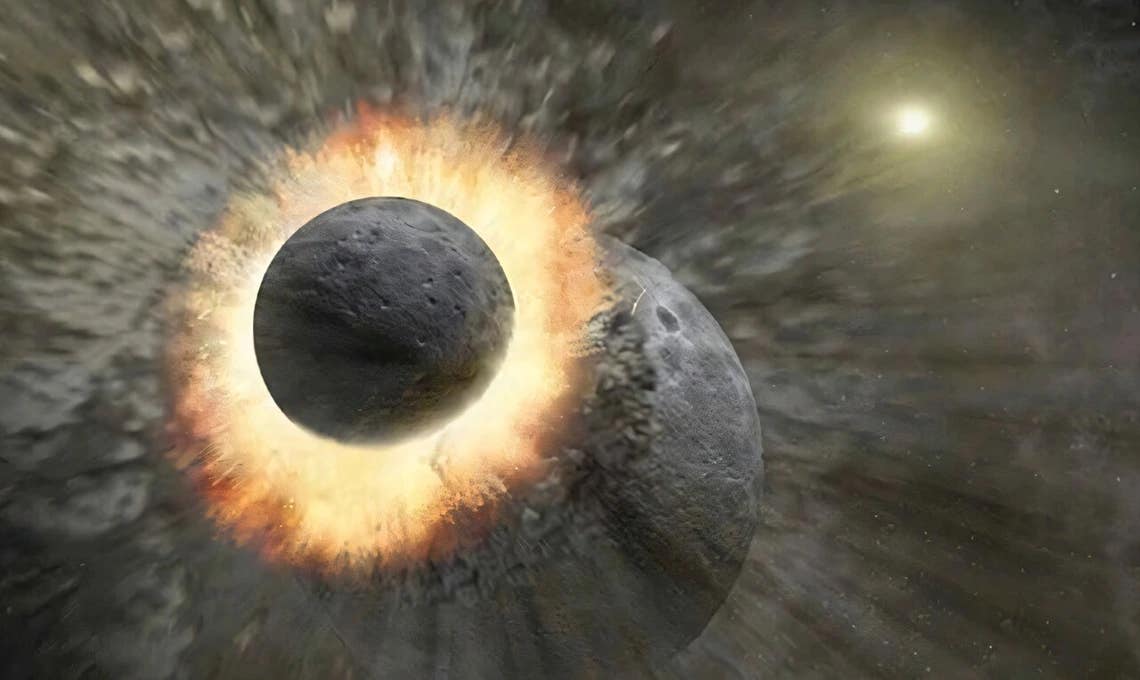
The solar system may once have contained a world several times larger than Earth that no longer exists. Rather than being ejected into interstellar space or colliding with another planet, it may have disappeared inside the Sun.
A new modeling study suggests such an event could have left a chemical fingerprint deep enough inside our star to survive for billions of years. Researchers found that adding the engulfment of a super-Earth to models of the young Sun can improve agreement with several measurements that standard solar models have struggled to reproduce simultaneously.
The research, published in Monthly Notices of the Royal Astronomical Society, was led by Professor Mutlu Yildiz of Ege University in Turkey. The team used stellar-evolution calculations to investigate whether material from a swallowed planet could alter the Sun's internal composition, sound-speed profile, convection-zone depth and surface abundances.
“Our new study suggests that a planet several times more massive than Earth may have fallen into the young Sun and left a lasting chemical imprint deep inside it,” Yildiz said.
The Sun has never perfectly matched its models
Scientists understand the Sun better than any other star because its mass, radius, luminosity and age can be measured with unusual precision. Helioseismology provides an even more powerful probe by using oscillations on the solar surface to infer conditions deep inside the star.
Those measurements have exposed persistent problems. Standard solar models do not perfectly reproduce the observed speed of sound beneath the Sun's convection zone, and they have difficulty matching the measured depth of that zone while simultaneously reproducing the Sun's surface composition.
Lithium presents another puzzle. The material from which the solar system formed contained substantially more lithium than appears in the modern solar atmosphere. The present photospheric abundance is more than two orders of magnitude below the estimated primordial value, suggesting that material from the Sun's surface must have been transported into hotter layers where lithium can be destroyed.
Researchers have proposed changes in opacity, diffusion, convection, turbulence and other internal processes to explain these differences. Yildiz and colleagues instead asked whether some of the Sun's present structure could preserve the aftermath of planet formation.
“We were interested whether these problems might have a common origin in the early chemical history of the Sun,” Yildiz said.
A missing planet could have changed the young Sun
The idea builds on an intriguing feature of our planetary system. Super-Earths, worlds larger than Earth but smaller than Neptune, are common around other stars, yet the solar system contains none.
Earlier theoretical work suggested that super-Earths could have formed in the inner solar system and migrated toward the Sun through the primordial gas disk. Under favorable conditions, such a planet could have spiraled inward until the Sun engulfed it.
The new research asks whether the Sun itself might retain evidence of such an event. Using the MESA stellar-evolution code, the researchers constructed non-standard solar models in which material with different chemical compositions was added during the Sun's early evolution.
Planet formation naturally separates materials. Rocky bodies concentrate heavy elements, while the gas remaining in a protoplanetary disk can become comparatively depleted in those elements. Accreting those different components at different stages can therefore create chemical layers inside a young star.
In the team's preferred scenario, metal-rich planetary material ends up beneath the solar convection zone. That localized enrichment changes opacity and the internal structure enough to bring the calculated Sun closer to helioseismic observations.
The models point toward a super-Earth
The most successful calculations did not favor an arbitrarily small asteroid or an enormous Jupiter-like planet. They repeatedly pointed toward the super-Earth regime.
Several of the team's closely related best-fitting models favored rocky planetary material corresponding to roughly 4.6 to 5.8 Earth masses. Across the wider model set, preferred solutions generally extended into the approximately 5-to-10-Earth-mass range.
The researchers also tested whether their improved results could simply reflect the greater flexibility of a more complicated model. Alternative models using turbulent mixing and varying convection parameters improved some measurements but did not achieve the same overall agreement as the preferred engulfment calculations.
“We thought planetary engulfment might affect the solar structure but did not expect the calculations to converge on such a specific super-Earth mass range,” Yildiz said. “That was one of the most interesting outcomes of the study.”
Lithium provided an additional constraint. The calculations could reproduce the Sun's strong lithium depletion when the accreted material was lithium-poor and when subsequent mixing remained shallow enough not to erase the heavy-element-rich layer beneath the convection zone.
Could a rocky planet actually survive the plunge?
A major question is whether a super-Earth could travel deeply enough into the Sun to create the proposed chemical layer rather than simply evaporating near the surface.
The researchers performed a first-order assessment combining planetary structure, Roche-lobe stability, drag and aerodynamic ablation. Their calculations indicate that a dense rocky planet could become compressed while descending through the Sun's convective envelope and lose surprisingly little mass through conventional aerodynamic erosion alone.
Increasing pressure shrinks the planet and reduces the cross-sectional area exposed to drag. Even under assumptions chosen to make erosion relatively efficient, classical drag and ablation did not destroy several Earth masses of rocky material before the planet could reach the bottom of the convective envelope.
That does not mean an intact super-Earth would simply sink unchanged into the Sun. Shock heating, fragmentation, tidal forces, hydrodynamic instabilities and eventual dissolution could all become important, and the study does not model that entire process in detail.
Instead, the calculations establish that rapid destruction by ordinary aerodynamic ablation is not inevitable. More sophisticated hydrodynamic simulations will be required to determine exactly how and where such a planet would break apart.
The Sun could preserve evidence of a vanished world
The result does not prove that the solar system once contained a super-Earth or that the Sun swallowed one. Planetary engulfment remains one possible explanation for discrepancies between solar models and observations, and the proposed internal chemical structure will need independent tests.
Helioseismology offers the most promising opportunity because sound waves probe layers that cannot be directly observed. Future measurements could determine whether the predicted structural fingerprint beneath the convection zone actually exists.
“The earlier work proposed that a super-Earth could have formed and migrated into the young Sun,” Yildiz said. “Our paper asks whether the Sun itself could still carry observable evidence that such an engulfment actually happened, and we believe it could.”
If that signature is eventually confirmed, one of the solar system's missing planets may not truly be gone. Its remains could have been hidden inside the Sun for more than four billion years.
Dig deeper into planetary engulfment and the Sun’s missing super-Earth
These studies explore how planets can fall into their stars, how those events alter stellar chemistry and why the solar system may have lost an early super-Earth.
On the formation of super-Earths with implications for the solar system: Proposes that super-Earths could have formed in the young solar system, migrated inward through the gas disk and ultimately fallen into the Sun. (The Astrophysical Journal, 2016)
Chemical evidence for planetary ingestion in a quarter of Sun-like stars: Uses chemical differences between paired Sun-like stars to argue that planetary ingestion occurs in a significant fraction of planetary systems. (Nature Astronomy, 2021)
Long-term lithium abundance signatures following planetary engulfment: Models how engulfing rocky planetary material can alter stellar lithium and how long those chemical signatures can remain observable. (Monthly Notices of the Royal Astronomical Society, 2022)
Planet engulfment signatures in twin stars: Examines how planetary ingestion changes the refractory-element composition of stars and how stellar mixing determines the lifetime of those signatures. (Monthly Notices of the Royal Astronomical Society, 2023)
At least one in a dozen stars shows evidence of planetary ingestion: Finds chemical evidence for planetary ingestion among co-natal stellar pairs, providing observational support that stars sometimes retain fingerprints of consumed planets. (Nature, 2024)
Research findings are available online in the journal Monthly Notices of the Royal Astronomical Society.
The original story "A missing super-Earth may have been swallowed up by the Sun billions of years ago" is published in The Brighter Side of News.
Related Stories
- ESA's Solar Orbiter reveals how the Sun’s corona transforms into solar wind
- Small whirlpool-like structures reveal how the Sun stores and releases energy
- Earth may not be swallowed by our dying sun after all, study finds
Like these kind of feel good stories? Get The Brighter Side of News' newsletter.
Joseph Shavit
Writer, Editor-At-Large and Publisher
Joseph Shavit, based in Los Angeles, is a seasoned science journalist, editor and co-founder of The Brighter Side of News, where he transforms complex discoveries into clear, engaging stories for general readers. With vast experience at major media companies like The Los Angeles Times, Times Mirror and Tribune Publishing, he writes with both authority and curiosity. His writing focuses on space science, planetary science, quantum mechanics, geology. Known for linking breakthroughs to real-world markets, he highlights how research transitions into products and industries that shape daily life.