Earth may not be swallowed by our dying sun after all, study finds
Earth may not be swallowed by the dying sun after all, but its survival still depends on uncertain late-stage stellar physics.

 Edited By: Joshua Shavit

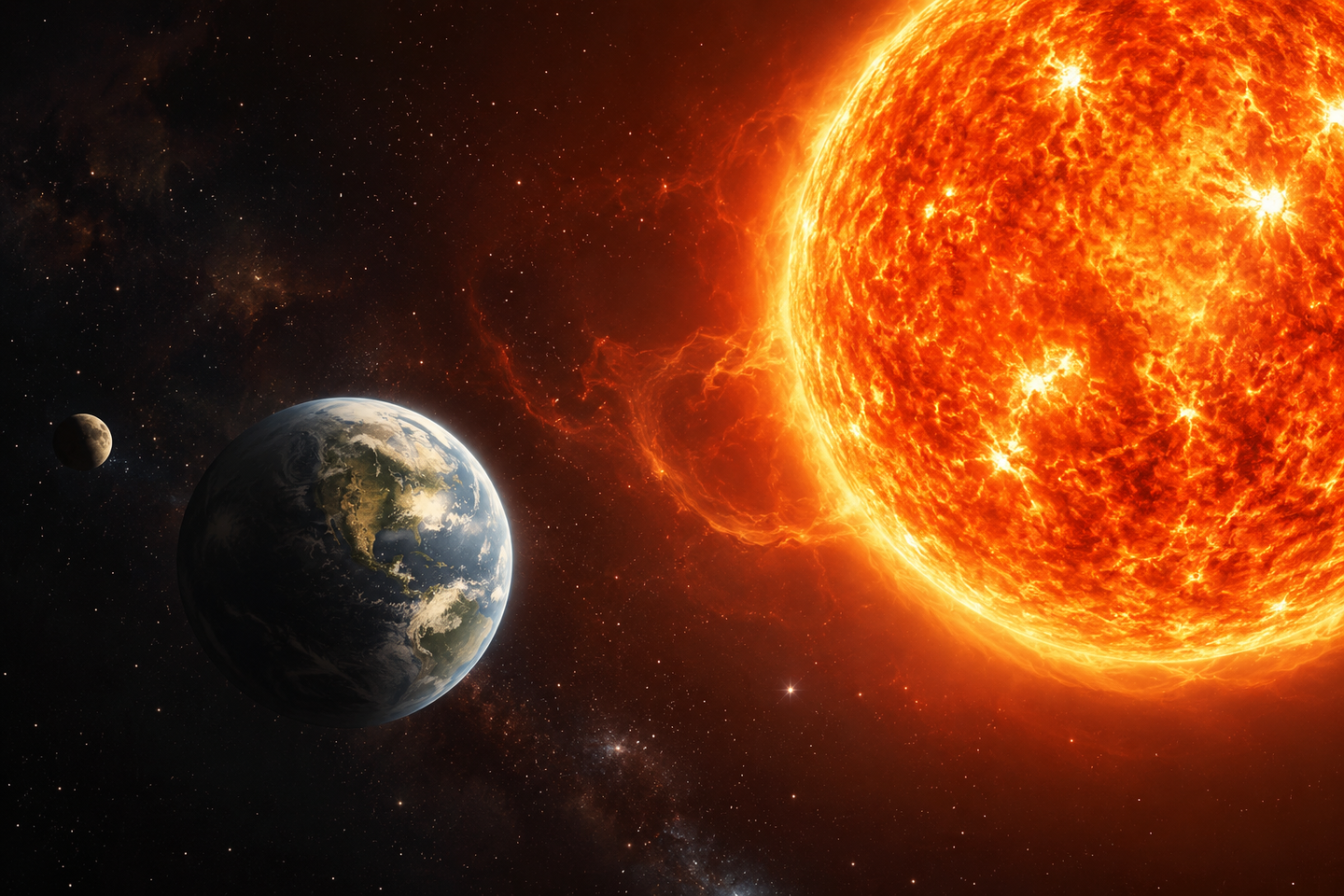
New models suggest Earth may avoid being swallowed by the dying sun, though its fate still depends on uncertain stellar mass loss. (CREDIT: AI-generated image / The Brighter Side of News)
For a long time, Earth’s ending seemed settled. In about five billion years, the sun will swell into a giant, the inner Solar System will be transformed, and our planet was widely expected to be consumed in the process. But that picture may not be as final as once thought.
New calculations suggest Earth might avoid being swallowed by the expanding sun, surviving both of the star’s giant late-life growth phases. The outcome is still uncertain, and no version of the future leaves Earth livable. But the work shifts a question many astronomers thought was nearly closed.
The tension comes down to two competing effects.
As the sun ages and expands beyond its current main-sequence phase, it will first enter the red giant branch, then later the asymptotic giant branch, or AGB. During both stages, the star will balloon outward and lose mass through a strong stellar wind. Those two changes tug planets in opposite directions. Expanding stars raise tides that can drain orbital energy and pull planets inward. At the same time, mass loss weakens the star’s gravitational grip, allowing planetary orbits to widen.
“Earth's fate depends on a delicate balance between these two effects,” lead author Mats Esseldeurs said in a statement. “If tidal interactions predominate, Earth is engulfed by the sun. If the sun's mass loss predominates, Earth escapes into an orbit larger than the radius of its star.”
A fight between drag and escape
Earlier studies often landed on the darker outcome, especially for Earth. But those predictions depended heavily on how tidal dissipation inside giant stars was described, and on how quickly the aging sun was assumed to shed mass.
The new study revisits both.
The team modeled the future evolution of the inner Solar System by combining orbital calculations with stellar evolution models of the sun from its early life to its white dwarf stage. They used updated prescriptions for tidal dissipation drawn from recent work on the internal structure and dynamics of evolved stars, including dynamical tides linked to internal gravity waves.
That matters because the older prescriptions generally predicted stronger tidal effects. Stronger tides make it easier for the star to sap a planet’s orbital energy, shrinking its orbit enough for engulfment later on.
Stephane Mathis, a co-author at the CEA Paris-Saclay center in France, told reporters that advances in tide modeling over the past 15 years showed “the dissipation is lower than previously expected.”
In practical terms, that means the swollen future sun may be less efficient at dragging Earth inward than earlier work assumed.
The researchers also tested how the sun’s mass loss changes the picture. Mass loss during the red giant branch is relatively well constrained by observations, but the AGB phase remains much murkier. Different prescriptions can produce rates that differ by more than an order of magnitude, and those differences matter because faster mass loss pushes planets outward more strongly.
Why an aging star near Earth matters now
To get a better handle on that uncertainty, the study looked to L2 Puppis, a nearby AGB star with an initial mass close to the sun’s. The star has been treated as a rough proxy for the sun’s future, though even there the measurements are not neat. One estimate based on dust emission gives a much higher mass-loss rate than another estimate based on carbon monoxide emission.
That spread highlights the problem. If the future sun sheds enough mass during the AGB phase, Earth can stay beyond danger. If the rate is lower, engulfment becomes more plausible.
Using a reference AGB mass-loss value and the updated tidal model, the new calculations found that Mercury and Venus are still doomed. Both are engulfed during the red giant branch. Mars survives. Earth, in these runs, also survives the red giant branch and then the AGB phase.
That is a sharp contrast with older tide prescriptions. When the team compared its newer approach with a Zahn-based model used in previous work, the older prescription produced stronger tidal dissipation and left Earth on a tighter orbit after the red giant branch. From there, Earth was pulled into the sun during the AGB phase.
Under the newer modeling, Earth moves farther outward, making survival more likely.
The difference is not small. It changes the broad conclusion.
Survival is possible, not settled
Even so, the paper does not claim the case is closed in Earth’s favor. The authors repeatedly stress that the result still hangs on uncertain AGB mass-loss rates.
For very low AGB mass-loss values, their models place Earth in danger. In some scenarios, the sun’s radius exceeds the Solar Roche lobe radius during a thermal pulse lasting only a few hundred years. That creates an awkward gray zone. The geometry suggests engulfment could happen, but the event is brief enough that the exact outcome is hard to model with confidence.
For the lowest tested value, engulfment looks likely. When it comes to slightly higher values, the result becomes uncertain. For values of ηBlöcker at 0.04 and above, Earth survives the AGB phase in their calculations.
So the new work does not say Earth will escape. It says Earth may escape, and that the older assumption of certain destruction now looks less secure.
There is another note of caution. Observations of tidal dissipation in evolved binary stars sometimes suggest stronger tidal effects than current models predict. If those results turn out to apply more directly to systems like Earth and the future sun, the chance of engulfment could rise again. The authors note that binary circularization involves higher-frequency tides than Earth’s migration, so the comparison may not be direct.
After all of this, the sun will end as a white dwarf, an extremely dense stellar remnant that no longer supports fusion in its core. By then, if Earth still exists, it will orbit a fading, cooling ember.
Practical implications of the research
This study reshapes a familiar picture of the Solar System’s far future by showing that Earth’s final orbit may be more sensitive to stellar physics than many earlier estimates suggested. It also underscores how uncertain late-stage stellar mass loss remains, even for stars similar to the sun.
Better observations of evolved stars such as L2 Puppis, along with future detections of planets around red giants, could help narrow those uncertainties.
Missions such as PLATO may eventually give astronomers a broader population of evolved planetary systems to compare, making Earth’s distant fate less speculative than it is now.
Research findings are available online in the journal Astronomy & Astrophysics.
The original story "Earth may not be swallowed by our dying sun after all, study finds" is published in The Brighter Side of News.
Related Stories
- Large-scale waves are forming deep inside our Sun
- The Sun could be one of thousands of solar twins moving through the Milky Way
- Astronomers discover massive bubble around dying star
Like these kind of feel good stories? Get The Brighter Side of News' newsletter.
Joseph Shavit
Writer, Editor-At-Large and Publisher
Joseph Shavit, based in Los Angeles, is a seasoned science journalist, editor and co-founder of The Brighter Side of News, where he transforms complex discoveries into clear, engaging stories for general readers. With vast experience at major media companies like The Los Angeles Times, Times Mirror and Tribune Publishing, he writes with both authority and curiosity. His writing focuses on space science, planetary science, quantum mechanics, geology. Known for linking breakthroughs to real-world markets, he highlights how research transitions into products and industries that shape daily life.