Alien technology could be hiding as microscopic dust on the Moon
Scientists propose examining lunar soil for tiny engineered particles that could preserve evidence of civilizations long since vanished.

 Edited By: Joshua Shavit

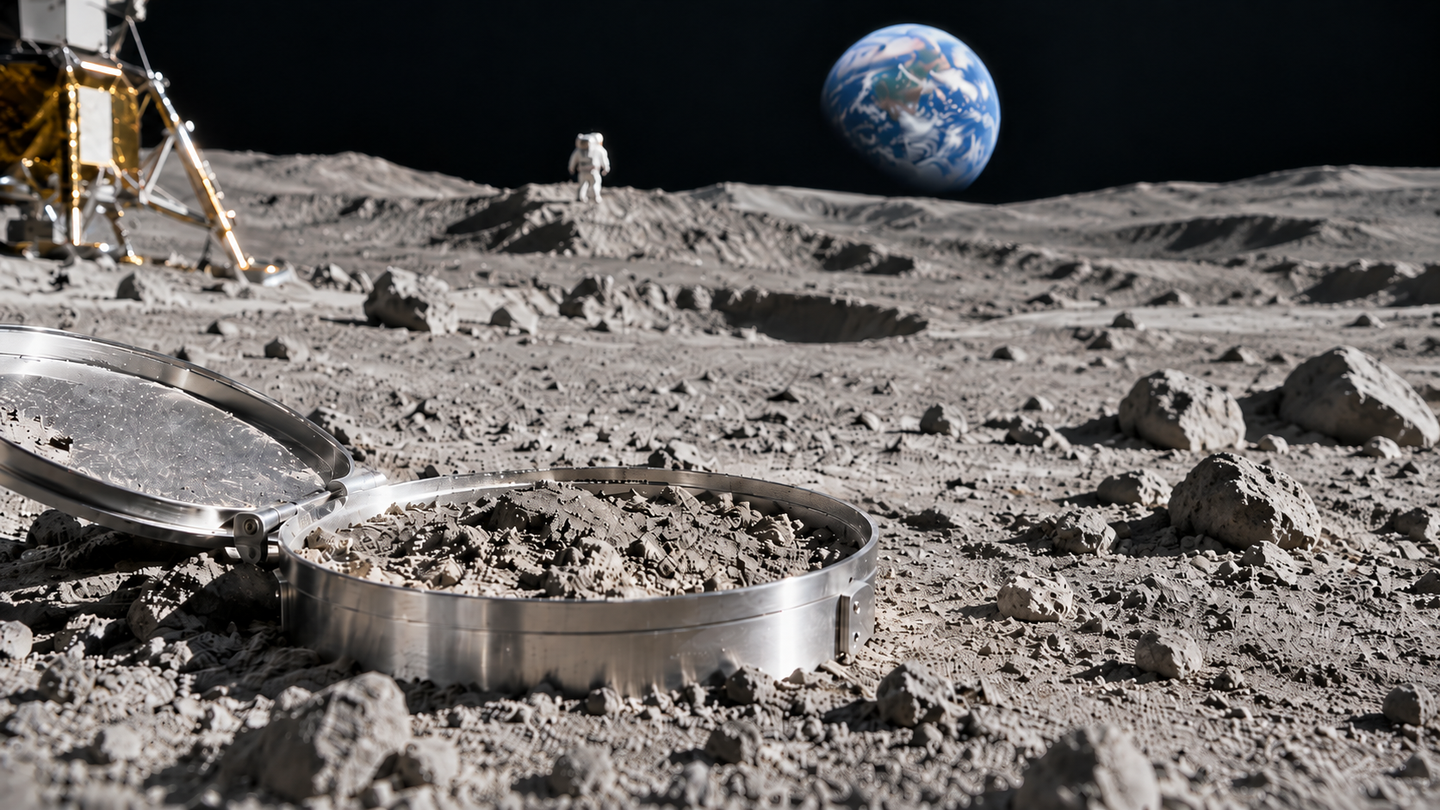
A new SETI framework proposes searching Moon dust for microscopic technological debris that may have crossed the galaxy billions of years ago. (CREDIT: Shutterstock)
- A new SETI framework proposes searching lunar soil for microscopic fragments of extraterrestrial technology that could have drifted through interstellar space and accumulated on the Moon during billions of years.
- The researchers calculate that examining roughly one cubic meter of well-characterized lunar regolith could begin placing quantitative limits on some forms of long-lived technological debris, even if no artificial particles are found.
- The proposal remains speculative and has not detected extraterrestrial technology, but advances in microscopy, spectroscopy, tomography and AI-assisted screening could make this unusual form of “exo-archaeology” experimentally testable.
The next major search for extraterrestrial intelligence might involve putting Moon dust under a microscope rather than pointing a radio telescope toward the stars.
A new study led by SETI Institute Affiliate Scientist Lewis Pinault proposes searching lunar regolith for microscopic particles that could represent the surviving debris of extraterrestrial technology. Such material might have drifted between stars for millions or billions of years before eventually reaching the Moon.
The work, currently available as a preprint while under review by the International Journal of Astrobiology, does not claim that artificial particles have been discovered. Instead, it develops a quantitative framework for determining whether microscopic technological material could travel through the Milky Way, survive arrival at the Moon and remain recognizable with modern laboratory instruments.
“The Moon has been quietly accumulating material from space for billions of years, much of it likely billions of years older than the Moon itself,” Pinault said. “We're asking whether that ancient collection might contain microscopic traces of technologies that existed long before humans ever looked up at the sky.”
The Moon could preserve an enormous extraterrestrial archive
Traditional SETI searches often look for radio transmissions, laser pulses or other signals generated by civilizations that exist at approximately the same cosmic moment as humanity. Physical debris offers a fundamentally different possibility.
An artificial particle might remain after its creators stopped transmitting or disappeared altogether. The Moon could be particularly useful because its surface has collected material for roughly four billion years without the atmosphere, flowing water and active geological recycling that continually transform Earth's surface.
The study calls unintentional microscopic technological debris “Arkhipov Particles,” after earlier proposals that artificial dust could travel naturally through interstellar space. Such material might originate from spacecraft collisions, industrial activity, eroding structures or fragments produced as large engineered systems gradually break apart.
The researchers also consider a more speculative category called “Bracewell Particles.” These would be microscopic objects deliberately engineered for interstellar dispersal, potentially serving as passive probes, information carriers, sensors or other distributed devices.
The distinction matters. Accidental debris could reveal technological activity without requiring anyone to send a message, while deliberate particles would imply that another civilization intentionally placed engineered material into interstellar space.
Tiny particles could travel surprisingly far
The proposal depends on microscopic material surviving the journey between stars.
Particles roughly 0.1 to 1 micrometer across interact strongly with interstellar gas, magnetic fields and radiation. Instead of simply retaining the speed of their original star system, they can become coupled to flows within the interstellar medium.
The team's calculations suggest refractory grains could survive for hundreds of millions of years and, under some conditions, more than a billion years. During that time, large-scale interstellar flows could transport them across hundreds of parsecs or potentially kiloparsec-scale distances.
The Sun's movement through the Milky Way provides another ingredient. Over roughly four billion years, the Solar System has repeatedly crossed different interstellar environments while orbiting the Galactic center.
If technological dust existed within some of those environments, the Moon would have spent billions of years acting as a passive collector.
Arrival presents another problem because high-speed impacts can melt or vaporize microscopic grains. The researchers identify a narrow range of trajectories in which solar radiation pressure and orbital geometry could reduce relative impact speeds enough to improve preservation.
Even destruction would not necessarily erase every clue. An engineered particle could leave unusual fragments, impact residues, alloys, layered structures, isotopic patterns or microscopic craters that differ from expected natural materials.
One cubic meter could become a SETI experiment
The researchers propose one cubic meter of lunar regolith as a reference volume for future searches.
That does not mean analyzing such a volume would be easy. Exhaustively examining its microscopic particles would require an enormous imaging and materials-analysis effort, particularly if researchers hope to find extremely rare anomalies among countless ordinary lunar grains.
Modern technology makes the idea less unrealistic than it once appeared. Scanning electron microscopy could reveal unusual surface structures, while energy-dispersive X-ray spectroscopy could examine elemental composition. Secondary ion mass spectrometry could search for unusual isotopic patterns, and focused-ion-beam tomography or nano-computed tomography could reveal internal structures.
Artificial origin could not be established from appearance alone. Researchers would need to exclude lunar minerals, meteorite fragments, presolar grains and contamination from human spacecraft before considering an extraterrestrial technological explanation.
The study therefore proposes using multiple independent lines of evidence. A particle might become particularly interesting if it combined anomalous composition, isotopic ratios and highly ordered internal structures that known natural processes could not readily explain.
AI could search mountains of lunar dust
Artificial intelligence could help researchers handle the enormous number of grains involved.
The proposed workflow would use machine vision to flag unusual objects rather than declaring anything extraterrestrial. Candidates could then undergo progressively more detailed chemical, isotopic and structural examination.
The researchers describe systems such as YOLO-ET, a machine-vision approach designed to identify unusual particles and microcraters in microscopic imagery. Unsupervised algorithms could also search for objects that fall outside the range represented by known lunar, meteoritic and human-made materials.
Contamination will be a major challenge. Decades of lunar exploration have already introduced metals, polymers, coatings and spacecraft debris to the Moon, while future missions will add considerably more.
Any serious search would therefore need detailed inventories of materials carried by spacecraft, strict sample-handling procedures and confirmation by independent laboratories.
A convincing discovery would likely require several unusual characteristics pointing toward the same conclusion rather than one seemingly artificial feature.
Finding nothing could still tell astronomers something
Perhaps the most important part of the proposal is that a failed search could still produce scientific information.
The researchers calculate that finding no artificial grains within a thoroughly characterized cubic meter could begin constraining certain scenarios in which advanced civilizations produced enormous amounts of long-lived microscopic debris over Galactic history.
Under the study's particular assumptions for undirected particles from large engineered systems, a null search could begin excluding scenarios in which eligible Sun-like stars typically dispersed more than roughly 0.1 Earth masses of durable technological particles over long timescales. That estimate depends strongly on assumptions about particle production, survival, transport and detection efficiency.
It is not a limit on how many extraterrestrial civilizations exist. Civilizations producing little particulate debris, using different materials or never sending matter into interstellar space could remain completely invisible to this method.
Future lunar exploration could make increasingly large searches possible. Samples returned by robotic missions and future human expeditions could be examined on Earth, while eventually microscopes and automated screening systems could analyze regolith directly on the lunar surface.
“The concept of searching the lunar regolith for microscopic technosignatures is at once extraordinarily original and eminently reasonable,” said SETI Institute President and CEO Bill Diamond.
The proposal transforms the Moon into something larger than a geological record of the Solar System. Its dust could also preserve fragments of material that wandered through the Galaxy long before humans existed.
If even one could be shown convincingly to be engineered and extraterrestrial, the search for intelligent life would change forever.
Dig deeper into lunar technosignatures and extraterrestrial artifacts
These resources examine Solar System artifact searches, technosignature evaluation and the lunar material that could make microscopic SETI searches possible.
Searching for alien artifacts on the moon: Paul Davies and Robert Wagner examine why the Moon's long-lived surface could preserve extraterrestrial artifacts and how lunar observations might be incorporated into SETI. (Acta Astronautica, 2013)
Nine axes of merit for technosignature searches: Sofia Sheikh develops a framework for comparing technosignature strategies and specifically evaluates Solar System artifacts as potentially long-lived and information-rich targets. (International Journal of Astrobiology, 2020)
Prior indigenous technological species: Jason Wright considers whether ancient technological artifacts could survive for geological timescales and identifies the Moon among the environments where extremely old evidence might persist. (International Journal of Astrobiology, 2018)
Lunar Regolith Sampling Technologies: A Critical Review: Reviews past and emerging technologies for collecting representative lunar soil, including challenges involving particle heterogeneity, contamination and sampling depth that would also matter for microscopic technosignature searches. (Space Science Reviews, 2025)
Interstellar Dust Grains: A foundational review of the physical properties, survival and astronomical behavior of interstellar dust, providing essential context for proposals involving micron-scale particles moving through the Galaxy. (Annual Review of Astronomy and Astrophysics, 2003)
Research findings are available online in the journal arXiv.
The original story "Alien Technology Could Be Hiding as Microscopic Dust on the Moon" is published in The Brighter Side of News.
Related Stories
- A space elevator connecting Earth and the Moon could be closer than ever
- The Moon’s far side could open a window into the universe before the first stars were born
- China's Chang’e-7 targets the Moon’s South Pole in search of usable water ice
Like these kind of feel good stories? Get The Brighter Side of News' newsletter.
Joseph Shavit
Writer, Editor-At-Large and Publisher
Joseph Shavit, based in Los Angeles, is a seasoned science journalist, editor and co-founder of The Brighter Side of News, where he transforms complex discoveries into clear, engaging stories for general readers. With vast experience at major media companies like The Los Angeles Times, Times Mirror and Tribune Publishing, he writes with both authority and curiosity. His writing focuses on space science, planetary science, quantum mechanics, geology. Known for linking breakthroughs to real-world markets, he highlights how research transitions into products and industries that shape daily life.