A tiny semiconductor device lifts quantum photon interference visibility to 90%
A two-step photon source reaches 90% interference visibility, revealing how emission timing and crystal vibrations shape quantum light.
 Universität Paderborn Writer: Johanna Pietsch

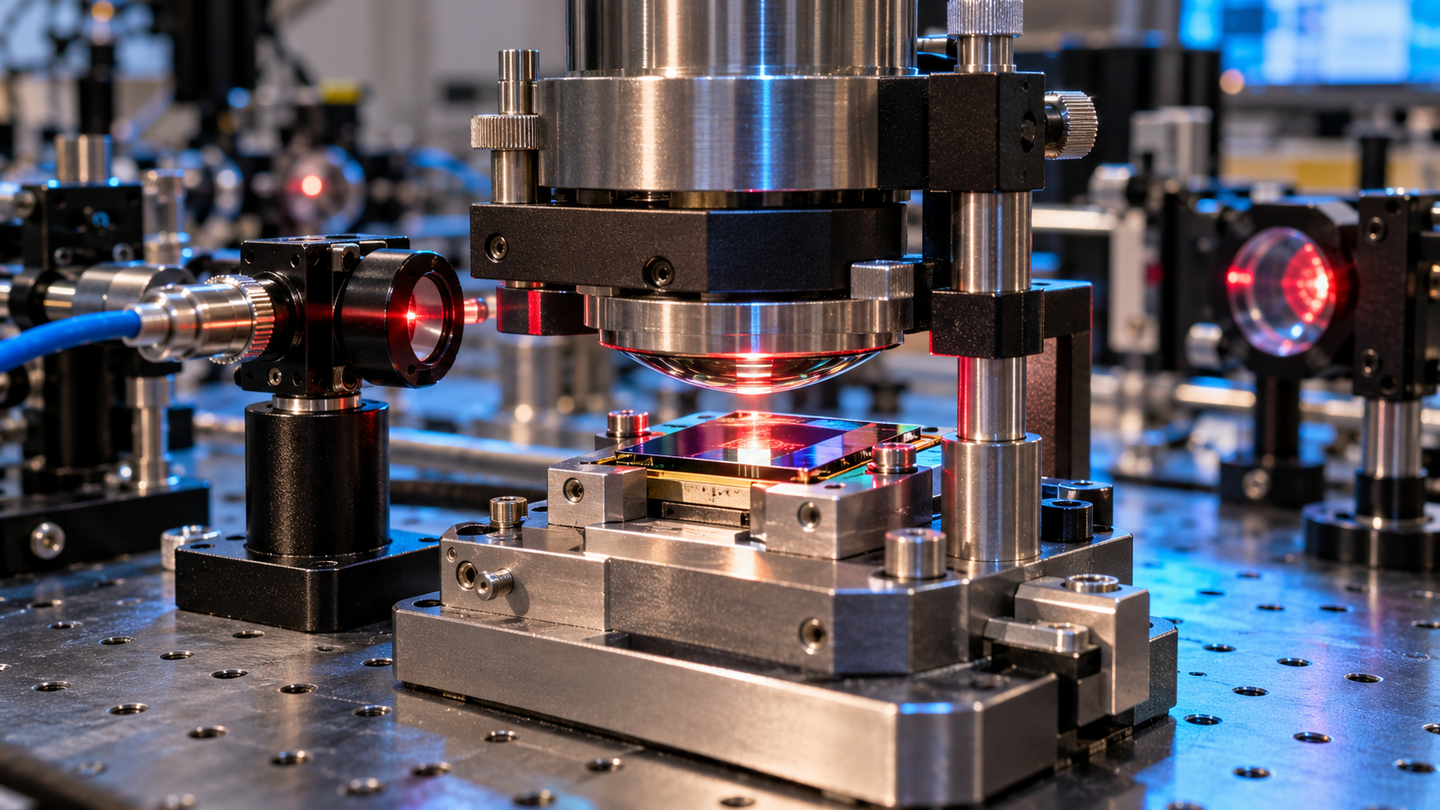
An optical cavity improves quantum-dot photon indistinguishability by controlling the timing of two successive light emissions. (CREDIT: Shutterstock)
- An optical cavity raised the first cascade photon’s measured interference visibility to 90%, compared with a typical value near 60%.
- Accelerating the first emission improved coherence for both photons, while accelerating the second had the opposite effect.
- Crystal vibrations and inefficient collection of the second photon remain obstacles to a practical source of entangled pairs.
Light particles intended for quantum communication can lose their usefulness because of the order in which they emerge. A semiconductor experiment has shown how controlling that sequence can produce photons that interfere much more reliably.
The work brings quantum dots closer to supplying high-quality light for advanced quantum communication schemes. It also exposes a practical tradeoff: improving photon coherence does not automatically make both particles easy to collect.
Scientists from the University of Basel, Paderborn University and Ruhr University Bochum reported the findings in Physical Review Letters. Their device uses an optical cavity to change how quickly a tiny semiconductor structure releases its two photons.
Two emissions create a timing problem
A quantum dot confines electronic excitations within a semiconductor and behaves in some respects like an artificial atom. Exciting it twice creates a biexciton, a bound complex containing two electrons and two holes. A hole represents a missing electron in the semiconductor.
The complex releases its energy in two steps. First, the biexciton decays into an exciton, emitting one photon. The remaining exciton then decays, releasing a second photon and returning the dot to its ground state.
“This is a process in which a quantum dot is doubly excited and the excitation then decays. This generates two photons, one after the other,” explains lead author Timon Baltisberger from the University of Basel.
That sequence, called a biexciton cascade, offers a route to entangled photon pairs. Entanglement and indistinguishability, however, describe different properties. Advanced communication schemes can require entangled pairs whose corresponding photons from separate emissions also interfere reliably.
The cascade introduces an obstacle because its two emissions are linked in time. The second photon cannot emerge before the first, and uncertainty in the first emission introduces timing jitter. This reduces photon coherence, which the experiment assessed through two-photon interference visibility.
A cavity changes the balance
The team placed an indium gallium arsenide quantum dot inside an open optical microcavity. One mirror formed part of the semiconductor structure. A curved upper mirror completed the cavity and allowed light to escape toward the collection system.
Changing the distance between those mirrors tuned the cavity’s resonance. That let the team selectively accelerate either the first or second transition within the same dot. The acceleration comes from the Purcell effect, through which the optical environment changes an emitter’s radiative decay rate.
The important quantity was the ratio between the biexciton lifetime and the exciton lifetime. Quantum optics predicts that indistinguishability improves when the first lifetime becomes much shorter than the second. Under those conditions, uncertainty in the first emission contributes less timing jitter to the cascade.
The experiment varied that lifetime ratio over two orders of magnitude. This provided a broad test of the prediction within a semiconductor, where crystal vibrations and other effects could complicate the result. The measured behavior closely followed the theoretical relationship.
Accelerating the second transition produced the reverse outcome. It made the exciton decay faster relative to the biexciton, increasing the lifetime ratio and reducing coherence. The choice of which emission to accelerate therefore mattered more than simply making the device faster.
The two photons reached different scores
With the cavity enhancing the first transition, the biexciton-to-exciton photon reached a raw interference visibility of 90%, with an uncertainty of two percentage points. The second photon reached 80%, with an uncertainty of six percentage points. Both improved under the same cavity setting.
For comparison, the typical lifetime ratio in an unmodified cascade gives a theoretical visibility near 60%. The new measurements demonstrate a substantial improvement, but the two photons did not achieve identical scores. Nor does the result mean that the different-frequency photons within each pair became interchangeable.
The researchers tested interference between successive photons of the same transition, separated by 13.1 nanoseconds. Spectral filters selected either the first or second emission for measurement. This distinction matters because useful interference involves matching the relevant photons across separate cascade events.
After correcting for imperfect single-photon purity, the visibility estimates rose to 94% for the first photon and 82% for the second. Those corrected figures allow comparison with the idealized theory. The raw measurements retain the influence of unwanted multiphoton contributions.
Crystal vibrations limit photon purity
Indistinguishability measures how well photons interfere, while single-photon purity concerns unwanted additional photons in the selected output. The experiment found that these qualities depend differently on the cavity setting. Improving one does not remove every limitation on the other.
When the cavity enhanced the biexciton transition, the measured zero-delay photon correlation was 2.3%, corresponding to purity near 98%. With the exciton transition resonant instead, that correlation fell below 0.1%. The difference pointed to a process called cavity feeding.
In the first configuration, the remaining exciton can sometimes emit into the cavity while also creating a phonon, a vibration of the crystal lattice. The phonon carries the energy difference needed for that otherwise mismatched emission. Occasionally, both cascade photons therefore enter the cavity output.
The authors identify possible ways to reduce this effect. These include dots with larger biexciton binding energies or larger gallium arsenide dots with weaker exciton coupling to phonons. Such changes remain proposed design routes rather than demonstrated improvements in this experiment.
Collecting a useful pair remains a challenge
The open cavity favors a narrow frequency range. When it efficiently collects the first photon, the second mostly leaves through other optical modes. A source intended to deliver entangled pairs must extract both photons efficiently, alongside meeting the conditions needed to preserve entanglement.
Possible approaches include an on-chip grating or a circular Bragg grating that combines selective emission enhancement with broader collection. The result establishes control over cascade coherence and identifies the remaining design work. Turning that control into a practical pair source requires addressing collection and crystal vibrations together.
Dig deeper into quantum dots and indistinguishable photons
These resources explore cascade timing, optical cavity design and the requirements for useful quantum light sources.
High-quality single photons from cavity-enhanced biexciton-to-exciton transition: Examines selective cavity enhancement as a route to high-quality single-photon emission. (Physical Review Applied, 2026)
On-Demand Indistinguishable and Entangled Photons Using Tailored Cavity Designs: Models cavity designs that improve photon indistinguishability while maintaining entanglement. (Advanced Quantum Technologies, 2024)
Quantum Light Source Based on Semiconductor Quantum Dots: A Review: Reviews quantum-dot emitters, their operating principles and methods for improving light collection. (Photonics, 2023)
A bright and fast source of coherent single photons: Demonstrates an efficient quantum-dot source using an open, tunable microcavity. (Nature Nanotechnology, 2021)
Crux of Using the Cascaded Emission of a Three-Level Quantum Ladder System to Generate Indistinguishable Photons: Investigates the timing correlations that limit indistinguishability in cascaded photon emission. (Physical Review Letters, 2020)
Research findings are available online in the journal Physical Review Letters.
The original story "A tiny semiconductor device lifts quantum photon interference visibility to 90%" is published in The Brighter Side of News.
Related Stories
- Quantum interference offers a radically different way to measure time
- Physicists find Einstein’s 'spooky' quantum effect inside Higgs boson decays
- ‘Shape-shifting’ quantum computer uses light to switch between different tasks
Like these kind of feel good stories? Get The Brighter Side of News' newsletter.
Shy Cohen
Writer