MIT scientists create nanoparticles to deliver cancer vaccines tailored to each patient
MIT researchers tuned antigen display on M13 particles to improve tumor protection in mice, advancing a potential platform for personalized cancer vaccines.
 MIT Writer: Anne Trafton

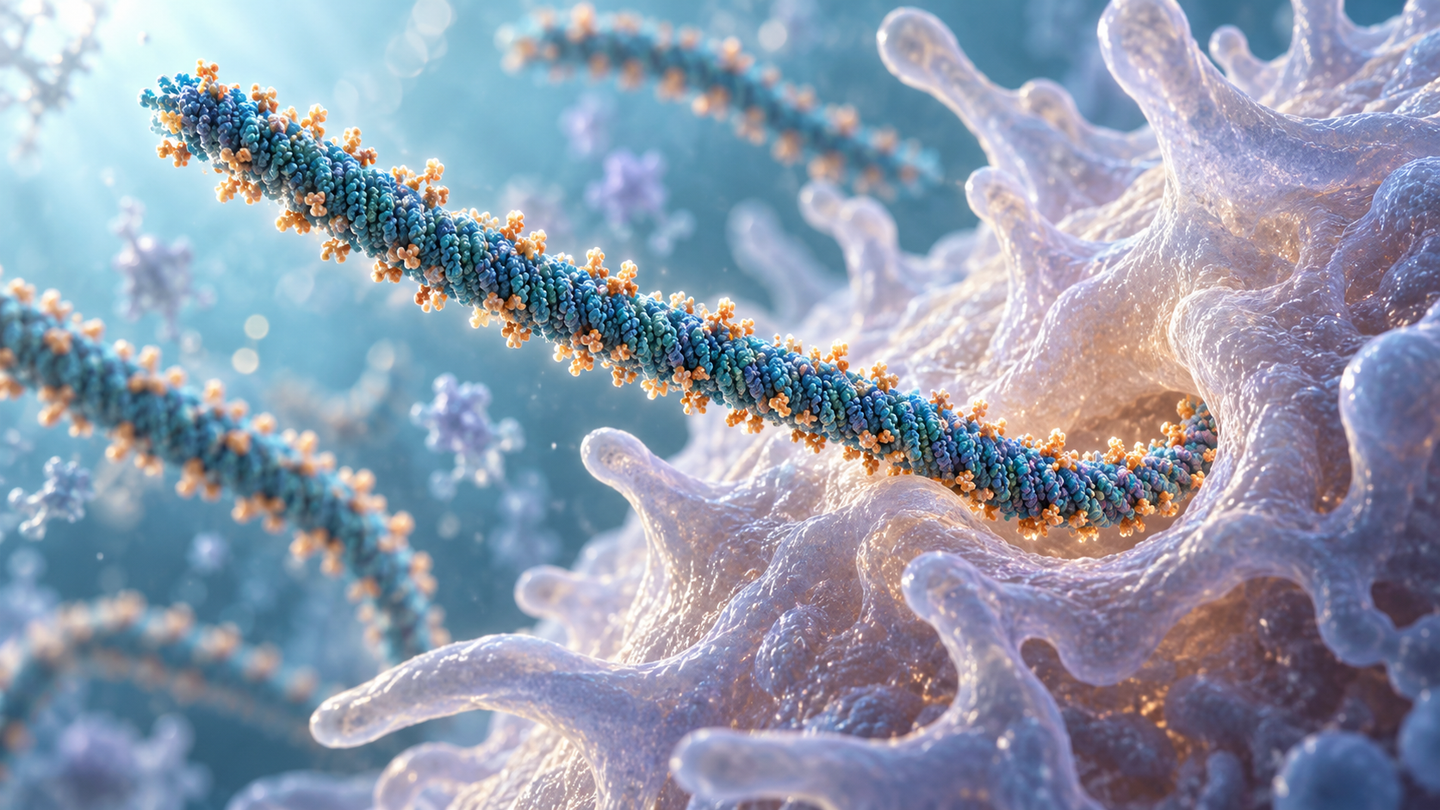
Artist’s illustration of antigen-coated M13 particles interacting with an immune cell. MIT researchers found that denser antigen displays strengthened targeted immune responses and improved tumor protection in mice vaccinated before exposure to cancer cells. (CREDIT: The Brighter Side of News)
- MIT researchers engineered M13 bacteriophage particles to control how densely they display antigens, strengthening targeted immune responses in mice.
- Higher-density vaccines improved protection in melanoma and colorectal tumor-cell challenge experiments, with a roughly sevenfold higher fraction of neoantigen-specific T cells in the colorectal model.
- The platform could support personalized cancer vaccines, but this study vaccinated mice before tumor-cell injections and did not establish effectiveness in people.
Packing more cancer targets onto a tiny viral scaffold helped mice mount a stronger defense against injected tumor cells. The finding points to a controllable feature of vaccine design: how densely a delivery particle displays the molecular markers that immune cells learn to recognize. It could help researchers refine personalized cancer vaccines.
The MIT study, published in Advanced Healthcare Materials, uses an engineered bacteriophage called M13. Shengnan Huang, a research scientist at the Koch Institute for Integrative Cancer Research, led the work. Senior author Angela Belcher is MIT’s James Mason Crafts Professor of Biological Engineering and Materials Science and Engineering.
The results come from laboratory experiments and small mouse studies, not clinical trials. The work focused on improving the design of a vaccine formulation. Mice received vaccines before researchers injected tumor cells, testing protection against a later challenge. Whether the same density adjustments improve treatment of established tumors requires further testing.
Turning a bacterial virus into a vaccine carrier
M13 is a bacteriophage, a virus that infects bacteria rather than human cells. Its single-stranded DNA sits inside a long protein shell, or capsid. The engineered particles in this study measured approximately 200 nanometers in length.
The researchers attached antigens, molecular targets recognized by immune cells, to a major capsid protein called pVIII. Each particle contained a mixture of ordinary pVIII and antigen-bearing versions. Altering that mixture changed the density of antigen displayed along the particle’s surface.
The viral DNA also supplies an immune-stimulating signal through Toll-like receptor 9, or TLR9. That gives M13 its own adjuvant activity, helping amplify the response to its antigen cargo. Combining the target and this immune activation signal within one scaffold is part of the platform’s appeal.
Making antigen density adjustable
Huang first worked with SIINFEKL, a short peptide commonly used as a model antigen in mouse immunology. Adding negatively charged amino acids alongside it helped antigen-bearing proteins assemble into the capsid. Changing where the proteins were produced in the genetic system further altered their relative abundance.
The team also introduced a regulatory mutation that reduced production of the antigen-bearing protein. Together, these methods adjusted its proportion from about 6% to 70.4% of the major coat proteins. That corresponds to roughly 36 to 420 antigen-bearing copies per 200-nanometer particle.
The highest density came with a manufacturing drawback: particle yield fell substantially. A mutation lowered display to approximately 34.7% while improving production. The work therefore identified a trade-off between maximizing antigen display and producing enough stable particles for further development.
“The antigen is the specific target we want to initiate the immune response against, which means we have to ensure the right dose of antigen to make sure that we can have a strong immune response,” Huang says. Her explanation highlights why the team investigated both particle design and the resulting immune activity.
How immune cells handled the particles
The researchers compared particles carrying approximately 6% and 34.7% antigen-bearing coat proteins. In laboratory tests, dendritic cells took up the higher-density particles about 2.8 times more efficiently. These antigen-presenting cells help teach T cells which molecular targets to recognize.
Higher-density particles also improved antigen presentation, the display of processed peptide fragments on the immune cell’s surface. Comparable presentation required roughly half as much particle uptake with the denser version. This suggests that changing surface display affected more than the number of particles reaching a cell.
Not every immune measurement increased. The two versions produced similar results for a dendritic-cell activation marker and TLR9 activation, consistent with their identical DNA cargo. The precise reasons for the uptake and presentation differences remain unresolved, including possible effects on surface charge and intracellular processing.
The particles also remained structurally stable in the reported tests. Blood measurements in mice showed little induction of two inflammatory signals, IL-6 and TNF-alpha. Those limited findings support further development but cannot establish a vaccine’s safety in people or rule out other adverse effects.
Testing protection against later tumor challenges
Mice received equal numbers of the two particle types on days zero and seven. On day 15, researchers injected melanoma cells engineered to express SIINFEKL. The higher-density vaccine produced stronger protection, slower tumor progression and a larger fraction of antigen-specific CD8 T cells, which can attack matching tumor cells.
That T-cell fraction rose from approximately 7.4% to 17.5%. The reported melanoma experiments included five to six mice per group for key immune and tumor measurements. These findings add to research investigating how nanoparticle vaccines can prepare an immune response before tumor exposure.
The researchers then switched to a mutated ADPGK peptide found in the mouse colorectal cancer model MC-38. Such tumor-specific targets are called neoantigens. Increasing their display raised the neoantigen-specific CD8 T-cell fraction from approximately 1.1% to 7.4%, a roughly sevenfold increase.
After MC-38 cells were injected under the skin, the denser vaccine slowed tumor growth and prolonged survival. Median survival reached 38 days, compared with 28 days for the lower-density vaccine and 25.5 days without vaccination. Key analyses used six to eight mice per group; this was a colorectal cancer cell model, not spontaneous cancer prevention.
What the comparisons can and cannot establish
Equal particle counts did not mean equal antigen doses. In the melanoma experiment, the lower- and higher-density particles supplied 1.5 and 8.5 micrograms of antigen, respectively. In the colorectal experiment, those doses were 1.7 and 12.4 micrograms.
Consequently, the results do not isolate surface density from total antigen dose. They show that these denser, higher-antigen formulations performed better under the tested conditions. Separating those contributions would help clarify how broadly the design principle applies to other nanomedicine delivery systems.
The study also does not show that the maximum achievable density is universally best. Only selected formulations underwent the main animal comparisons, and different antigen sequences behaved differently during assembly. Researchers must consider immune activity, particle production and formulation properties together when choosing a design.
Toward patient-specific vaccines
The platform’s potential advantage is its modular construction. Researchers could replace one antigen sequence with another while retaining the underlying scaffold. That could eventually support vaccines selected around molecular targets in an individual patient’s tumor, although the current experiments did not create personalized treatments for human patients.
Earlier work from the group tested the M13 platform against established mouse colorectal tumors in combination with anti-PD-1 treatment. That separate result should not be treated as proof that density adjustments alone treat existing cancer. Combination approaches remain an important question in cancer immunotherapy.
Alberto Danielli, an associate professor of molecular biology at the University of Bologna who was not involved, identified a clear next step. “I look forward to seeing whether this platform is also effective against established tumors and whether additional tumor antigens can be displayed with comparable molecular and immunological efficacy,” he says. Those tests would help determine whether a tunable mouse vaccine scaffold can become a more broadly useful delivery platform.
Dig deeper into personalized cancer vaccines
These studies connect the M13 platform with clinical research on tumor-specific vaccines and the immune responses they generate.
A Programmable Nanovaccine Platform Based on M13 Bacteriophage for Personalized Cancer Vaccine and Therapy
Earlier work from the same group tested modular phage engineering and treatment of established mouse tumors alongside checkpoint blockade. (Advanced Materials, August 2025)
RNA neoantigen vaccines prime long-lived CD8+ T cells in pancreatic cancer
Follow-up from a small clinical trial examines durable vaccine-induced T cells and their association with delayed pancreatic cancer recurrence. (Nature, February 2025)
A neoantigen vaccine generates antitumour immunity in renal cell carcinoma
A phase 1 study investigates personalized vaccines and tumor recognition in nine patients after removal of high-risk kidney cancer. (Nature, February 2025)
Individualised neoantigen therapy mRNA-4157 (V940) plus pembrolizumab versus pembrolizumab monotherapy in resected melanoma (KEYNOTE-942): a randomised, phase 2b study
This randomized trial provides clinical context for combining a personalized vaccine with an immune checkpoint inhibitor after melanoma surgery. (The Lancet, January 2024)
An immunogenic personal neoantigen vaccine for patients with melanoma
This foundational small clinical study demonstrated the feasibility and immunogenicity of patient-specific peptide vaccines targeting tumor mutations. (Nature, July 2017)
Research findings are available online in the journal Advanced Healthcare Materials.
The original story "MIT scientists create nanoparticles to deliver cancer vaccines tailored to each patient" is published in The Brighter Side of News.
Related Stories
- New universal cancer vaccine fights tumors by kickstarting immune defenses
- Breakthrough breast cancer vaccine stops tumors before they start
- Groundbreaking cancer vaccine found to both kill and prevent brain cancer
Like these kind of feel good stories? Get The Brighter Side of News' newsletter.
Joseph Shavit
Writer, Editor-At-Large and Publisher
Joseph Shavit, based in Los Angeles, is a seasoned science journalist, editor and co-founder of The Brighter Side of News, where he transforms complex discoveries into clear, engaging stories for general readers. With vast experience at major media companies like The Los Angeles Times, Times Mirror and Tribune Publishing, he writes with both authority and curiosity. His writing focuses on space science, planetary science, quantum mechanics, geology. Known for linking breakthroughs to real-world markets, he highlights how research transitions into products and industries that shape daily life.