A violent volcanic eruption triggered a rare atmospheric cleanup
The 2022 Tonga eruption may have sparked a rare chemical process that destroyed methane high above Earth.

 Edited By: Joseph Shavit

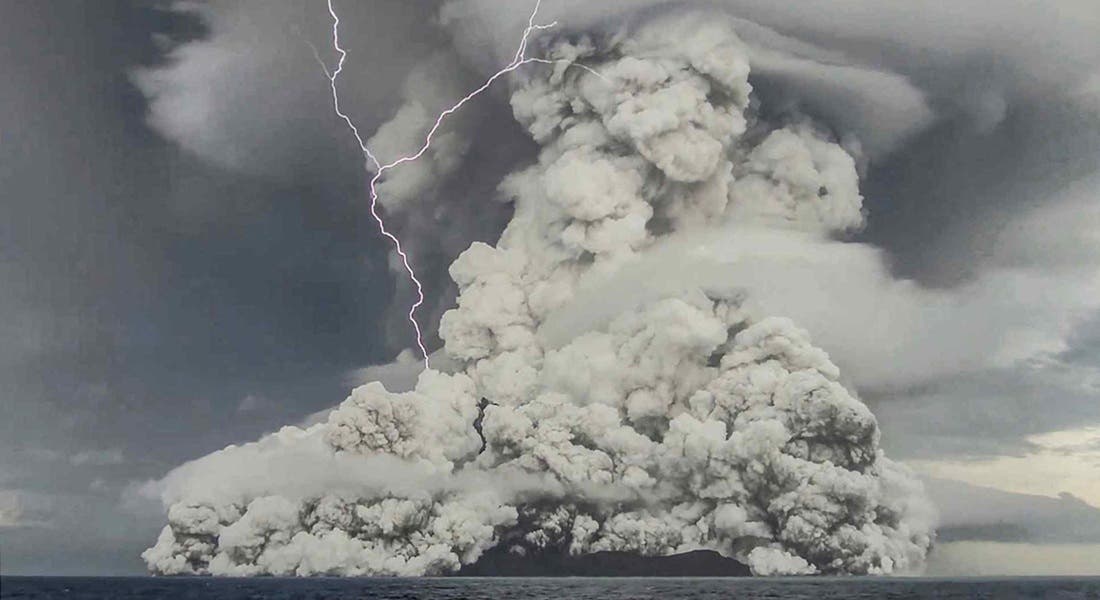
The Hunga Tonga–Hunga Ha’apai-volcanic eruption on 15 january 2022. Image taken from a video of the eruption. (CREDIT: Tonga Geological Services)
A towering plume from the 2022 Hunga Tonga-Hunga Ha’apai eruption did more than blast ash, seawater and gases deep into the atmosphere. It also appears to have triggered an unexpected burst of methane destruction. This offers scientists a rare look at how one of the planet’s most powerful greenhouse gases can be broken down in open air.
That surprise emerged from satellite observations of formaldehyde, a short-lived chemical that forms as methane oxidizes. In the days after the South Pacific volcano erupted on Jan. 15, 2022, researchers spotted unusually high formaldehyde levels inside the plume. They tracked the cloud for 10 days as it drifted toward South America.
“When we analysed the satellite images, we were surprised to see a cloud with a record-high concentration of formaldehyde. We were able to track the cloud for 10 days, all the way to South America. Because formaldehyde only exists for a few hours, this showed that the cloud must have been destroying methane continuously for more than a week,” said Dr. Maarten van Herpen of Acacia Impact Innovation BV, first author of the research published in Nature Communications.
The finding matters because methane is the second most important greenhouse gas after carbon dioxide and is currently responsible for about 0.5 C of warming. Over 20 years, methane traps about 80 times more heat than CO2. However, it also breaks down much faster, usually within about a decade. That makes methane cuts one of the fastest ways to slow near-term warming.
A strange signal high above the Pacific
The Hunga Tonga-Hunga Ha’apai eruption was extraordinary from the start. The submarine volcano, located about 150 meters below sea level, hurled material above 30 kilometers and up to roughly 55 kilometers into the atmosphere. It also injected an estimated 146 ± 5 teragrams of water vapor into the stratosphere, about 10 percent of the total stratospheric burden. Hundreds of gigagrams of sulfur dioxide were also injected.
Yet the formaldehyde signal stood out for a different reason.
Formaldehyde does not linger long in sunlight. Around the TROPOMI satellite overpass time, the team calculated a lifetime of about 2.5 hours. That meant any formaldehyde directly emitted by the volcano should have mostly disappeared by the time the satellite saw the plume about 20 hours later. Instead, the signal remained strong on Jan. 16 and persisted on Jan. 17. In fact, it could still be detected as late as Jan. 25.
The researchers concluded that formaldehyde had to be forming continuously inside the plume.
At its strongest, the formaldehyde enhancement reached 1.6 × 10^15 molecules per square centimeter. Using plume thickness estimates, the team calculated a peak concentration of about 12 parts per billion at around 30 kilometers altitude. This is unusually high for the stratosphere. Previous observations linked to biomass burning had stayed below 0.1 parts per billion at 20 kilometers.
Salt, iron and chlorine
The chemistry may sound exotic, but the researchers think it follows a process they had already identified in a very different setting.
In earlier work, the team found that Sahara dust blowing over the Atlantic can mix with sea salt to form iron salt aerosols. When sunlight hits those particles, chlorine atoms are produced. Those chlorine atoms can then react with methane and start breaking it apart.
“What is new, and completely surprising, is that the same mechanism appears to occur in a volcanic plume high up in the stratosphere, where the physical conditions are entirely different,” said Professor Matthew Johnson of the University of Copenhagen’s Department of Chemistry, who worked on both studies.
The Tonga eruption supplied a strange but useful combination: salty seawater, volcanic ash and intense sunlight high in the atmosphere.
The idea is that seawater injection provided salt, while fine ash particles may have carried iron. Sunlight then helped generate reactive chlorine, which attacked methane in the plume. The formaldehyde seen by satellite was the chemical trail left behind.
One detail strengthened that case. The formaldehyde tracked more closely with aerosols than with sulfur dioxide. That pointed to particle-driven chemistry, rather than sulfur alone, as the more direct link.
The team also examined other possible explanations, including non-methane volatile organic compounds from the volcano and oxidation driven mainly by hydroxyl radicals. They found those alternatives did not fit the observations well.
Measuring methane loss from space
To detect the event, the researchers used the TROPOMI instrument aboard the European Space Agency’s Sentinel-5P satellite, which monitors air pollution and greenhouse gases around the globe each day.
“How do you prove that methane has been removed from the atmosphere? How do you know your method works? It’s very difficult. But here we address that problem by showing that methane breakdown can in fact be observed using satellites,” said Dr. Jos de Laat of the Royal Netherlands Meteorological Institute, senior author of the study.
That was not a routine measurement. Formaldehyde retrievals from a stratospheric volcanic plume sit far outside the instrument’s normal operating conditions.
“Retrieving formaldehyde from TROPOMI in a stratospheric volcanic plume is far outside the instrument's standard operating conditions, we had to carefully correct the satellite's sensitivity for the unusual altitude of the signal and account for interference from the high sulfur dioxide concentrations. Getting these corrections right was essential to confirm that what we were seeing was real,” said Dr. Isabelle De Smedt of the Royal Belgian Institute for Space Aeronomy.
Using those corrected observations, the team estimated methane oxidation at 900 ± 220 metric tons per day in the plume, with a midday rate of 75 ± 18 metric tons per hour on Jan. 16. The researchers inferred that this could only happen if the eruption had also lofted methane into the stratosphere at elevated concentrations.
They argue that chlorine, not hydroxyl chemistry alone, best explains the scale of the effect. Their analysis suggests an average methane enhancement of at least 14 parts per million in the Jan. 16 cloud.
The work does not settle every question. The authors say confirmation of the proposed iron-chloride photochemistry will require dedicated laboratory experiments and modeling. They also note that Tonga offered unusual conditions, including exceptional seawater injection and relatively modest sulfur emissions. Therefore, the same chemistry may not play such a large role in other eruptions.
Practical implications of the research
The broader importance of the study is not that volcanoes will solve global warming. It is that nature may have revealed a process that engineers are already trying to understand. Scientists want to know whether methane can be removed from the atmosphere faster and whether that removal can be measured credibly.
Open-air methane removal ideas have drawn growing interest because they could, in theory, lower warming more quickly than waiting for methane to disappear on its own. But verification remains a major obstacle. Satellites can detect methane emissions well. However, measuring methane destruction, especially over oceans, has been much harder.
This work offers a possible answer. By tracking formaldehyde, a short-lived intermediate produced when methane oxidizes, scientists may have a way to monitor methane removal from space.
“It’s an obvious idea for industry to try to replicate this natural phenomenon, but only if it can be proven to be safe and effective. Our satellite method could offer a way to help figure out how humans might slow global warming,” Johnson said.
Research findings are available online in the journal Nature Communications.
The original story "A violent volcanic eruption triggered a rare atmospheric cleanup" is published in The Brighter Side of News.
Related Stories
- The hidden mantle flow shaping Yellowstone’s supervolcano
- Ancient Ocean Volcanoes Linked to Repeated Triassic Extinctions
- After 700,000 years, Iran’s dormant Taftan volcano is starting to rise
Like these kind of feel good stories? Get The Brighter Side of News' newsletter.
Rebecca Shavit
Writer
Based in Los Angeles, Rebecca Shavit is a dedicated science and technology journalist who writes for The Brighter Side of News, an online publication committed to highlighting positive and transformative stories from around the world. Having published articles on MSN, AOL News, and Yahoo News, Rebecca's reporting spans a wide range of topics, from cutting-edge medical breakthroughs to historical discoveries and innovations. With a keen ability to translate complex concepts into engaging and accessible stories, she makes science and innovation relatable to a broad audience.