The biggest black holes grow by crashing into each other over and over again
The heaviest black holes in gravitational-wave data appear to come from repeated mergers, not direct stellar collapse.

 Edited By: Joseph Shavit

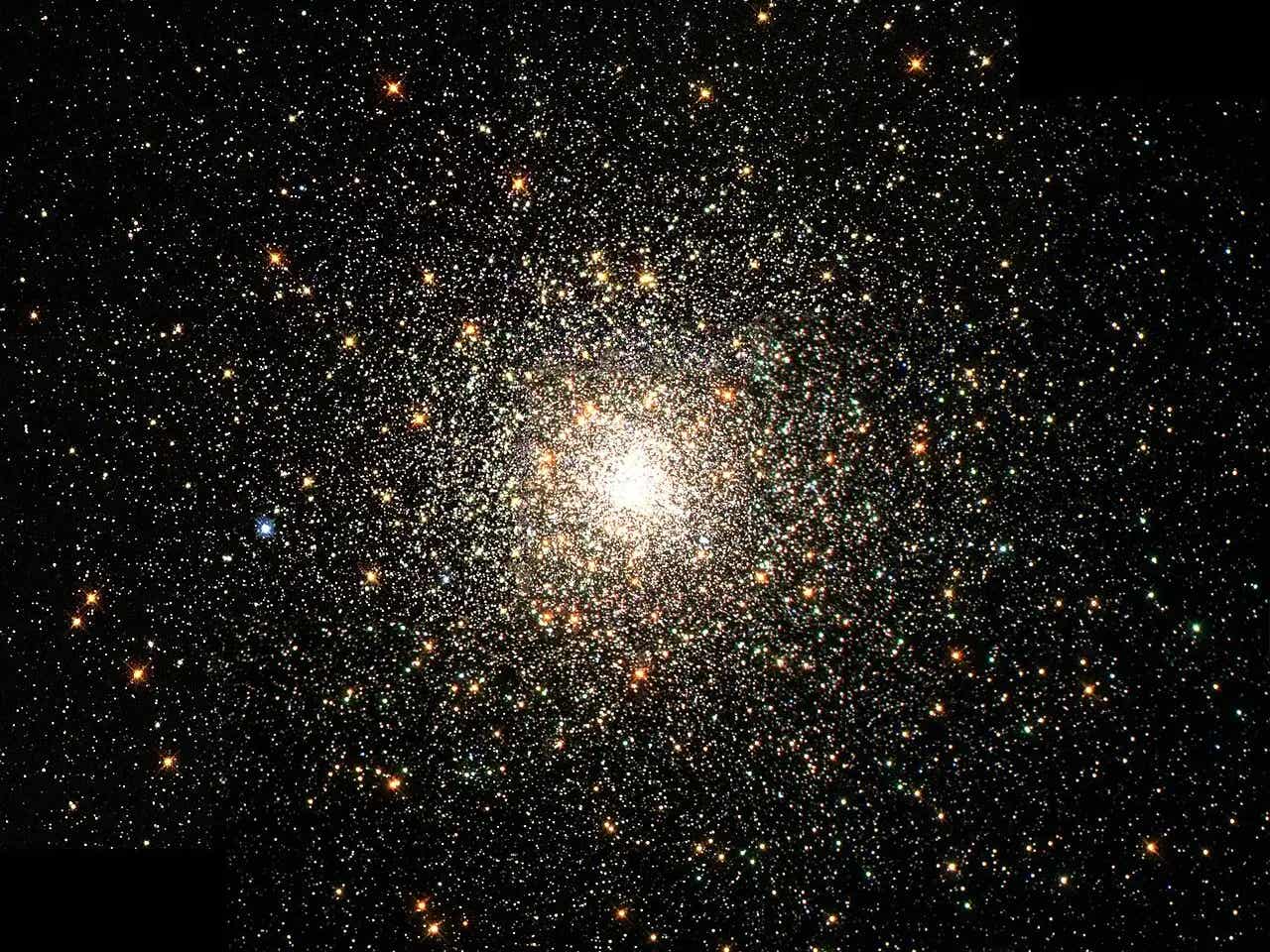
About 28,000 light-years away, the globular cluster M80 is home to hundreds of thousands of stars bound together by gravity. Crowded environments like this can help drive the growth of black holes through consecutive mergers. (CREDIT: NASA, ESA, STScI and A. Sarajedini / University of Florida)
Some of the biggest black holes ever picked up through gravitational waves may not have formed in a single stellar collapse at all. Instead, they seem to be the battered products of repeated smashups inside some of the most crowded stellar environments in the universe.
That is the picture emerging from a new analysis led by Cardiff University, which examined 153 confident black hole merger detections from version 4.0 of the LIGO-Virgo-KAGRA gravitational-wave catalog. The team found that the heaviest black holes in the sample do not behave like an extension of the lighter ones. They look like a separate population.
“Gravitational-wave astronomy is now doing more than counting black hole mergers,” said lead author Dr. Fabio Antonini of Cardiff University’s School of Physics and Astronomy. “It is starting to reveal how black holes grow, where they grow, and what that tells us about the lives and deaths of massive stars. This is exciting because we can use the information to test our understanding of how stars and clusters evolve in the Universe.”
The dividing line appears near 45 times the mass of the Sun.
Below that point, the data fit what astronomers would expect from black holes born more directly from collapsing stars. Those systems tend to have relatively modest spins. Above it, the pattern shifts. The heavier black holes show broader spin behavior, including faster spins pointing in seemingly random directions, a pattern that fits repeated mergers in dense star clusters far better than ordinary stellar binaries do.
A split in the black hole population
The researchers used gravitational-wave data to map how spin changes with the mass of the larger black hole in each binary. That spin signature matters because it offers clues about where a black hole came from.
In a quiet stellar binary, spins are more likely to retain some order. In a packed cluster, where black holes can form pairs, merge, and then merge again, that order breaks down. A merger remnant can get kicked into a new encounter, creating a heavier black hole with a new spin history. Over time, that process can stack up mass in a way a single dying star cannot.
“What surprised us most was how clearly the high-mass black holes stand out as a separate population,” said co-author Dr. Isobel Romero-Shaw, an Ernest Rutherford Fellow at Cardiff University.
“Unlike the lower-mass systems we analysed, which were generally slowly-spinning, the higher-mass systems are consistent with having more rapid spins, oriented in seemingly random directions. This is the exact signature you would expect if black holes were repeatedly merging in dense star clusters.
“That makes the cluster origin much more compelling than it was with earlier catalogues.”
The new catalog is more than twice the size of the earlier GWTC-3 dataset used in related work. In the older sample, 69 sources were available. The new one includes 153, with 34 systems above 45 solar masses. That larger sample let the team tighten its statistical constraints and test whether the earlier hint of a high-mass spin transition would hold up. It did.
The researchers report a Bayes factor greater than 10,000 in favor of a model with a distinct high-mass spin component over one in which black holes of all masses share the same spin distribution. In plainer terms, the evidence for a split population is now very strong.
The return of a long-predicted mass gap
The findings also sharpen the case for one of stellar astrophysics’ most discussed missing zones: the pair-instability mass gap.
Theory has long predicted that stars above a certain core mass should not leave behind black holes in a broad mass range. Instead, violent pair-instability processes should either pulse away material or blow the star apart completely. That would suppress the direct birth of black holes roughly between about 40 and 130 solar masses.
But gravitational-wave detections have kept turning up black holes that seem to sit in or near the lower end of that range, raising an obvious question. Are the stellar models wrong, or are these black holes being made some other way?
Dr. Antonini said the new work points strongly to the second option.
“In our study we find evidence for the long-predicted pair-instability mass gap — a range of masses where stars are not expected to leave behind black holes at all. Gravitational-wave detectors have successfully found black holes that appear to sit in or near that gap, which we identify at around 45 solar masses.
“So, the key question now is are these black holes telling us that our models of stellar evolution are wrong, or are they being made in another way?
“The biggest black holes in the current sample seem to be telling us about cluster dynamics, not just stellar evolution.
“Above about 45 solar masses the spin distribution changes in a way that is hard to explain with normal stellar binaries alone but is naturally explained if these black holes have already been through earlier mergers in dense clusters.”
The overall mass distribution also contains what the team calls a “cliff,” a steep drop in merger rate near 40 solar masses, followed by a shallower high-mass plateau. That shape fits cluster-based hierarchical merger models, where first-generation black holes thin out and merger remnants begin to populate the gap.
There is also a possible hint of another, lower-mass feature around 14 solar masses. The authors describe that as only marginal evidence for now, not a statistically required result.
What black holes may be saying about nuclear physics
The study does not stop with black hole family history. It also uses the inferred lower edge of the pair-instability gap to say something about a crucial nuclear reaction inside massive stars: the conversion of carbon into oxygen during helium burning.
That reaction, written as 12C(α, γ)16O, helps set the carbon-to-oxygen balance in stellar cores before collapse. In turn, that balance influences when pair instability begins. By linking the observed transition near 45 solar masses to the lower edge of the mass gap, the team derived an astrophysical estimate for the reaction’s S-factor at 300 keV.
Their estimate is consistent with recent nuclear-physics determinations, but the authors argue gravitational-wave data could eventually provide especially useful constraints because the black hole mass spectrum is so sensitive to the details of helium burning in massive stars.
“In the future, gravitational-wave data may help scientists study nuclear physics, because the mass limit set by pair instability depends on the nuclear reactions taking place in the cores of massive stars,” said co-author Dr. Fani Dosopoulou, a research associate at Cardiff University.
That makes the work unusually broad in its reach. A catalog built from ripples in space-time may now be informing questions about supernovae, red supergiants, white dwarfs, and even the chemical ingredients that shape later generations of stars and planets.
Practical implications of the research
This research suggests gravitational-wave observatories are becoming tools not just for spotting black hole collisions, but for reconstructing how the heaviest black holes grow. If the interpretation holds, mergers above about 45 solar masses can serve as markers of dense environments such as globular clusters, and possibly other places like nuclear star clusters or active galactic nucleus disks.
The results also give astronomers a cleaner way to test models of stellar death. If black holes in the lower pair-instability gap mostly come from earlier mergers, then the gap itself may still exist just as theory predicted, with later collisions filling it in.
Over the next observing runs, larger catalogs should show whether this two-population picture becomes even sharper. They may also turn black hole demographics into an unexpected probe of nuclear physics deep inside massive stars.
Research findings are available online in the journal Nature Astronomy.
The original story "The biggest black holes grow by crashing into each other over and over again" is published in The Brighter Side of News.
Related Stories
- Black hole GW190521 may be a wormhole from another universe
- Massive binary star system may be feeding the Milky Way’s central black hole
- ‘Dancing jets’ from black hole reveal their immense power
Like these kind of feel good stories? Get The Brighter Side of News' newsletter.
Joshua Shavit
Writer and Editor
Joshua Shavit is a NorCal-based science and technology writer with a passion for exploring the breakthroughs shaping the future. As a co-founder of The Brighter Side of News, he focuses on positive and transformative advancements in technology, physics, engineering, robotics, and astronomy. Having published articles on AOL.com, MSN, Yahoo News, and Ground News, Joshua's work highlights the innovators behind the ideas, bringing readers closer to the people driving progress.