Alberta fossil offers first reported evidence of raptors feeding on tyrannosaurs
An Alberta fossil suggests a small raptor fed on a much larger Albertosaurus, offering a rare glimpse of dinosaur scavenging.
 University of Alberta Writer: Geoff McMaster

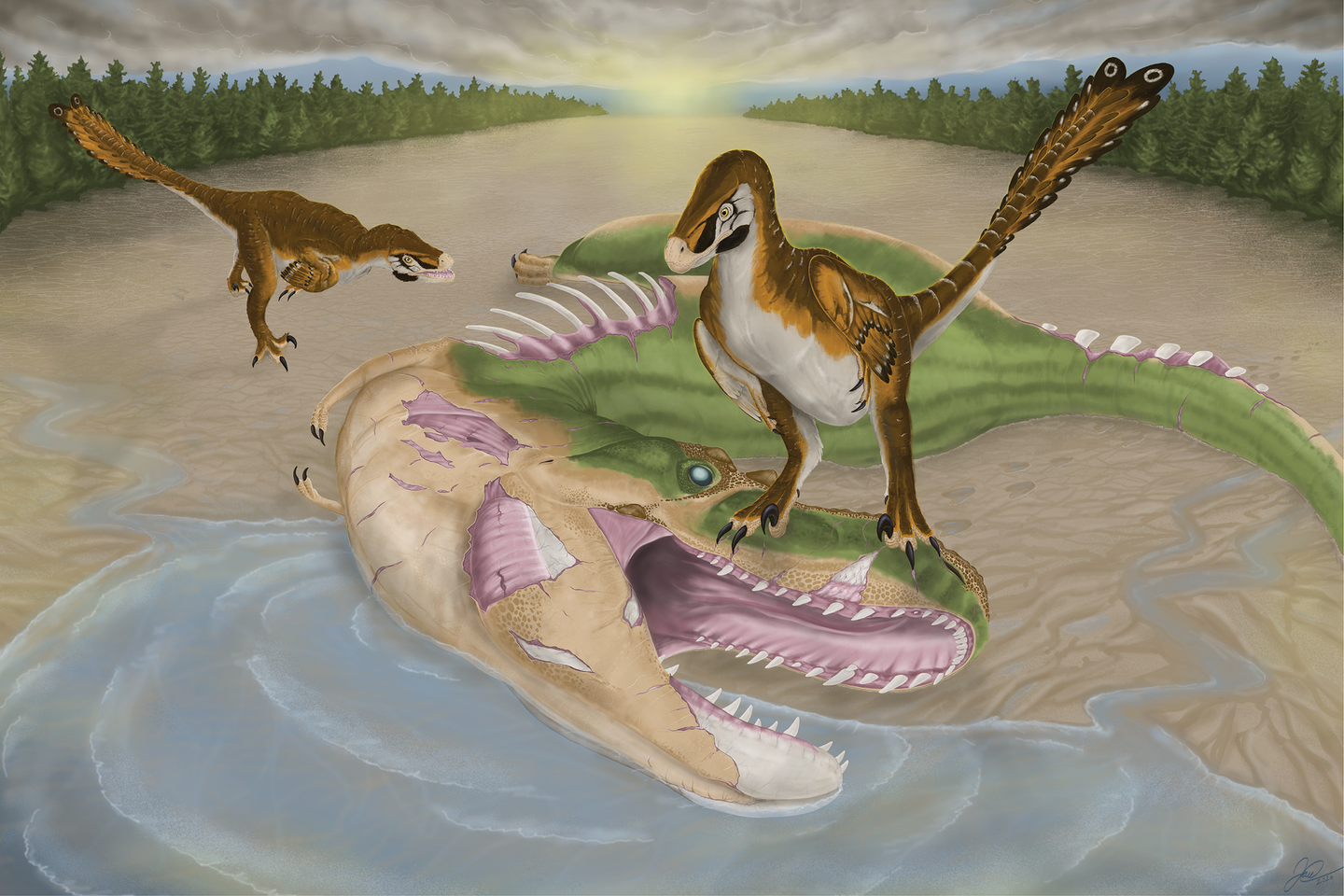
Reconstruction of potential scenario for the cause of tooth marks on TMP 2022.007.0040: Atrociraptor scavenge the carcass of Albertosaurus along the edge of a river floodplain; artwork by JAD. (CREDIT: Joshua Doyon et al, Journal of Paleontology 2026)
- Tooth marks on an Albertosaurus jaw favor a small raptor feeding on the much larger dinosaur’s carcass.
- The study offers the first reported evidence of dromaeosaurid feeding on a tyrannosaur, suggesting opportunistic scavenging.
- A very young Albertosaurus remains an alternative suspect, and the marks do not reveal the cause of death.
A dinosaur weighing more than half a metric ton appears to have become a meal for a much smaller carnivore. Scratches on its jaw point toward a raptor feeding on the remains of an Albertosaurus, a relative of Tyrannosaurus rex.
The fossil analysis, published in the Journal of Paleontology, was led by University of Alberta researcher Joshua Doyon. Coauthors include university paleontologist Philip Currie and Royal Tyrrell Museum researchers Caleb Brown and François Therrien.
The team favors a small dromaeosaurid, the dinosaur group commonly called raptors, as the animal responsible. If that interpretation is correct, the specimen provides the first reported evidence of one feeding on a tyrannosaur. Scavenging is considered more likely than an attack on the living animal.
A public discovery becomes a feeding investigation
A member of the public found the scattered remains in 2022 near Drumheller, Alberta. The site lies in the Red Deer River valley, about five kilometers north of Morrin Bridge. Its rocks belong to the Late Cretaceous Horseshoe Canyon Formation.
Royal Tyrrell Museum staff collected and prepared the specimen, then recognized possible tooth marks on its jaw bones. That observation gave Doyon an opportunity to investigate a feeding encounter preserved in unusually fine detail. He began the work while still an undergraduate.
The remains include several skull elements and part of a shattered limb bone. They represent the smallest associated skull of Albertosaurus described so far, although the dinosaur itself was hardly small. Estimates based on skull dimensions put its length near six meters and its mass at approximately 533 kilograms.
Growth marks in the limb bone indicate that it was at least eight years old and still growing. Some early growth records may have disappeared as the bone remodeled, leaving its exact age uncertain. The specimen was a subadult, rather than a fully grown predator.
Tiny scratches preserve the teeth behind them
Two jaw bones hold different clues. On the outer surface of one, called the surangular, a tooth left a mark approximately 8.2 millimeters long. Within that mark, the researchers identified about 28 smaller scratches made by the serrations along a tooth’s edge.
Those serrations can help distinguish potential feeders. Their spacing varies among dinosaur groups and with tooth size. The team compared the fossil traces with teeth and tooth sockets in museum collections, checking which animals could have produced them.
Another bone, the splenial, preserves three nearly parallel tooth scrapes on the inside of the lower jaw. Their spacing offers a different clue: the distance between neighboring teeth in the animal’s mouth. Combining both kinds of evidence narrowed the possibilities more effectively than either could alone.
The researchers also checked whether excavation or preparation had produced the damage. They interpreted the traces as feeding marks rather than tool scratches. Their pattern pointed toward serrated dinosaur teeth, while the tooth shapes of other possible animals did not fit.
The angle of a bite changes the apparent spacing
Measuring the scratches directly was only the beginning. A row of teeth dragged obliquely across bone can leave marks closer together than the teeth actually sit. The same problem affects the spacing recorded by individual tooth serrations.
The team developed a correction that accounts for this angle. Because the original tooth position cannot be recovered exactly, they tested alternative orientations. These produced a range of possible tooth and serration spacings, rather than one definitive measurement.
That correction matters for identifying the feeder. An uncorrected distance can suggest an animal with smaller, more tightly packed teeth. Accounting for the direction of movement changes which dinosaur mouths fit the evidence.
The three splenial scrapes illustrate the difference. Their average measured spacing was about 2.35 millimeters, but the proposed corrections increased it to approximately 4.44 or 8.53 millimeters. Those alternatives depend on how the tooth row crossed the bone, an orientation the researchers reconstructed rather than directly observed.
The combined comparisons best supported a dromaeosaurid. Atrociraptor marshalli is the only confidently identified member of that group from the Horseshoe Canyon Formation, making it a candidate. However, the marks cannot establish the feeder’s species with certainty.
The analysis also has practical limits. Tooth rows and bitten bones are curved, and serration spacing varies along a tooth. Missing specimens of very small dinosaurs further complicate comparisons, especially when assessing a young tyrannosaur as an alternative.
A young cannibal remains another possibility
A very young Albertosaurus could also have left the marks. The paper estimates that such an animal might have measured approximately 2.9 meters long and been younger than two. It would therefore have been considerably smaller than the subadult whose jaw it marked.
That explanation would indicate cannibalism, since Albertosaurus is the only tyrannosaur known from this formation. Feeding on members of the same species has been documented in tyrannosaurs before. Here, the unusual feature would be the very young age of the possible feeder.
The researchers also could not completely exclude Richardoestesia, another small carnivorous dinosaur. A dromaeosaurid nevertheless provides the strongest overall match. None of these possibilities should be treated as an identification equivalent to finding the feeder’s tooth embedded in the bone.
There is another complication: both sets of marks need not have come from the same animal. Different individuals, or even different species, could have visited the carcass. The fossil cannot establish whether feeding happened once or across several encounters.
A meal does not establish a kill
The feeding marks show no healing, indicating that they formed around the time of death or afterward. That evidence cannot, by itself, distinguish predation from scavenging. The cause of the Albertosaurus’s death remains unknown.
Size makes scavenging the favored explanation. A possible dromaeosaurid feeder would have weighed roughly 16 to 18 kilograms, compared with the Albertosaurus’s estimated 533 kilograms. That creates a body-mass disparity of about 30 to one.
Clean edges around the marks suggest feeding occurred before the bones fully dried and weathered. Their position near jaw muscles and other mouth tissues also fits access to remaining meat. The scratches likely record teeth accidentally contacting bone, rather than deliberate bone consumption.
The finding adds a feeding interaction without overturning Albertosaurus’s position as an apex predator. Even a dominant hunter can become food after death. In this case, a few millimeters of damage preserve evidence that a smaller carnivore may have taken that opportunity.
Dig deeper into dinosaur feeding and scavenging
These studies examine fossil feeding traces, cannibalism and changes in dinosaur diets during growth.
Exceptionally preserved stomach contents of a young tyrannosaurid reveal an ontogenetic dietary shift in an iconic extinct predator: Preserved prey remains provide direct evidence of what a juvenile tyrannosaur ate and how diet changed with growth. (Science Advances, 2023)
Cannibalism in Tyrannosaurus rex: Examines tooth marks interpreted as evidence that tyrannosaurs fed on members of their own species. (PLOS ONE, 2010)
High frequencies of theropod bite marks provide evidence for feeding, scavenging, and possible cannibalism in a stressed Late Jurassic ecosystem: Explores how marked bones can reveal carcass use and feeding relationships within an ancient ecosystem. (PLOS ONE, 2020)
Ontogenetic dietary shifts in Deinonychus antirrhopus (Theropoda; Dromaeosauridae): Insights into the ecology and social behavior of raptorial dinosaurs through stable isotope analysis: Uses tooth chemistry to investigate differences between juvenile and adult raptor diets. (Palaeogeography, Palaeoclimatology, Palaeoecology, 2020)
Bite and tooth marks on sauropod dinosaurs from the Morrison Formation: Surveys feeding traces on large herbivores and considers what tooth contact reveals about carnivore behavior. (PeerJ, 2023)
Research findings are available online in the Journal of Paleontology.
The original story "Alberta fossil offers first reported evidence of raptors feeding on tyrannosaurs" is published in The Brighter Side of News.
Related Stories
- 2.6-million-year-old jaw fossil challenges long-held ideas about early hominins
- Scotland’s famous 'Lizzie' fossil was not the early reptile scientists thought
- 240 million-year-old tusked herbivore fossil upends the timeline of early dinosaur evolution
Like these kind of feel good stories? Get The Brighter Side of News' newsletter.
Joseph Shavit
Writer, Editor-At-Large and Publisher
Joseph Shavit, based in Los Angeles, is a seasoned science journalist, editor and co-founder of The Brighter Side of News, where he transforms complex discoveries into clear, engaging stories for general readers. With vast experience at major media companies like The Los Angeles Times, Times Mirror and Tribune Publishing, he writes with both authority and curiosity. His writing focuses on space science, planetary science, quantum mechanics, geology. Known for linking breakthroughs to real-world markets, he highlights how research transitions into products and industries that shape daily life.