240 million-year-old tusked herbivore fossil upends the timeline of early dinosaur evolution
A museum fossil named after the Wamanda people is forcing scientists to reconsider the age of Tanzania’s earliest dinosaur candidates.

 Edited By: Joseph Shavit

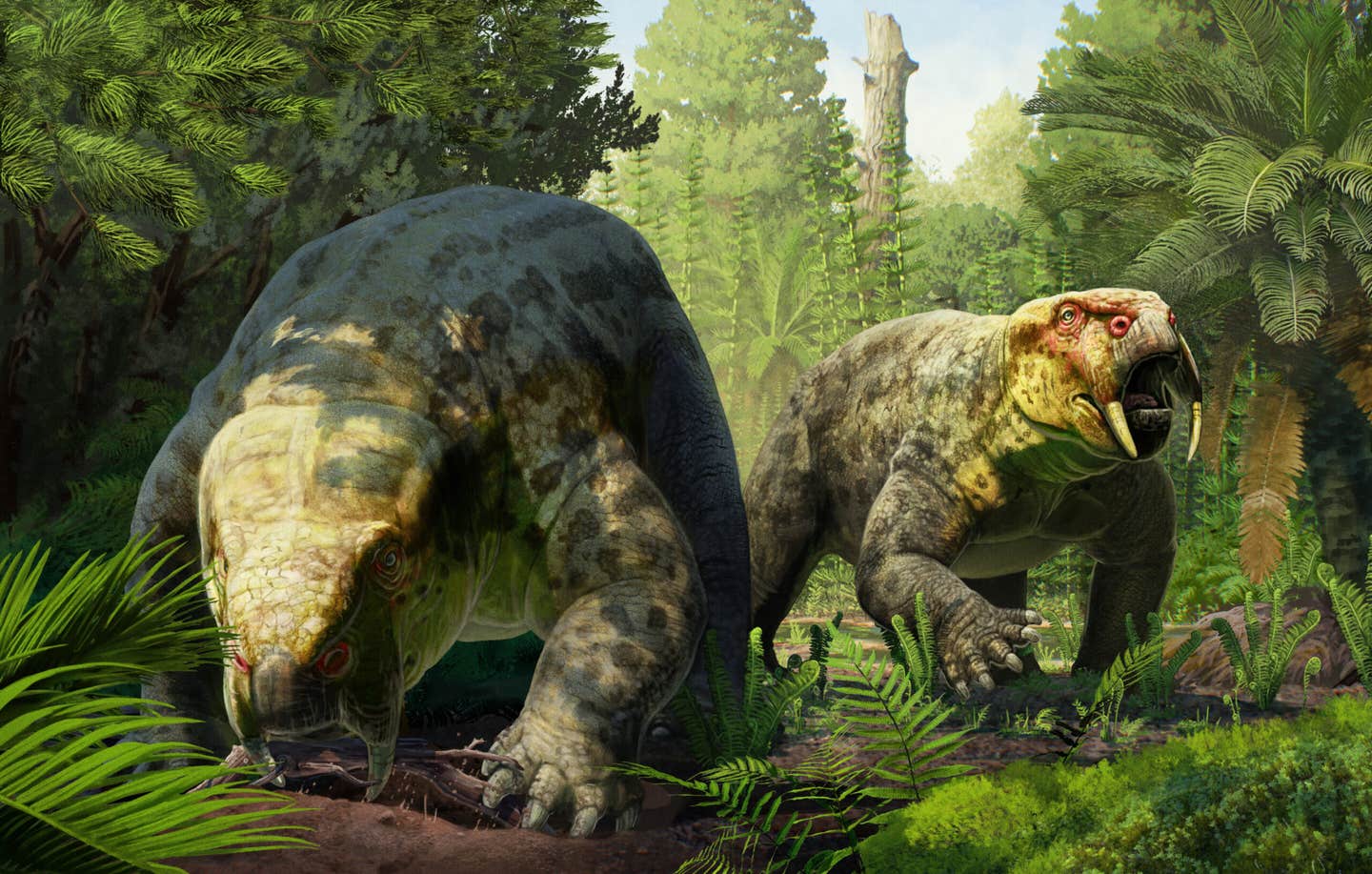
A museum fossil named after the Wamanda people is forcing scientists to reconsider the age of Tanzania’s earliest dinosaur candidates. (CREDIT: Gabriel Ugueto)
- A newly named Tanzanian dicynodont, Dinodontosaurus isiyavamanda, is the first confirmed member of its genus found outside South America.
- Its presence links Tanzania’s Lifua Member with similarly aged South American fossil beds, supporting a younger Late Triassic age than previously proposed.
- That revised age means controversial dinosaur candidates from the same Tanzanian rocks may no longer predate the earliest dinosaur records from South America.
A tusked herbivore whose bones spent more than six decades in a museum collection is changing how paleontologists date one of Africa’s most important Triassic fossil deposits.
The animal, newly named Dinodontosaurus isiyavamanda, lived in what is now Tanzania roughly 240 million years ago. It belonged to the dicynodonts, a successful group of plant-eating synapsids related more closely to mammals than to dinosaurs.
Its identity carries unusual importance because Dinodontosaurus was previously known only from South America. Finding the same genus in Tanzania creates a new link between fossil-bearing rocks on the two continents and suggests that the Tanzanian deposits are younger than traditionally thought.
That, in turn, affects the age assigned to controversial fossils from the same geological unit that have been proposed as some of the world’s earliest dinosaurs.
A museum skeleton finally gets a name
The main specimen was collected in 1963 during a British expedition to Tanzania and eventually entered the collections of the Natural History Museum in London.
It includes much of a skull and lower jaw, along with parts of the shoulder, limbs, vertebral column, pelvis and tail. Researchers later determined that material stored under the same catalogue number represented at least four individuals, so they concentrated on bones confidently associated with the principal skeleton.
A second skull specimen discovered in 2012 supplied additional evidence.
Nigel Larkin, now a visiting research fellow at the University of Reading, first studied the older skeleton for a master’s thesis in 1994 and concluded that it probably represented a species unknown to science.
Nearly three decades later, improved imaging and a larger international collaboration allowed researchers to examine it in much greater detail.
Anatomy points to a South American genus
Several features placed the animal within Dinodontosaurus.
The skull had structures characteristic of the genus, including distinctive frontal and postorbital bones, prominent tusks and the shape of its caniniform region. Yet the Tanzanian specimen also differed from the known South American species D. brevirostris and D. tener.
One of the clearest differences appeared on the palate. A ridge on the premaxilla expanded forward into a broad, bulbous structure instead of remaining ridge-shaped throughout its length.
Other distinctions included a groove along the temporal bar, wider-spreading lower jaw branches and differences around the snout, eye region and pineal opening.
The team named the animal Dinodontosaurus isiyavamanda. Its species name comes from the Manda words “isi ya vamanda,” meaning “country of the Wamanda,” recognizing people from the region where the fossils were found.
Evolutionary tests agree, but not on every detail
Researchers tested the animal’s position using 199 anatomical characters across 124 taxonomic units.
Parsimony and Bayesian analyses both grouped the Tanzanian species with the two recognized South American Dinodontosaurus species. The Bayesian analysis gave the grouping a posterior probability of 0.88.
Exactly how the three species are related remains less certain. One analysis placed D. isiyavamanda closest to D. tener, but that relationship had weak support.
A maximum-likelihood analysis produced a different placement near Stahleckeriidae, but its bootstrap support was only 1%. The disagreement highlights continuing uncertainty in the family tree of these large Triassic dicynodonts.
More study of the extensive Tanzanian postcranial material may eventually clarify those relationships.
A skull may also reveal how herbivores divided food
The new species increases the number of known dicynodont taxa from the middle-to-upper Lifua Member to five, and possibly six.
That raises an ecological question: how could so many large herbivores occupy the same environment?
D. isiyavamanda had a relatively short secondary palate compared with several other dicynodonts living in the same ecosystem. Researchers suggest that this arrangement may have increased mechanical advantage and bite force.
Its unusual bulbous palatal structure may also indicate a different method of processing vegetation. If so, differences in feeding mechanics could have allowed several large herbivore species to divide available food resources rather than compete for exactly the same plants.
The idea remains a hypothesis, and future biomechanical work is planned.
One fossil changes the age of an entire fauna
The most far-reaching implication comes from geography.
Before this discovery, Dinodontosaurus was known from Brazil and Argentina. Its confirmed presence in Tanzania strengthens correlations between the Lifua Member and South American formations containing similar Triassic animals.
New radiometric ages in South America indicate that some of those corresponding rocks are substantially younger than the age historically assigned to Tanzania’s Manda Beds.
The researchers therefore argue that the middle-to-upper Lifua Member is probably latest Ladinian to Carnian in age rather than Anisian.
That matters because the same Tanzanian rocks produced Nyasasaurus parringtoni, an animal proposed as either an extremely early dinosaur or a very close dinosaur relative. If the rocks are younger, Nyasasaurus and other candidates from the unit would no longer extend the dinosaur lineage as far back in time as once proposed.
Museum collections can rewrite evolutionary timelines
The revised interpretation does not settle exactly when dinosaurs originated. The status of Tanzania’s earliest dinosaur candidates remains debated, and correlations based on fossil animals still carry uncertainty.
What D. isiyavamanda provides is another independent clue for matching the Tanzanian rocks with better-dated sequences elsewhere in the former supercontinent.
The finding also shows why old museum collections continue to matter. Much of the crucial skeleton had remained in London since 1963, waiting for detailed study and techniques such as micro-CT imaging.
“This fossil specimen from Tanzania has been in our care for over 60 years, and it’s wonderful that its identity has now been brought to light,” said Natural History Museum curator Mike Day.
One previously unnamed herbivore has now connected eastern Africa with South America, added a species to the Triassic world and forced another look at the timeline surrounding the rise of dinosaurs.
Dig deeper into Triassic dicynodonts and dinosaur origins
These studies explore Dinodontosaurus, the dating of related South American faunas and the disputed early dinosaur record that makes the Tanzanian discovery important.
New specimen of Dinodontosaurus (Therapsida, Anomodontia) from west-central Argentina (Chañares Formation) and a reassessment of the Triassic Dinodontosaurus Assemblage Zone of southern South America: This study reassessed South American Dinodontosaurus fossils and their biostratigraphic significance, providing an important comparison for the new Tanzanian species. (Journal of South American Earth Sciences, 2020)
The oldest South American silesaurid: New remains from the Middle Triassic (Pinheiros-Chiniquá Sequence, Dinodontosaurus Assemblage Zone) increase the time range of silesaurid fossil record in southern Brazil: This paper describes an early dinosaur relative from the Brazilian Dinodontosaurus Assemblage Zone and examines similarities among Triassic faunas in Brazil, Tanzania and Zambia. (Journal of South American Earth Sciences, 2022)
U-Pb age constraints on dinosaur rise from south Brazil: High-precision zircon dating placed important Brazilian dinosaur-bearing rocks at about 233 million years old and helped recalibrate the chronology of dinosaur origins in western Pangaea. (Gondwana Research, 2018)
The oldest dinosaur? A Middle Triassic dinosauriform from Tanzania: This influential study described Nyasasaurus parringtoni as either an early dinosaur or its close sister taxon, making the age of Tanzania’s Manda Beds central to debates over dinosaur origins. (Biology Letters, 2013)
Deep faunistic turnovers preceded the rise of dinosaurs in southwestern Pangaea: Fossils from Argentina’s Chañares Formation document major changes in vertebrate communities shortly before dinosaur diversification and provide context for the South American rocks compared with Tanzania. (Nature Ecology & Evolution, 2017)
Research findings are available online in the journal Journal of Vertebrate Paleontology.
The original story "240 million-year-old tusked herbivore fossil upends the timeline of early dinosaur evolution" is published in The Brighter Side of News.
Related Stories
- First-ever amber discovery in Antarctica reveals lost prehistoric rainforest
- Why don't giant prehistoric insects still exist?
- Earliest known human-animal figurine provides 12,000-year-old glimpse into prehistoric beliefs
Like these kind of feel good stories? Get The Brighter Side of News' newsletter.
Rebecca Shavit
Writer
Based in Los Angeles, Rebecca Shavit is a dedicated science and technology journalist who writes for The Brighter Side of News, an online publication committed to highlighting positive and transformative stories from around the world. Having published articles on MSN, AOL News, and Yahoo News, Rebecca's reporting spans a wide range of topics, from cutting-edge medical breakthroughs to historical discoveries and innovations. With a keen ability to translate complex concepts into engaging and accessible stories, she makes science and innovation relatable to a broad audience.