ALMA observatory maps a cosmic ‘hamburger’ that may be building a giant planet
ALMA maps gas, dust, and a sulfur monoxide arc in Gomez’s Hamburger, revealing possible giant-planet formation alongside an asymmetric disk and wind-like gas.
 ESO Writer: Bárbara Ferreira

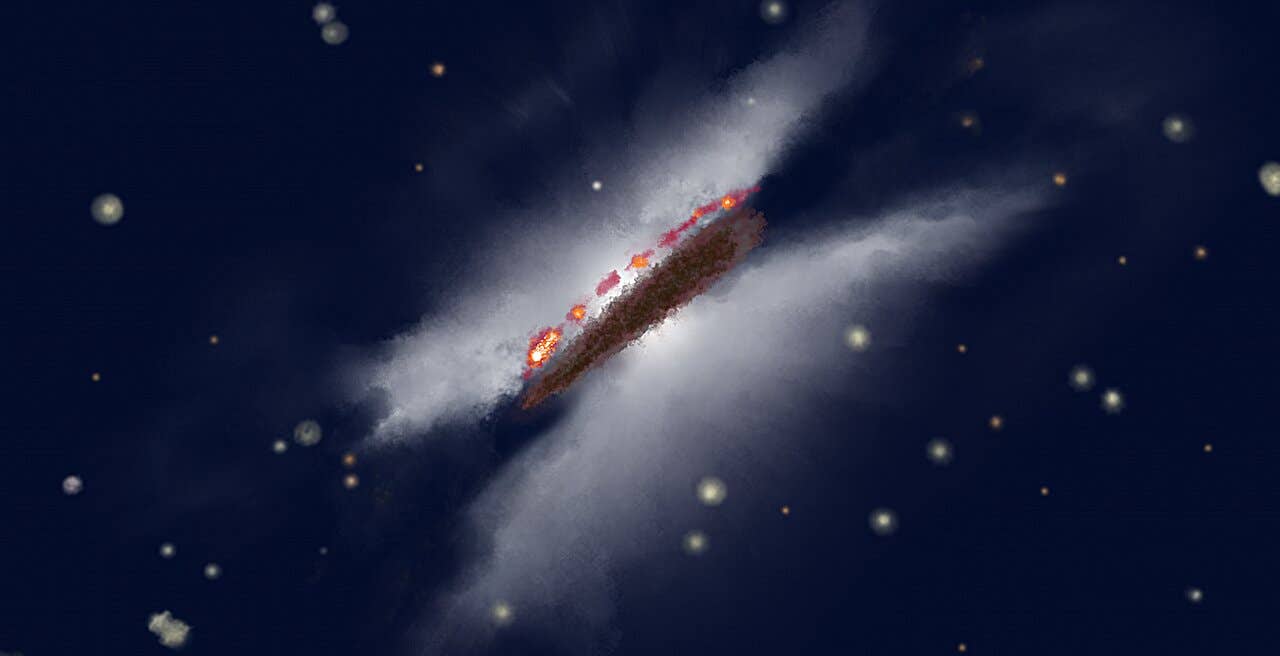
An artist’s impression of Gomez’s Hamburger shows gas and dust rotating around a young star in distinct layers, as mapped by ALMA at millimeter wavelengths. (CREDIT: NSF/AUI/NSF NRAO/P. Vosteen)
- ALMA detected sulfur monoxide emission peaking near GoHam b, a dense clump that may be forming a giant planet.
- The nearly edge-on disk reveals layered gas, concentrated dust, pronounced asymmetry, and extended gas with unusual motion.
- The planet candidate and possible wind remain unconfirmed, with additional chemical and motion measurements needed to distinguish competing explanations.
Sulfur-bearing gas is giving astronomers a new way to investigate a possible giant planet hidden inside Gomez’s Hamburger. ALMA observations reveal a narrow arc of sulfur monoxide whose brightest region lies near a dense clump called GoHam b. The alignment suggests that heating around a forming object could be changing the disk’s chemistry.
The study, led by Charles Law, an assistant professor at the University of Minnesota, has been accepted by The Astrophysical Journal. The manuscript is available on arXiv, with a revised version posted October 5. Its findings bring together chemical, structural, and motion measurements from one of the largest known planet-forming disks.
A sideways view reveals the layers
Gomez’s Hamburger, often shortened to GoHam, consists of a young star surrounded by a broad disk of gas and dust. Astronomers see that disk almost edge-on, allowing its upper and lower regions to appear separately. This orientation provides an unusually direct view of the vertical structure within a potential planetary nursery.
“GoHam gives us a rare and clear view of the vertical and radial structure of a very large, nearly edge-on disk,” Law said. He described the system as a benchmark for testing detailed models of planet formation and disk evolution. Its size and uneven structure allow researchers to examine several processes within the same environment.
The team used the Atacama Large Millimeter/submillimeter Array in Chile to observe dust emission at a wavelength of 0.9 millimeters. They also mapped two forms of carbon monoxide, ¹²CO and ¹³CO, plus carbon monosulfide, known as CS, and sulfur monoxide, or SO. These molecular signals reveal different emitting layers within the disk.
The ¹²CO emission appears highest above the central plane, followed by ¹³CO, with CS closer to the middle. All three trace gas above the thinner distribution of millimeter-sized dust grains. Their relative heights reflect the disk’s chemical and physical conditions and how the emission travels through surrounding material.
A sulfur arc near an old candidate
The SO emission stands out because it forms a narrow arc along the eastern side of the disk. Its brightness is strongly uneven between north and south, peaking near the southern GoHam b overdensity. That location also coincides with enhanced millimeter dust emission and a gap-like feature in observations of smaller grains.
Earlier observations had already identified GoHam b as an unusually dense concentration of material. Using the revised distance adopted in the new study, its projected separation from the star is approximately 280 astronomical units. One astronomical unit equals the average distance between Earth and the Sun.
Those earlier findings made the clump a candidate for a young protoplanet, an object still assembling within its parent disk. The new SO observations add a chemical clue to that hypothesis. They do not establish that the clump has become a gravitationally bound planet.
The proposed connection depends on how sulfur moves between solid grains and gas. In cold disk regions, sulfur-bearing material can remain locked in icy grain coatings. Local heating or shocks can release that material, increasing the abundance of molecules such as SO in the gas.
A collapsing fragment could produce the necessary disturbance through compression, accretion, or associated spiral structures. The resulting chemical enhancement might reveal activity that is difficult to observe directly through the dust. This makes the sulfur arc a possible indicator of the environment around a forming object.
Reading a possible chemical wake
The SO-emitting gas follows approximately the rotation expected within the disk. A local heating source could still affect gas that subsequently travels onward around the star. The extended arc might therefore record a chemical wake, with its brightest emission closest to the disturbance.
Several other processes could also produce enhanced SO emission. Uneven stellar illumination, greater penetration of ultraviolet radiation near the dust edge, or incoming material striking the disk could change local chemistry. The challenge is determining which explanation also accounts for the nearby gas concentration and dust structures.
A large disk with an uneven supply of solids
GoHam’s southern dust emission extends farther from the star while occupying a narrower vertical distribution than the northern emission. That combination points to a significant difference between the disk’s two halves. It could involve the redistribution of larger grains, although temperature and transparency also affect the observed brightness.
The researchers consider gravitationally driven disturbances, an eccentric disk, vortices, and uneven illumination among the possible explanations. Some of these processes could concentrate solid material into regions favorable for planet formation. Observations across additional wavelengths would help distinguish actual concentrations of grains from other causes of brighter emission.
The study estimates approximately 180 Earth masses of dust under commonly used temperature and emission assumptions. That is about five times the average dust mass reported for disks around comparable Herbig stars. The estimate may be too low because some dust emission could be obscured by material along the line of sight.
A massive disk is particularly interesting because its own gravity can influence its structure. Gravitational instability can generate spiral arms and concentrations that, under suitable conditions, collapse into bound fragments. GoHam offers a setting for testing whether such a process helps produce giant planets far from their stars.
Wispy gas may be leaving the disk
The northern disk contains another distinct feature: faint, extended carbon monoxide emission with motion that departs from the expected orbital pattern. Some structures appear as wispy bands extending from different heights. They are consistent with a possible disk wind, although the observations do not definitively identify one.
Radiation-driven heating could allow gas to escape through photoevaporation. Alternatively, magnetic forces could launch an outflow with some similar features. The team cannot yet distinguish those mechanisms, and the strength of the surrounding ultraviolet radiation field remains uncertain.
Distance changes the scale of the investigation
The team estimates GoHam’s distance at 139 ± 24 parsecs, or roughly 450 light-years. This places it closer than the 250-parsec distance assumed in some earlier work. The revision reduces earlier distance-dependent estimates of the disk’s physical size and mass.
Even at that closer distance, the carbon monoxide disk reaches approximately 900 astronomical units in radius and heights of about 350 astronomical units. Modeling the gas motion also gives a stellar mass of 2.2 ± 0.5 times the Sun’s. These measurements define the setting in which the possible fragment and the surrounding disturbances must be explained.
The next tests concern whether other sulfur-bearing molecules and warm-gas indicators also brighten near GoHam b. Their distribution could distinguish fragment-driven heating from irradiation or incoming material. Establishing what powers that localized chemistry would bring astronomers closer to deciding whether this dense clump represents an early stage of giant-planet formation.
Dig deeper into giant planet formation
These five resources explain GoHam’s chemistry and structure, along with the gravitational processes that may produce distant giant planets.
- An SMA Molecular Inventory of the Edge-on Protoplanetary Disk Gomez’s Hamburger: A complementary survey identifies 11 molecules in GoHam and examines possible chemical signatures of gravitational instability without finding definitive evidence for it. The Astrophysical Journal, July 2026.
- Spirals and Clumps in V960 Mon: Signs of Planet Formation via Gravitational Instability around an FU Ori Star?: Observations of spiral structures and compact clumps in another young system provide a comparison for interpreting possible disk fragmentation. The Astrophysical Journal Letters, July 2023.
- A three-dimensional view of Gomez’s hamburger: Earlier molecular-line observations show how disk rotation can help reconstruct GoHam’s three-dimensional structure and locate emission associated with its candidate clump. Monthly Notices of the Royal Astronomical Society, April 2020.
- Gravitational Instabilities in Circumstellar Disks: This review explains how disk self-gravity can generate spirals, density fluctuations, and fragments, and examines the conditions under which fragmentation occurs. Annual Review of Astronomy and Astrophysics, September 2016.
- Very Large Telescope observations of Gomez’s Hamburger: Insights into a young protoplanet candidate: Infrared observations connect reduced emission with a previously identified dense structure, establishing important earlier evidence behind the GoHam b hypothesis. Astronomy & Astrophysics, June 2015.
Research findings are available online in The Astrophysical Journal.
The original story "ALMA observatory maps a cosmic 'hamburger' that may be building a giant planet" is published in The Brighter Side of News.
Related Stories
- In a dusty young solar system, two giant planets are taking shape
- Rotation rate helps astronomers differentiate giant planets from brown dwarf stars
- Why are giant planets found at the outer reaches of solar systems
Like these kind of feel good stories? Get The Brighter Side of News' newsletter.
Joseph Shavit
Writer, Editor-At-Large and Publisher
Joseph Shavit, based in Los Angeles, is a seasoned science journalist, editor and co-founder of The Brighter Side of News, where he transforms complex discoveries into clear, engaging stories for general readers. With vast experience at major media companies like The Los Angeles Times, Times Mirror and Tribune Publishing, he writes with both authority and curiosity. His writing focuses on space science, planetary science, quantum mechanics, geology. Known for linking breakthroughs to real-world markets, he highlights how research transitions into products and industries that shape daily life.