Ancient DNA offers new clues to the origins of English, Germanic and Celtic languages
Ancient DNA from thousands of people reveals migrations that may explain Germanic and Celtic language origins and reshape the history of Viking ancestry.
 University of Copenhagen Writer: Sole Moller

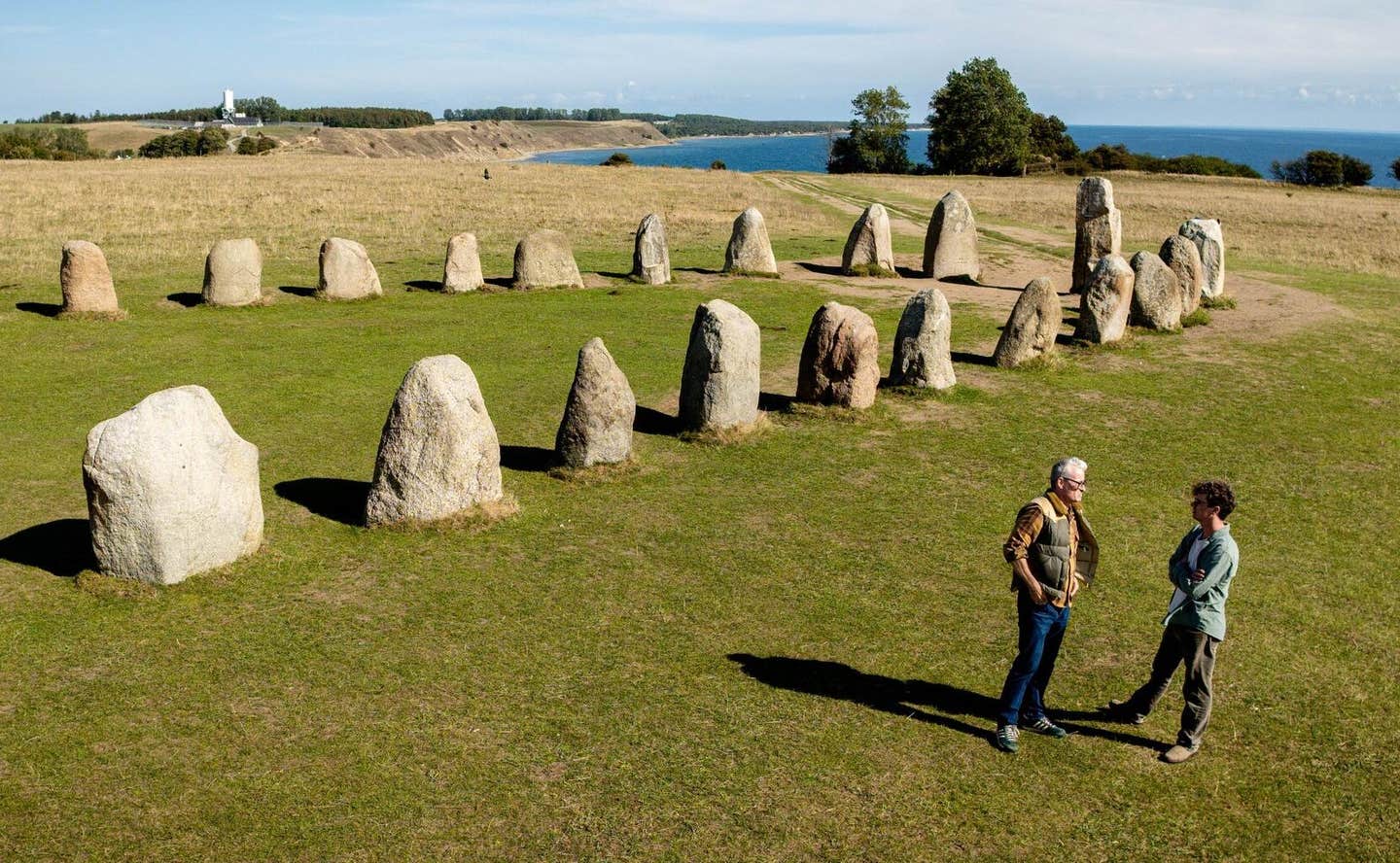
Ale’s Stones, a monumental ship-shaped stone formation overlooking the Baltic Sea in southern Sweden, dates to approximately 600–1000 CE, coinciding with a period of migration back into the region. (CREDIT: From left: Eske Willerslev, senior author; Hugh McColl, lead author)
- Ancient DNA reveals a previously unknown migration into Scandinavia that may have carried an early ancestor of Germanic languages.
- Two Nature papers combine thousands of ancient genomes with archaeology and linguistics to trace population movements across Europe.
- The findings also connect pre-Viking migrations with Old Norse and favor an inland origin for Celtic, while leaving important uncertainties.
English and German may owe part of their shared history to people who entered Scandinavia around 4,000 years ago. Their arrival, revealed through ancient DNA, offers a possible route for an early ancestor of Germanic languages. It also places that proposed arrival centuries later than commonly assumed. The language connection comes from matching genetic findings with archaeological and linguistic evidence.
Two papers in Nature examine how population movements helped shape Germanic and Celtic languages. The international team included researchers at the University of Copenhagen, Leiden University and the University of Gothenburg. Together, the papers describe several migrations across different periods. They do not establish a simple equation between someone's ancestry and the language they spoke.
Reading a history without written records
The Germanic research, published in Nature, added newly sequenced genomes from 712 ancient individuals. After filtering and combining suitable samples, the final analysis included 4,587 people. That total comprised 578 newly sequenced individuals and 4,009 previously published ones. The resulting collection allowed comparisons between ancient genomes from different places and periods.
Researchers looked for DNA segments inherited from shared ancestors. Those segments helped distinguish closely related populations whose differences can disappear in broader comparisons. Models then estimated how ancestries mixed and spread. Comparing the results with archaeological evidence gave the team a way to test proposed migration histories.
“DNA sequences do not tell us directly which language people spoke,” said senior author Eske Willerslev, a Copenhagen professor. “But by combining ancient DNA with linguistic and archaeological evidence, we can begin to trace how languages spread and changed over thousands of years.” That distinction governs the interpretation of both papers. Genetics supplies evidence of movement, while language history supplies a separate set of clues.
Written evidence presents a particular obstacle for Germanic history. The earliest runic inscriptions appear long after the first steppe-related migrations into Scandinavia. That gap leaves many centuries in which populations and speech could have changed. Ancient genomes help fill the demographic part of that interval, although they cannot replace missing linguistic records.
A later arrival in Scandinavia
Earlier migrations carrying ancestry from the Eurasian steppe reached Scandinavia roughly 4,800 years ago. These movements have often been linked to the introduction of Germanic's ancestral branch. The new analysis identifies another arrival around 4,000 years ago, probably from the northeastern Baltic region. Its ancestry spread widely during the Bronze Age, providing another possible route for that linguistic introduction.
The researchers call the proposed language Palaeo-Germanic, a predecessor of the later Proto-Germanic ancestor of today's Germanic languages. Its expected geographical range fits the spread of the incoming ancestry. That alignment makes the migrants plausible carriers, rather than confirmed speakers. Under this interpretation, the relevant migration occurred about 800 years later than the earlier steppe arrival.
The timing also fits clues from borrowed vocabulary. Contacts with Celtic speakers to the south and Finno-Saamic speakers to the east place early Germanic in northern Europe. Yet matching those contacts with population history cannot reveal the words any individual used. The authors acknowledge that cultural transmission, including language spreading without substantial genetic change, remains possible.
Later developments reinforce that caution. The transition to Proto-Germanic around the beginning of the northern European Iron Age did not coincide with a major detected influx of ancestry. Social changes or developments within the language itself may instead have contributed. Shared Germanic dialects eventually connected populations that retained distinct genetic histories.
A migration before the Vikings
Another major change appeared much later, before the Viking Age. People related to populations in northern Germany or southern Jutland moved into Denmark and southern Sweden. Around 1,500 years ago, this influx helped reshape communities whose descendants included many Danish and Swedish Vikings. On the Danish islands, local ancestry that had previously been common largely disappeared from the sampled record.
The shift coincided with the development of Old Norse. Incoming people were closely related genetically to populations involved in the Anglo-Saxon migrations into Britain. That relationship may help explain cultural and linguistic connections between the regions. It does not mean all Vikings came from Germany or that every Scandinavian community experienced the same change.
Norway supplies an important counterexample. Its transition from the Iron Age to the Viking Age showed greater genetic continuity, even as its language changed. The emergence of Old Norse therefore involved more than population replacement. Sparse sampling also leaves uncertainty about the newcomers' precise origins, including whether southern Jutland contributed substantially.
The available evidence therefore supports a regional history rather than a single origin story for everyone who spoke Old Norse. Changing ancestry and changing language overlapped in some places, while following different paths elsewhere.
Tracing Celtic beyond the Atlantic coast
The companion paper in Nature examines a different linguistic puzzle. Celtic languages survive in places including Ireland, Wales, Scotland and Brittany, but once extended across much more of Europe. Their beginnings have prompted competing explanations for over a century. One influential proposal places their origins along Europe's Atlantic coast, while others look farther inland.
The analysis favors an inland setting for the ancestral language, in France and possibly northwestern Italy between 4,000 and 3,000 years ago. Later movements spread ancestry outward into regions where Celtic languages were historically spoken. The researchers consider this a relatively simple explanation for their distribution. It challenges an exclusively Atlantic account without making genetic movement identical to language transmission.
The proposed history includes older and younger population changes, rather than one wave sweeping everywhere simultaneously. Earlier migrations established part of the ancestry shared across western Europe. Later movements provide possible connections to the expansion of Celtic into Britain, Ireland and elsewhere.
The language interpretation depends on combining this sequence with independent linguistic and archaeological arguments. The result offers a way to compare competing origin models against the same demographic evidence. It does not establish that every movement into a historically Celtic-speaking region introduced Celtic speech.
Where ancestry and language diverge
The Germanic paper itself shows why ancestry cannot serve as a language label. Individuals associated with later Gothic groups in southern Europe carried little eastern Scandinavian ancestry. Their history is consistent with people adopting a language and identity through cultural exchange. A shared language could therefore connect communities with quite different origins.
There are also practical gaps in the evidence. Cremation practices left few recoverable genomes from some important transition periods. Missing samples can obscure the timing or source of a migration, and models depend on which populations are available for comparison. More detailed DNA analysis can sharpen those comparisons, but cannot recover the speech of people who left no written record.
For the researchers, the advance lies in testing historical explanations against several independent records. Migration dates can support a proposed linguistic route or make it harder to sustain. Archaeology adds evidence about contacts and changing ways of life. Together, these records narrow the possibilities while preserving the difference between tracing people's movements and establishing what they said.
Dig deeper into ancient DNA and European languages
These studies provide background on migration, social organization and the limits of reconstructing Europe's past from genomes.
Continental influx and pervasive matrilocality in Iron Age Britain
Explores family networks and cross-channel migration in communities relevant to debates about Celtic-speaking Britain. (Nature, January 2025)
High-resolution genomic history of early medieval Europe
Introduces a method for distinguishing closely related ancestries and reconstructing movements during the first millennium. (Nature, January 2025)
The Anglo-Saxon migration and the formation of the early English gene pool
Examines migration across the North Sea and its contribution to early medieval England's population. (Nature, September 2022)
Large-scale migration into Britain during the Middle to Late Bronze Age
Investigates continental ancestry entering Britain during a period central to discussions of Celtic language dispersal. (Nature, December 2021)
Population genomics of the Viking world
Shows the regional diversity and long-distance contacts behind Viking Age populations. (Nature, September 2020)
Research findings are available online in the journal Nature.
The original story "Ancient DNA offers new clues to the origins of English, Germanic and Celtic languages" is published in The Brighter Side of News.
Related Stories
- Ancient DNA identifies 146,000 year-old 'Dragon Man' as a Denisovan
- Ancient DNA suggests humans reached America far earlier than previously thought
- Ancient DNA in Oceania reveals hidden human evolution and health insights
Like these kind of feel good stories? Get The Brighter Side of News' newsletter.
Joshua Shavit
Writer and Editor
Joshua Shavit is a NorCal-based science and technology writer with a passion for exploring the breakthroughs shaping the future. As a co-founder of The Brighter Side of News, he focuses on positive and transformative advancements in technology, physics, engineering, robotics, and astronomy. Having published articles on AOL.com, MSN, Yahoo News, and Ground News, Joshua's work highlights the innovators behind the ideas, bringing readers closer to the people driving progress.