Ancient DNA identifies 146,000 year-old ‘Dragon Man’ as a Denisovan
Two molecular studies link the nearly complete Harbin skull, at least 146,000 years old, to the elusive Denisovan lineage.

 Edited By: Joshua Shavit

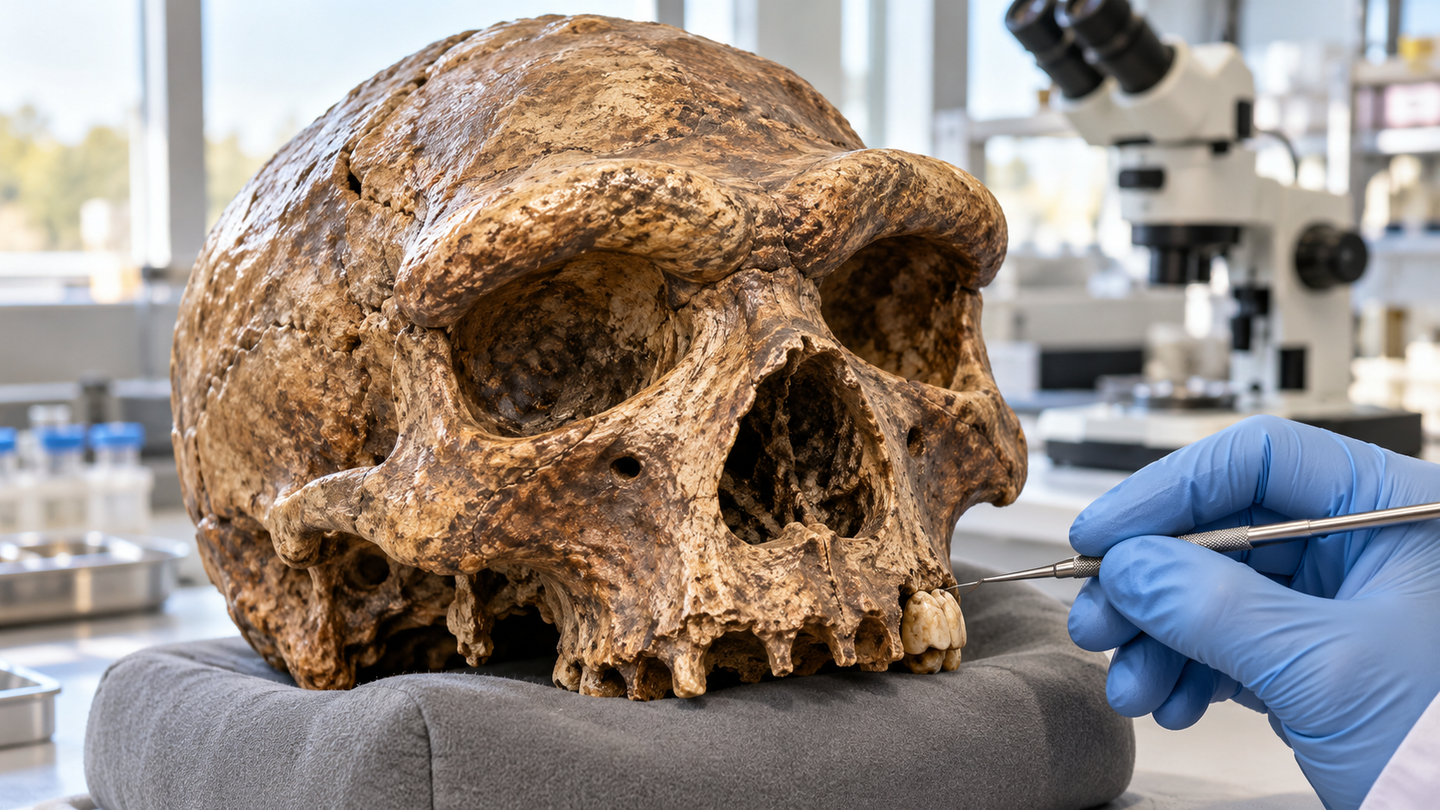
Ancient DNA from tooth plaque and proteins from skull bone identify China’s Dragon Man as Denisovan, revealing detailed anatomy. (CREDIT: The Brighter Side of News)
- Ancient DNA and proteins identify China’s nearly complete “Dragon Man” skull as Denisovan.
- The fossil, at least 146,000 years old, connects molecular evidence with detailed Denisovan skull anatomy.
- DNA came from hardened tooth plaque and proteins from skull bone; the lineage’s formal species name remains unresolved.
A trace of hardened plaque on a single surviving molar helped solve the identity of one of Asia’s most puzzling human fossils. The nearly complete Harbin skull, nicknamed “Dragon Man,” belonged to a Denisovan, an extinct human lineage closely related to Neanderthals.
Two molecular studies published in 2025 supplied complementary evidence. A team led by Qiaomei Fu of the Chinese Academy of Sciences’ Institute of Vertebrate Paleontology and Paleoanthropology recovered mitochondrial DNA from dental calculus. A separate analysis recovered ancient proteins from skull bone.
The findings appeared in Cell and Science. Together, they connect a richly preserved skull with a lineage previously represented mainly by fragmentary remains.
“This is a pin in the map we can use to say, ‘This is what Denisovans looked like,’” said Carina Schlebusch, an evolutionary anthropologist at Uppsala University who was not involved in either study.
A recognizable skull with an uncertain identity
The Harbin cranium comes from Heilongjiang Province in northeastern China. Direct uranium-series dating established a minimum age of approximately 146,000 years, rather than an exact date for the individual’s life.
Its preservation makes it especially valuable. The skull is nearly complete and undistorted, retaining features that small teeth or bone fragments cannot reveal together.
When researchers described it in 2021, its large size, thick brow ridges and heavy upper jaw attracted attention. Hebei GEO University researcher Ji Qiang and colleagues proposed a new species, Homo longi, with the name referring to “dragon.”
Other researchers suspected a Denisovan connection because of the fossil’s location, age and anatomy. However, comparisons of shape produced conflicting interpretations of its relationship to other ancient humans.
Some analyses grouped Harbin with the Denisovan-associated Xiahe jaw from the Tibetan Plateau. Others separated them, illustrating the difficulty of assigning fossils to populations using anatomy alone.
Denisovans were first recognized as a distinct lineage through genetic evidence in 2010. Connecting their molecular identity with informative skull anatomy remained a major gap in reconstructing human evolution across Asia.
Hardened plaque succeeds where bone DNA fails
Fu’s team initially searched for ancient DNA in samples from the skull’s petrous bone and tooth material. Those attempts did not recover usable ancient human DNA.
The researchers then turned to dental calculus, the mineralized plaque attached to the remaining molar. Its hardened structure can preserve biological material long after other sources become unusable.
A sample weighing just 0.3 milligrams yielded ancient mitochondrial DNA. That genetic material comes from the cell’s energy-producing mitochondria and provides evidence about maternal ancestry.
Modern contamination complicated the analysis. Nearly four-fifths of the human genetic material extracted from the sample came from modern sources, making careful identification of the ancient component essential.
The surviving ancient sequences matched Denisovan mitochondrial DNA. Comparisons also linked Harbin to an early Denisovan lineage represented by individuals from Siberia. This was not a complete nuclear genome, which would offer a broader account of the individual’s ancestry. The independent protein evidence therefore adds an important second line of support.
“We can finally clearly show it’s Denisovan DNA, and it’s related to early Denisovans,” Fu said.
The result demonstrates why researchers sometimes need to examine unexpected parts of a fossil. It also shows that unsuccessful DNA recovery from dense bone does not necessarily exhaust a specimen’s molecular evidence.
Skull proteins provide an independent check
The protein study followed a different route, using two samples from the petrous bone. This distinction matters: its evidence did not come from the same plaque sample that yielded mitochondrial DNA.
The researchers identified 95 ancient proteins after separating likely contaminants from material belonging to the fossil. Chemical changes associated with degradation helped authenticate the ancient proteins.
Their analysis recovered 19,299 peptides, the smaller protein fragments used to reconstruct sequences. That provided substantially more protein information than earlier studies of several other ancient human specimens.
Because DNA directs protein production, differences in protein sequences can reveal inherited variation. Researchers compared Harbin’s sequences with those associated with Denisovans, Neanderthals, modern humans and other apes.
One Denisovan-associated amino acid variant was supported with high confidence. Two additional variants offered potential support, although the paper treated those identifications as less reliable.
A broader analysis of protein sequences also placed Harbin with Denisovans. The grouping received 98% or 100% statistical support, depending on the comparison dataset, reinforcing the conclusion from mitochondrial DNA.
“Taking the two studies together, it’s pretty clear this is a Denisovan individual,” said Bence Viola, a University of Toronto paleoanthropologist who was not involved in either study.
A better reference for Asia’s ancient humans
Harbin gives researchers an anatomical reference anchored by molecular identification. Its skull and tooth features can now guide comparisons with fossils from excavations and museum collections.
That could help assess specimens whose identities remain uncertain. However, resemblance to Harbin would be a reason for further investigation, rather than automatic proof of Denisovan ancestry.
Earlier molecular work had already connected fossils from Siberia, the Tibetan Plateau and Taiwan with Denisovans. The Harbin findings add northeastern China to that evidence and strengthen the picture of a geographically widespread lineage.
The protein paper points to Denisovan populations occupying varied environments, including low-lying plains, high plateaus and subtropical woodlands. Establishing relationships among those populations will require additional molecular sampling.
A 2019 study attempted to reconstruct Denisovan anatomy from DNA methylation patterns, proposing features including a long face and wider pelvis. Such predictions addressed a sparse fossil record, but Harbin now offers direct cranial anatomy for comparison.
The skull does not reveal the complete Denisovan body or every population’s appearance. It does provide a much fuller view of one individual than the fragments that previously dominated molecularly identified remains.
The lineage is clearer than the species name
Identifying Harbin as Denisovan does not settle every taxonomic question. Researchers still debate how to classify Denisovans and Neanderthals, including whether to recognize separate species or categories within Homo sapiens.
Genetic evidence shows that Denisovans interbred with modern humans. That history complicates simple divisions, while leaving their identification as a distinct ancient lineage well supported.
The name Homo longi also depends on which other fossils ultimately prove to be Denisovan. If an older applicable species name already exists, taxonomic priority could affect the name used for the group.
“Until we know which specimens are Denisovans, we can’t be sure which name is valid,” Viola said. Harbin’s molecular identity is now much clearer, while its formal classification remains open.
Dig deeper into Denisovan fossils and ancient molecules
These studies explore how genomes, proteins and anatomical predictions have expanded the evidence for Denisovans across Asia.
A High-Coverage Genome Sequence from an Archaic Denisovan Individual: This foundational genome study established a detailed genetic reference for Denisovans and investigated their contributions to living populations. (Science, 2012)
A late Middle Pleistocene Denisovan mandible from the Tibetan Plateau: Ancient proteins identified the Xiahe jaw, connecting Denisovans with a fossil outside Siberia. (Nature, 2019)
Middle and Late Pleistocene Denisovan subsistence at Baishiya Karst Cave: Archaeological and protein analyses investigate Denisovan occupation and animal use on the Tibetan Plateau. (Nature, 2024)
A male Denisovan mandible from Pleistocene Taiwan: Protein evidence identifies the Penghu jaw as Denisovan, extending the lineage’s confirmed fossil distribution. (Science, 2025)
Reconstructing Denisovan Anatomy Using DNA Methylation Maps: This study explores an indirect method for predicting Denisovan anatomical traits from reconstructed gene-regulation patterns. (Cell, 2019)
The original story "Ancient DNA identifies 146,000 year-old 'Dragon Man' as a Denisovan" is published in The Brighter Side of News.
Related Stories
- Denisovan jawbone discovery unlocks secrets of ancient human migration
- 67,800 year-old cave wall hand stencil offers clues to Australia’s first settlement
- Two unknown human ancestors still live in our DNA
Like these kind of feel good stories? Get The Brighter Side of News' newsletter.
Joseph Shavit
Writer, Editor-At-Large and Publisher
Joseph Shavit, based in Los Angeles, is a seasoned science journalist, editor and co-founder of The Brighter Side of News, where he transforms complex discoveries into clear, engaging stories for general readers. With vast experience at major media companies like The Los Angeles Times, Times Mirror and Tribune Publishing, he writes with both authority and curiosity. His writing focuses on space science, planetary science, quantum mechanics, geology. Known for linking breakthroughs to real-world markets, he highlights how research transitions into products and industries that shape daily life.