Ancient DNA rewrites the story of the extinct North America ‘Cheetah’
The Ice Age cat looked like a cheetah but DNA, Arctic fossils and isotopes reveal an adaptable puma relative with an unusual diet.
 UC Santa Cruz Writer: Mike Peña

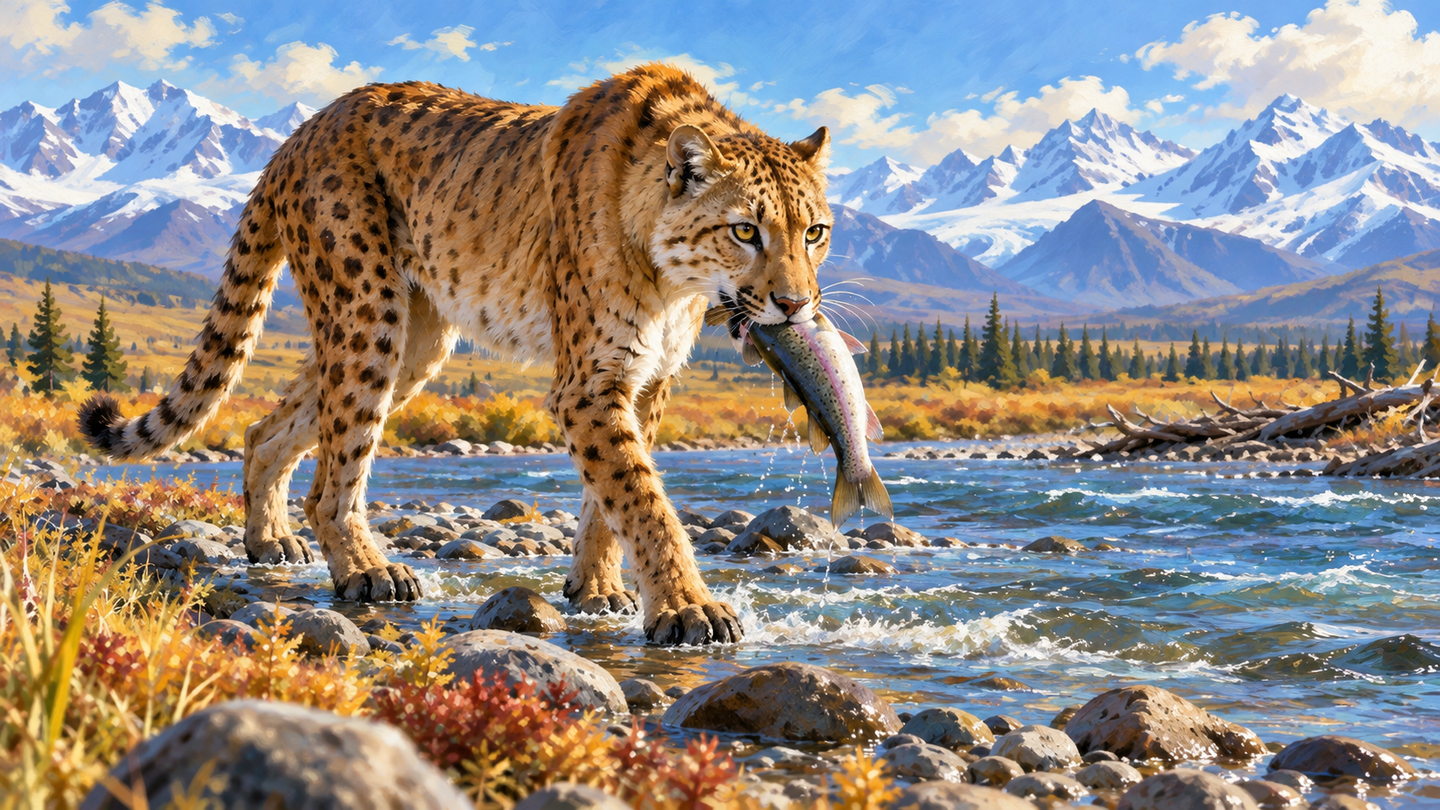
Ancient DNA shows the American “cheetah” was a puma relative, while Yukon fossils reveal a surprising diet linked to fish. (CREDIT: Shutterstock)
- Ancient DNA shows the extinct “American cheetah,” Miracinonyx trumani, was actually the sister species of modern pumas, with the two lineages splitting about 2.6 million years ago.
- Isotopes from three Yukon specimens indicate northern populations relied heavily on aquatic food webs, likely including fish, while Wyoming animals behaved more like terrestrial generalist predators.
- Fossils from Arctic Canada extend the species’ known range more than 20 degrees of latitude northward, revealing a far more adaptable predator than its cheetah-like appearance suggested.
The extinct predator known for decades as the “American cheetah” may have been one of the most misunderstood large cats of Ice Age North America.
Ancient DNA from Miracinonyx trumani now shows that the long-legged animal was not especially close to the modern African cheetah. Instead, it was the sister lineage of the puma, while chemical evidence from fossils in Canada's Yukon suggests some northern populations occupied an extraordinary ecological niche linked closely to fish.
Researchers led by the University of California, Santa Cruz combined high-coverage ancient genomes with radiocarbon dating and stable-isotope measurements to reconstruct the cat's evolutionary history and diet.
“It’s very hard to imagine a prehistoric species we’ve never seen without comparing it to something we know,” said first author Molly Cassatt-Johnstone. “But this approach can limit our understanding of ancient animals’ complexity, unique evolutionary histories, and behaviors.”
A cheetah look-alike that was really closer to pumas
The nickname made intuitive sense. M. trumani had a slender body, elongated forelimbs and enlarged nasal structures resembling adaptations seen in fast-running animals. Its fossils have also been found alongside pronghorn, helping inspire the idea that the cat evolved to chase one of North America's fastest surviving mammals across open grasslands.
Yet appearance turned out to be misleading.
The team generated especially complete nuclear genomes from a roughly 23,500-year-old Wyoming specimen and a well-preserved Yukon fossil, then compared them with genomes from nine other cat species. The analysis placed M. trumani firmly beside the modern puma, Puma concolor.
The two lineages split about 2.6 million years ago. Miracinonyx and modern cheetahs, meanwhile, shared a more distant ancestor around 4.7 million years ago.
Their similar bodies therefore represent evolutionary convergence: unrelated lineages independently evolving similar traits under comparable environmental pressures.
Earlier anatomical studies had already begun questioning whether M. trumani really hunted like an African cheetah. Research on its elbow joint, for example, suggested a combination of features without a clear modern equivalent, rather than the extreme specialization expected in a pure high-speed pursuit predator.
Fossils reveal an unexpected Arctic range
Three fossils from Yukon Territory created another surprise.
They had previously been tentatively classified as pumas because they came from far north of M. trumani's recognized range. DNA showed that all three were actually M. trumani and lived roughly 31,000 to 34,000 years ago.
That discovery pushes the animal's known distribution more than 20 degrees of latitude northward. Its range now stretches from subtropical regions such as present-day Florida to Arctic Yukon.
The northern cats shared Beringia with a formidable community of predators, including steppe lions, scimitar cats, gray wolves, brown bears and giant short-faced bears. Surviving among those competitors would likely have required a distinctive ecological strategy.
Genetic evidence suggests the Wyoming and Yukon populations remained connected relatively late into the Pleistocene. Their maternal lineages appear to have separated around 43,000 years ago, although the uncertainty around that estimate is substantial.
Yukon cats appear to have depended heavily on fish
Stable isotopes offered the clearest clue to what the Arctic cats were doing.
Nitrogen values in the Yukon fossils were about 6 parts per thousand higher than those of contemporary terrestrial carnivores and prey. The signals were also remarkably similar among specimens separated by nearly 400 kilometers and more than 2,000 years.
Their isotope values fell within ranges associated with fish-eating carnivores. More detailed amino-acid nitrogen measurements placed the Yukon animals at trophic level 4, making them tertiary consumers. Wyoming M. trumani, by contrast, averaged around trophic level 3, consistent with predators feeding mainly on terrestrial herbivores.
The evidence does not reveal exactly how the Yukon cats acquired aquatic food. They could have caught fish in shallow water, targeted dense seasonal spawning runs or scavenged carcasses along riverbanks.
Fish were available in Ice Age Beringia. Archaeological and paleontological research has identified salmon, burbot and other fish in Pleistocene sites across Alaska and surrounding regions, demonstrating that aquatic resources formed part of northern food webs.
The new isotope evidence therefore supports substantial exploitation of aquatic resources rather than proving a single fishing technique or an exclusively fish diet.
Its internal clock may also have changed
The paleogenomes revealed clues to another possible northern adaptation.
Two genes involved in circadian regulation, PER3 and NOS1, carried loss-of-function variants in both analyzed Miracinonyx individuals. PER3 helps regulate responses to day length and seasonal sleep timing, while NOS1 contributes to the body's synchronization with light.
The authors suggest that reduced dependence on those pathways could reflect adaptation to high latitudes with extreme seasonal daylight. Another possibility is that flexible nocturnal or twilight activity reduced the importance of normal light-driven rhythms.
The genetic sample remains small, however, so those interpretations are hypotheses rather than confirmed behavioral adaptations.
A predator with no simple modern equivalent
The results undermine one of paleontology's most familiar evolutionary stories.
Previous isotopic work from Wyoming did support pronghorn as part of Miracinonyx's diet, but not as its exclusive prey. Wolves and American lions also consumed pronghorn, weakening the idea of a unique cheetah-pronghorn arms race.
The new study expands that picture dramatically. In the south, M. trumani could operate as a terrestrial grassland predator. In the Arctic, some populations exploited aquatic food chains.
“There are probably other extinct species that, unfortunately, have been reduced to fewer dimensions than they deserve,” Cassatt-Johnstone said.
That may be the larger lesson of the so-called American cheetah. Its body resembled a cheetah, its DNA points toward pumas, and its ecology appears to have changed radically across a continent.
The nickname survives, but the animal behind it now looks much stranger and more adaptable than the name ever implied.
Dig deeper into Miracinonyx and Ice Age predator ecology
These resources explore the anatomy, diet, evolutionary relationships and Arctic environments that shaped interpretations of the so-called American cheetah.
Elbow-joint morphology in the North American ‘cheetah-like’ cat Miracinonyx trumani: Finds that the cat's forelimb anatomy does not fit a simple modern-cheetah model and instead suggests a distinctive predatory strategy without a direct living analogue. (Royal Society Open Science, 2023)
Were pronghorns (Antilocapra) primary prey for North American cheetahs (Miracinonyx)?: Uses carbon and nitrogen isotopes from Natural Trap Cave to test the proposed predator-prey relationship between Miracinonyx and pronghorn. (Quaternary International, 2023)
The brain of the North American cheetah-like cat Miracinonyx trumani: Reconstructs aspects of the extinct cat's neuroanatomy and examines what its brain morphology reveals about behavior and evolutionary convergence. (Journal of Mammalian Evolution, 2023)
The difference between trivial and scientific names: There were never any true cheetahs in North America: Reviews genetic and fossil evidence showing why Miracinonyx should not be interpreted as a true North American member of the modern cheetah lineage. (BMC Evolutionary Biology, 2016)
Freshwater and anadromous fishing in Ice Age Beringia: Documents salmon and freshwater fish in Pleistocene Beringia, providing evidence that substantial aquatic resources were available within the environments occupied by northern Miracinonyx. (Science Advances, 2023)
Research findings are available online in the journal Current Biology.
The original story "Ancient DNA rewrites the story of the extinct North America ‘Cheetah’" is published in The Brighter Side of News.
Related Stories
- Century-old myth about the Tasmanian tiger may have been dangerously wrong
- Saving lost species: Scientists are resurrecting the extinct Tasmanian Tiger
- 37,000-year-old saber-toothed cub found frozen in Russian tundra
Like these kind of feel good stories? Get The Brighter Side of News' newsletter.
Joshua Shavit
Writer and Editor
Joshua Shavit is a NorCal-based science and technology writer with a passion for exploring the breakthroughs shaping the future. As a co-founder of The Brighter Side of News, he focuses on positive and transformative advancements in technology, physics, engineering, robotics, and astronomy. Having published articles on AOL.com, MSN, Yahoo News, and Ground News, Joshua's work highlights the innovators behind the ideas, bringing readers closer to the people driving progress.