A space elevator connecting Earth and the Moon could be closer than ever
One space elevator concept demands extraordinary graphene. Another changes the physics enough that today’s fibers could theoretically work.

 Edited By: Joshua Shavit

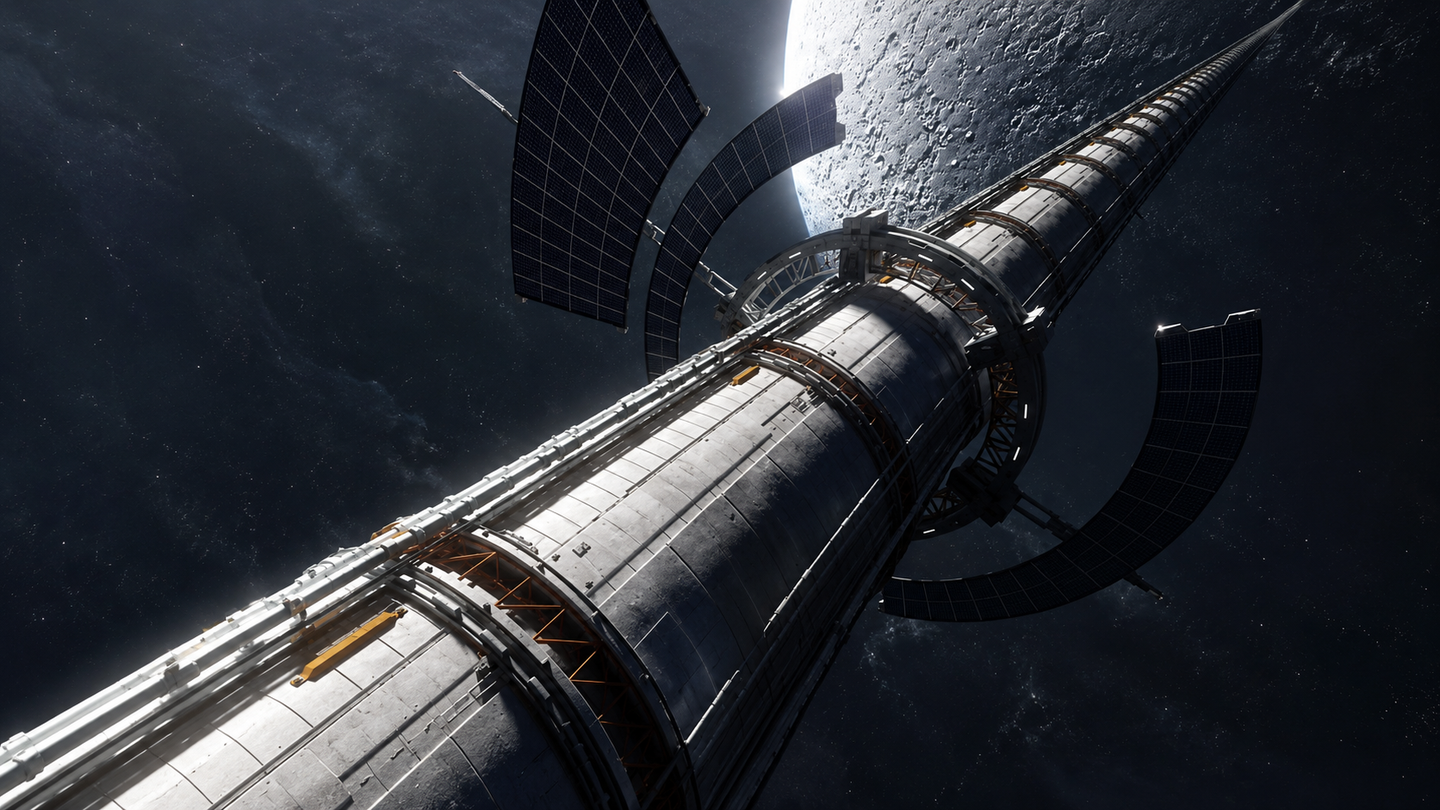
Graphene advances and a Moon-anchored Spaceline offer two possible routes toward cheaper travel between Earth and deep space. (CREDIT: Wikimedia / CC BY-SA 4.0)
- A Moon-anchored “Spaceline” could theoretically reach toward Earth using materials such as Zylon, Kevlar or Dyneema that already exist, avoiding the extreme tension of a conventional space elevator.
- Separate advances in graphene manufacturing have strengthened hopes for a traditional Earth-based space elevator, although no material has yet been manufactured at the required 100,000-kilometer length and tether quality.
- Both concepts could sharply reduce propellant needs beyond Earth orbit, but enormous challenges involving manufacturing, deployment, debris, dynamics and cost remain unresolved.
Getting into space still requires throwing away an extraordinary amount of mass.
Rockets accelerate by expelling propellant, forcing launch vehicles to carry fuel not only for their spacecraft but also to accelerate the remaining fuel. That fundamental constraint has driven decades of interest in space elevators, enormous cables that could allow electrically powered climbers to haul cargo upward without carrying their own rocket propellant.
Two developments suggest there may be more than one route toward that goal. The International Space Elevator Consortium, or ISEC, is highlighting rapid progress in graphene manufacturing for a conventional Earth-based elevator. An earlier analysis by physicists Zephyr Penoyre and Emily Sandford showed another possibility: hang the cable from the Moon instead.
Their “Spaceline” would experience dramatically different forces and, according to their calculations, could be supported with high-performance fibers already manufactured today.
Graphene is bringing the classic elevator closer
A conventional space elevator would begin near Earth's equator and extend far beyond geostationary orbit, where an orbiting object remains over the same location on Earth. A counterweight beyond that point would keep the cable under tension as Earth rotates.
The concept demands an extraordinary tether. ISEC's current architecture envisions cables roughly 100,000 kilometers long, and the organization identifies graphene among the leading material candidates. Its current materials guidance says single-crystal graphene remains the ultimate target because of its combination of tensile strength and low mass.
Manufacturing has nevertheless advanced fastest with polycrystalline graphene, which consists of many crystalline regions joined along grain boundaries. ISEC reports that this form can already be produced in kilometer-scale lengths at about two meters per minute, although it emphasizes that neither existing graphene nor competing materials are yet available at finished space-elevator tether quality.
That distinction is critical. Producing a long sheet of graphene is not equivalent to producing a defect-free structural cable able to survive decades under enormous tension.
ISEC's own recent discussions acknowledge unresolved problems. Researchers still need to understand multilayer strength, manufacturing defects, radiation, orbital debris and the engineering required to fabricate and deploy unprecedented quantities of tether material. A 2026 ISEC report describes even the electrical-power system for climbers as an active research problem.
Hanging from the Moon changes the physics
Penoyre, then at the University of Cambridge, and Sandford, then at Columbia University, approached the material problem differently.
Instead of asking for a stronger cable, they asked whether the cable could experience less force.
Their Spaceline starts at the Moon and hangs toward Earth. Unlike a conventional elevator, which rotates with Earth once every day, the lunar cable follows the Moon's roughly monthly orbit. Its own weight toward Earth pulls it taut while the lunar anchor holds the opposite end.
That slower rotation and different gravitational environment greatly reduce the stress.
The cable would also cross the Earth-Moon L1 region, where competing gravitational and orbital effects produce a balance point between the two worlds. Cable tension reaches its maximum around this region, while gravity pulls different parts of the line in opposite directions.
The crucial result was that the line does not need to descend anywhere near Earth's surface. Extending from the Moon to roughly geostationary distance avoids the tremendous load encountered by a ground-anchored elevator.
Existing fibers could theoretically hold it
The researchers compared the necessary specific strength with materials ranging from steel and spider silk to carbon fiber, Kevlar, Dyneema and Zylon.
Their calculations indicated that a simple constant-width Spaceline becomes feasible once a material crosses a relative-strength threshold of roughly 3. Zylon and Dyneema fall near or above that range, while a conventional Earth-based elevator would require a value above roughly 50.
A carefully tapered cable could reduce the mass further. Their preferred hybrid design would remain thin where stresses were low and become wider where necessary to stay below its breaking stress.
That does not mean engineers could start building one tomorrow. The calculations primarily establish that tensile strength itself is not necessarily a fundamental barrier to a Moon-anchored design.
Manufacturing hundreds of thousands of kilometers of reliable fiber, carrying it into space, deploying it without tangling or breaking, protecting it from impacts and repeatedly moving payloads along it would still represent an engineering undertaking without precedent.
A 40-ton cable could reach toward Earth
Penoyre and Sandford explored what a minimal structure might look like.
For one modeled cable with a cross-sectional area of square meters, they estimated a mass of about 40,000 kilograms. They described the raw material and launch expense as potentially reaching hundreds of millions of dollars, while a complete practical project could cost billions.
The cable's Earthward tip would remain far above the planet rather than touching the ground. Rockets would still be required to reach it.
Once docked, however, payloads could travel along the tether using externally supplied energy. The authors estimated that access to the lunar surface through such a system could reduce required fuel to roughly one-third of conventional values.
That makes the Spaceline less a replacement for launch vehicles than a transportation network for movement after spacecraft have climbed out of the deepest part of Earth's gravity well.
A station between Earth and Moon
The authors considered the Earth-Moon Lagrange region potentially more important than the Moon itself.
A station attached to the tether near that location could provide a relatively stable base for assembling structures and moving equipment between destinations. The researchers imagined large telescopes, particle accelerators, gravitational-wave instruments, power stations and staging points for missions deeper into the solar system.
For now, both versions of the space elevator remain proposals rather than construction projects.
Graphene manufacturing is advancing, but ISEC still describes tether-quality production at the enormous scale required as future work. The Spaceline calculations show that today's fibers may be strong enough on paper, but they do not demonstrate that an operational lunar cable can be manufactured, deployed or maintained.
Together, the ideas reveal how the space-elevator problem is changing. One approach waits for stronger materials. The other changes the gravitational problem so radically that existing ones might suffice.
Either way, the goal remains the same: make leaving Earth's neighborhood less dependent on throwing away mountains of rocket fuel.
Dig deeper into space elevators and advanced tether materials
These resources explore graphene, orbital tethers and the engineering physics behind alternatives to rocket-only transportation.
Space Elevator Tether Materials: Reviews current candidate materials including single-crystal graphene, polycrystalline graphene, carbon nanotubes and hexagonal boron nitride, along with remaining manufacturing challenges. (International Space Elevator Consortium, 2026)
Powering the Space Elevator: Evaluates solar, laser, microwave and electrically powered approaches for operating climbers along a future space-elevator tether. (International Space Elevator Consortium, 2026)
The Space Elevator: NIAC Phase II Final Report: Examines the architecture, tether requirements, deployment strategy and transportation potential of a conventional Earth-based space elevator. (NASA Institute for Advanced Concepts, 2003)
Strength of graphene and its grain boundaries: Experiments examine how crystalline grain boundaries affect graphene's exceptional tensile strength, a central issue for scaling the material into structural applications. (Science, 2012)
Large-area synthesis of high-quality and uniform graphene films on copper foils: Demonstrates chemical-vapor-deposition growth and transfer of large graphene films, an important foundation for later attempts to manufacture graphene at industrial scales. (Science, 2009)
Research findings are available online in the journal arXiv.
The original story "A space elevator connecting Earth and the Moon could be closer than ever" is published in The Brighter Side of News.
Related Stories
- Solar cells made from moon dust could power future space missions
- Russia patents a modular spacecraft designed to create artificial gravity
- Travelers could embark on celestial vacations to luxury space hotels by 2030
Like these kind of feel good stories? Get The Brighter Side of News' newsletter.
Joseph Shavit
Writer, Editor-At-Large and Publisher
Joseph Shavit, based in Los Angeles, is a seasoned science journalist, editor and co-founder of The Brighter Side of News, where he transforms complex discoveries into clear, engaging stories for general readers. With vast experience at major media companies like The Los Angeles Times, Times Mirror and Tribune Publishing, he writes with both authority and curiosity. His writing focuses on space science, planetary science, quantum mechanics, geology. Known for linking breakthroughs to real-world markets, he highlights how research transitions into products and industries that shape daily life.