Ancient skull fractures strengthen evidence of human sacrifice around Egypt’s royal burials
Modern forensic analysis finds potentially lethal trauma in ancient Abydos skulls, adding evidence to a century-old sacrifice debate.

 Edited By: Joseph Shavit

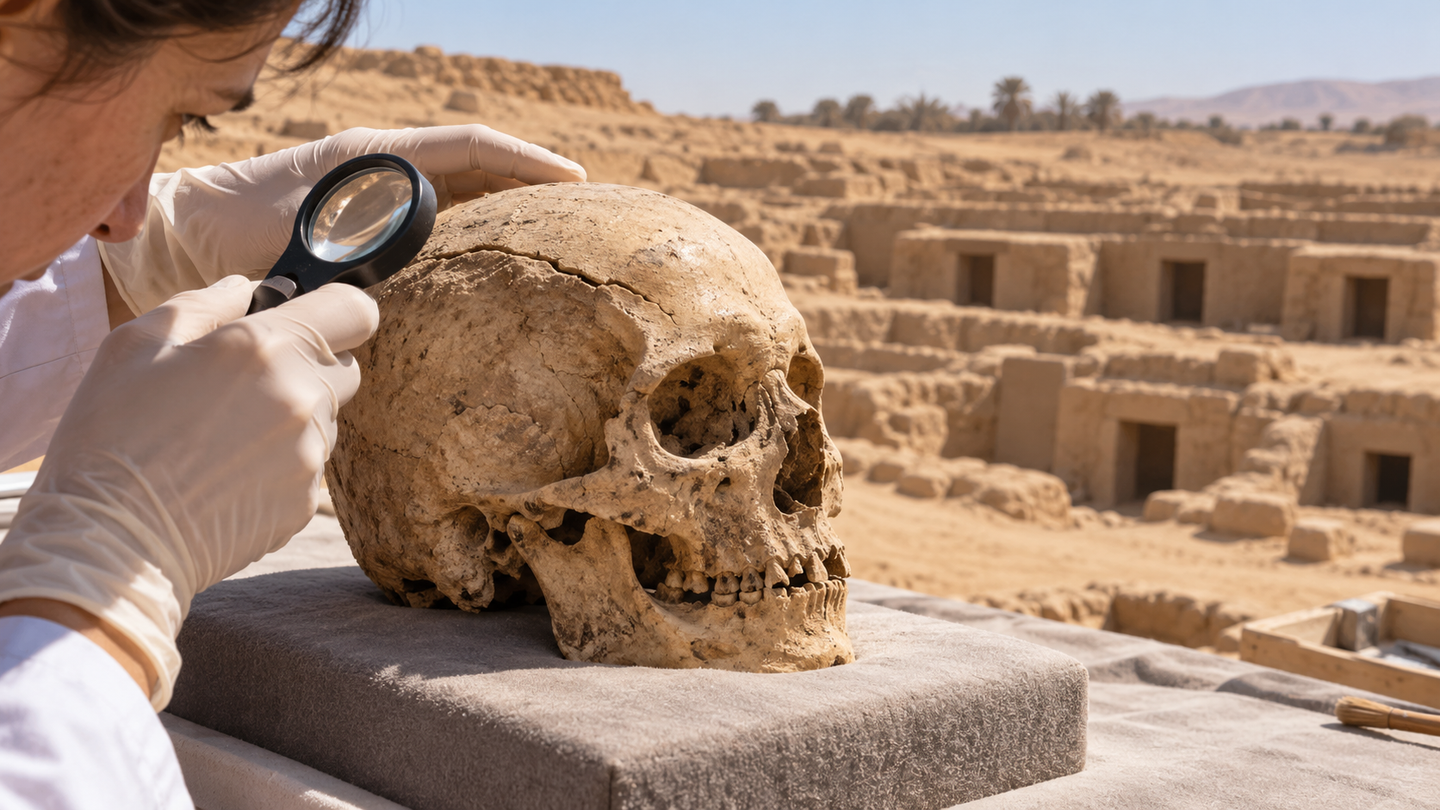
Injuries in 18 of 46 skulls from Abydos strengthen evidence of retainer sacrifice around Egypt’s First Dynasty royal burials. (CREDIT: The Brighter Side of News)
- Eighteen of 46 skulls from subsidiary burials at Abydos showed potentially lethal injuries inflicted near the time of death.
- The findings strengthen evidence that some members of Egypt’s early royal households were sacrificed to accompany deceased rulers.
- The incomplete sample cannot establish how all retainers died, whether injuries caused death, or whether anyone volunteered.
Fractures once treated as damage from an ancient burial environment may instead record violence against people associated with Egypt’s earliest rulers. A reassessment of 46 preserved skulls from Abydos identified potentially lethal injuries near the time of death in 18 individuals, or 39% of the sample.
The findings strengthen the case for retainer sacrifice, the killing of household or court members to accompany a deceased ruler. They also challenge a century-old claim that these remains showed no evidence of serious trauma. The surviving bones cannot establish every person’s cause of death.
Purdue University anthropologist Roselyn Campbell discusses the reassessment in Frontiers in Environmental Archaeology. The archaeological case study draws on her earlier analyses to examine how forensic advances change interpretations of old collections. It combines skeletal evidence with burial records and photographs.
“I was drawn to these retainers partly because, even though they were buried around royalty, they are mostly relegated to footnotes in the grander narrative,” Campbell said. “Who were these people and how did they view the ruler and their own role in his or her life and death?”
Small graves beside royal monuments
The burials date to Egypt’s First Dynasty, approximately 3078–2900 BCE. Early rulers built chamber tombs and separate enclosures probably used for rituals connected with the royal funerary cult. Rows of subsidiary graves surrounded these monuments, sometimes numbering in the hundreds.
Archaeologist Flinders Petrie excavated the subsidiary burials around the enclosures in the early 1920s. He recorded the graves, photographed some intact skeletons and documented their accompanying objects. Many graves had already been disturbed before excavation.
Some individuals had simple coffins, while others did not. Grave goods included pottery, copper tools, flint knives and ivory objects. A few surviving markers supplied names and titles, offering glimpses of people otherwise largely absent from written history.
The titles mostly suggest lower- or middle-ranking officials and artisans, rather than the highest members of the court. Campbell also questions earlier assumptions that women in these graves were necessarily royal wives or concubines. Their sex alone cannot establish their relationship to the ruler.
The burial pattern changed over the dynasty. Aha, its first ruler, had relatively few subsidiary graves, while successors had hundreds around their monuments. Numbers then declined sharply, and the pattern appears to have disappeared by the beginning of the Second Dynasty.
Petrie suspected sacrifice because so many graves appeared to have been closed together. Other scholars argued for natural deaths followed by burial near royal monuments. Evidence that some graves were sealed individually complicated the debate, leaving the bodies themselves crucial to assessing those explanations.
What modern fracture analysis reveals
Petrie reburied most of the excavated bodies but retained skulls, some of which eventually reached Britain. Campbell examined 46 crania in Cambridge University’s Duckworth Collection. They came from subsidiary graves around the funerary enclosures of Djer, Djet and Merneith.
Linear fractures across the skull vault were the most common injuries. Some skulls also showed sharp-force trauma, including a penetrating wound to the side of the head and a chopping injury near an eye. These findings indicate more varied treatment than a single uniform killing method.
Forensic specialists distinguish healed injuries from damage affecting fresh bone and breaks occurring after bone dries. Fresh bone retains moisture and flexibility, so it can bend before breaking. Fracture edges, surfaces and other features help identify that response.
The injuries were classified as perimortem, meaning they occurred around the time of death. That category can include damage shortly after death, while bone remains fresh. It therefore cannot, by itself, prove that a particular fracture killed someone.
Nevertheless, the linear fractures could have caused bleeding inside the skull, unconsciousness and death. Petrie apparently noticed some damaged areas, applying paraffin wax to stabilize them. Campbell argues that he likely lacked the forensic knowledge needed to distinguish these injuries from later burial damage.
Neither the weapon nor the ritual is settled
Egyptian royal imagery often shows a king striking an enemy with a mace. That familiar scene does not identify what happened at Abydos. The depicted victims are enemies, and stone maces generally produce depressed fractures, unlike the predominantly linear injuries in this sample.
Experimental and forensic research associates isolated linear fractures with impacts involving broad, flat surfaces. A lighter wooden implement is one possible explanation. Falls can also produce linear fractures, although similar injuries in numerous individuals require an explanation beyond an isolated accident.
Campbell considers whether bodies could have been thrown into graves or damaged by collapsing roofs. Those events might also have injured or displaced other bones and objects. Petrie’s surviving photographs and notes do not resolve every possibility, especially because the rest of the skeletons are unavailable.
His suggestion that unusual limb positions revealed people buried alive also remains unproven. Bodies can shift as they decay, and placement, coffins and gradual infilling affect how bones settle. An outstretched arm is not reliable evidence that someone struggled during burial.
Retainer sacrifice could have served beliefs about continued service in the afterlife or demonstrated royal power. The archaeological record cannot reveal whether these individuals agreed to die, were selected or were forced. Nor does the absence of skull trauma establish a peaceful death among the remaining individuals.
An incomplete collection still holds evidence
The preserved crania represent only about 5%–15% of the subsidiary burial populations at the individual enclosures. Their selection and survival may not reflect the larger population. The 39% finding therefore applies to the examined sample, rather than everyone buried around First Dynasty monuments.
Wax creates another obstacle. Thick layers sometimes cover external and internal skull surfaces, trapping soil and obscuring features. Missing bodies also prevent a fuller assessment of age, sex, disease and injuries elsewhere in the skeleton.
Some individuals without visible cranial injuries could have died naturally. Others might have been killed through methods, such as asphyxiation, that leave no obvious skeletal evidence. Available remains cannot distinguish those possibilities or provide a complete death toll.
The study makes a broader argument for revisiting archaeological collections with updated expertise. At Abydos, that approach supports sacrifice while revealing uncertainty about its methods and circumstances. The result gives the people buried beside royalty a more substantial place in the history of early Egypt.
Dig deeper into ancient burials and forensic archaeology
These studies explore royal sacrifice, skeletal injuries and the processes that shape archaeological burial evidence.
Human sacrifice and intentional corpse preservation in the Royal Cemetery of Ur: Uses modern analysis of excavated remains to reassess how attendants died and were prepared for royal burial in ancient Mesopotamia. (Antiquity, 2011)
Understanding blunt force trauma and violence in Neolithic Europe: the first experiments using a skin-skull-brain model and the Thames Beater: Tests how a replica wooden weapon produces injuries, providing context for interpreting ancient skull fractures. (Antiquity, 2017)
Distinction between perimortem and postmortem fractures in human cranial bone: Compares fracture patterns near death with experimentally produced breaks in dry skulls. (International Journal of Legal Medicine, 2020)
Unraveling Neolithic sharp-blunt cranial trauma: Experimental approach through synthetic analogues: Investigates injuries made by stone axes and adzes to improve interpretations of archaeological trauma. (Journal of Archaeological Science, 2023)
From individualized mummies to collective accumulations: an archaeothanatological analysis of funerary reuse in Theban Tomb 209 (Twenty-Fifth Dynasty–Ptolemaic Egypt): Examines how repeated burial and movement of remains affect the interpretation of an Egyptian tomb. (Frontiers in Environmental Archaeology, 2026)
Research findings are available online in the journal Frontiers in Environmental Archaeology.
The original story "Ancient skull fractures strengthen evidence of human sacrifice around Egypt’s royal burials" is published in The Brighter Side of News.
Related Stories
- Karnak’s hidden island: What lies beneath Egypt’s great temple
- Archeologists reveal how ancient Egyptians built the pyramids
- Bust of Cleopatra VII may have been found at ancient Egyptian temple
Like these kind of feel good stories? Get The Brighter Side of News' newsletter.
Joshua Shavit
Writer and Editor
Joshua Shavit is a NorCal-based science and technology writer with a passion for exploring the breakthroughs shaping the future. As a co-founder of The Brighter Side of News, he focuses on positive and transformative advancements in technology, physics, engineering, robotics, and astronomy. Having published articles on AOL.com, MSN, Yahoo News, and Ground News, Joshua's work highlights the innovators behind the ideas, bringing readers closer to the people driving progress.