Apes and humans share an ancient laughter rhythm dating back 15 million years
Great apes and humans share an ancient laughter rhythm, and it may help explain how speech gradually evolved.

 Edited By: Joseph Shavit

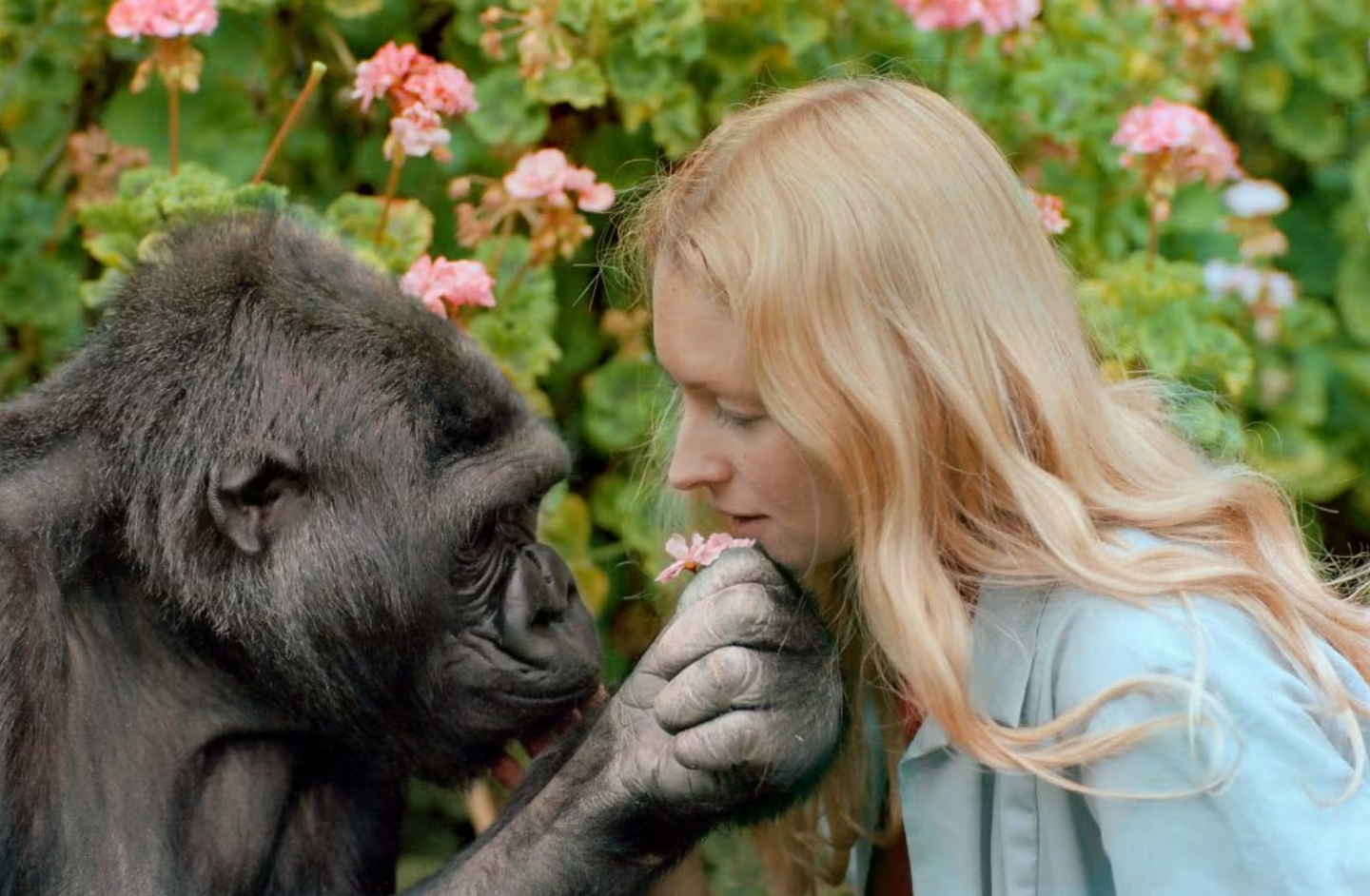
Study finds great apes share a laughter rhythm dating back 15 million years, offering clues to how human speech evolved. (CREDIT: Scene from “Koko: The Gorilla Who Talks.” 2016. BBC)
A laugh can feel spontaneous, messy, almost impossible to pin down. But deep inside that burst of sound, researchers found a timing pattern so stable that it may have survived for 15 million years, long before humans began to speak.
That pattern appears across all living great apes, according to a study in Communications Biology led by researchers at the University of Warwick. By comparing laughter from orangutans, gorillas, bonobos, chimpanzees, and humans, the team found that each species produces laughter with evenly spaced intervals between successive sounds.
The finding points to a striking possibility. A basic rhythmic structure in laughter may already have been present in the common ancestor shared by all great apes, then preserved across millions of years of evolution even as species moved in different directions.
“How did humans evolve the remarkable ability to speak?” said Dr. Chiara De Gregorio, an honorary research associate in the Department of Psychology at the University of Warwick. “Speech leaves no fossils, and complex language exists only in our own species. But we've found a 15-million-year-old clue in an unexpected place: our laughter.”
Unlike speech, laughter is shared across the great ape family. That makes it one of the few living behaviors that can offer a glimpse into the vocal capacities of extinct ancestors.
A sound older than speech
Because sound does not fossilize, scientists cannot directly trace the earliest steps that led to speech and language. Comparative work with our closest living relatives offers one of the only ways to study those lost stages.
Laughter is especially useful for that purpose because it appears across great apes and across age and sex classes. It also tends to show up in similar situations, especially during social play and tickling, where it helps signal friendly intent and maintain social coordination.
To explore how its rhythm may have changed over time, the Warwick team analyzed 140 laughter bouts from 17 individuals: four orangutans, two gorillas, three bonobos, four chimpanzees, and four humans. The subjects ranged from six months to seven years old, and most were observed in ex situ settings.
The researchers marked the start and duration of each laugh sound, then measured the timing between one onset and the next. They also examined how variable those intervals were and whether the sequences followed a regular rhythmic pattern.
What emerged was a shared pulse. Across species, great ape laughter was isochronous, meaning the timing between bursts followed a regular beat.
That does not mean every laugh sounded identical. It means the underlying structure remained recognizable.
Where humans begin to pull away
The study also found that laughter changed gradually along the hominid line. It became faster over evolutionary time, with humans showing the quickest tempo. Human laughter was also more variable, suggesting a broader rhythmic range.
That mattered because the team sees variability as a sign of greater vocal control.
In the data, humans stood apart in another way. They were the only species that changed laughter tempo depending on context, producing faster laughter during tickling than during play. The nonhuman great apes did not show that same context-sensitive modulation.
That difference lines up with everyday experience. Human laughter can erupt uncontrollably when someone is tickled, but it can also be shaped by situation, including a polite laugh in a meeting, a nervous laugh after a mistake, or the kind of laughter that sweeps through a group.
The researchers argue that this growing ability to control timing may reflect a long evolutionary shift toward more flexible vocal behavior.
Dr. Adriano Lameira, associate professor in the Department of Psychology at the University of Warwick, said laughter offers “a rare evolutionary window into the vocal transformations that unfolded across hominid evolution until the first humans appeared on scene.”
“Contrary to the classic notion that the first humans suddenly acquired vocal control capacities remarkably different from their predecessors, laughter evolution tells us that humans lay on a continuum, a prolongation of vocal control capacities that were already being cumulatively honed in for 15 million years,” he said.
Tickling, play, and the road to control
The pattern was not perfectly uniform across situations. Tickling laughter was highly regular, while play laughter departed more from strict regularity.
The study suggests that may reflect the physical demands of play itself. Rough-and-tumble play can twist, compress, and strain the chest, which may disrupt breathing and alter the rhythm of vocal bursts. Tickling laughter, by contrast, may preserve a cleaner view of the underlying timing pattern.
That makes tickling an especially useful comparison point for studying long-term changes in the coordination between breathing and sound production.
The authors argue that laughter helps map an evolutionary pathway toward increased vocal flexibility. In that view, speech did not appear all at once. Instead, it may have grown out of older systems that were already becoming more refined.
The team also notes a limitation. The number of individuals per species was small, especially for gorillas and bonobos, so larger samples will be needed to sharpen species-level estimates, particularly for rhythmic variability.
Even so, the overall picture was consistent. A shared timing pattern appears deeply rooted, while the human branch shows a gradual move toward faster, more variable, and more context-sensitive laughter.
That combination, the researchers suggest, may mark an important precursor to speech.
Practical implications of the research
The study does not claim that laughter turned directly into language. What it does offer is a rare behavioral clue to how vocal control may have developed over time.
If humans gradually gained more control over the rhythm and timing of sounds already present in ancestral communication, that could help explain how the building blocks of speech emerged without requiring a sudden evolutionary leap.
It also strengthens the idea that some of the foundations of human communication are older than language itself. By looking closely at a behavior shared with other great apes, researchers may be able to better understand how breathing, timing, and social signaling slowly combined into the vocal flexibility that speech depends on.
Research findings are available online in the journal Nature Communications Biology.
The original story "Apes and humans share an ancient laughter rhythm dating back 15 million years" is published in The Brighter Side of News.
Related Stories
- Great apes show mental differences that do not follow human rules
- Scientists are rethinking the origins of living apes
- Why apes eating fruit is key to human love for alcohol consumption
Like these kind of feel good stories? Get The Brighter Side of News' newsletter.
Hannah Shavit-Weiner
Medical & Health Writer
Hannah Shavit-Weiner is a Los Angeles–based medical and health journalist for The Brighter Side of News, an online publication focused on uplifting, transformative stories from around the globe. Having published articles on AOL.com, MSN and Yahoo News, Hannah covers a broad spectrum of topics—from medical breakthroughs and health information to animal science. With a talent for making complex science clear and compelling, she connects readers to the advancements shaping a brighter, more hopeful future.