Strange red object from the early universe could be the first ‘black hole star’
MoM-BH*-1 looks like a solar-system-sized star, but its extreme brightness points to a black hole buried inside dense hydrogen gas.
 MIT Writer: Abby Abazorius

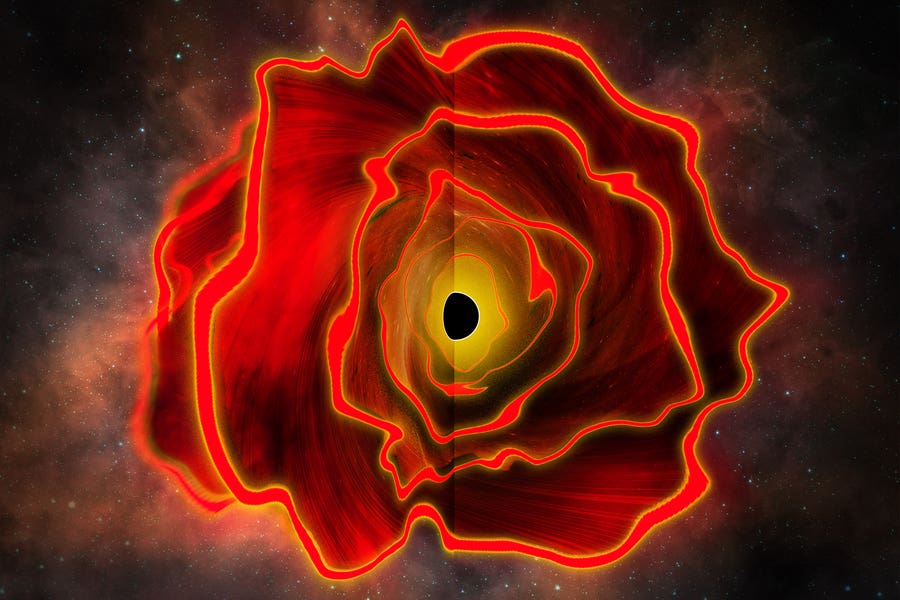
A JWST black hole star candidate may explain mysterious little red dots and how massive black holes grew in the early universe. (CREDIT: Jose-Luis Olivares, MIT)
- JWST has found an early-universe object that looks star-like but shines about 100 billion times more powerfully than any known star could physically produce.
- Its unusual light may come from a feeding black hole surrounded by an enormous, extremely dense cocoon of hydrogen gas.
- The object could help explain JWST’s mysterious “little red dots” and offer clues to how massive black holes grew so quickly after the Big Bang.
A blazing red point in the early universe looks roughly as large as the solar system, yet shines about 100 billion times more powerfully than any known star could physically manage.
The object, called MoM-BH*-1, was identified with NASA’s James Webb Space Telescope, or JWST. It appeared when the universe was only a few hundred million years old.
Its mix of star-like and black-hole-like traits has led astronomers to propose a new type of object: a “black hole star.” The team envisions a central, actively feeding black hole wrapped in an enormous, extremely dense envelope of hydrogen gas.
“Our picture of this object is evolving very rapidly,” says lead author Rohan Naidu, a NASA Hubble Fellow and Pappalardo Fellow at MIT’s Kavli Institute for Astrophysics and Space Research. “We think there is a central black hole that is 100,000 times as massive as the sun. And around this black hole, there would be this very extended envelope of gas that looks like a star the size of the solar system. It’s huge.”
A red dot that refused to behave like a galaxy
Naidu and colleagues found MoM-BH*-1 during the “Mirage or Miracle” survey, designed to investigate exceptionally bright galaxies in the early universe. Some apparent early galaxies, the team suspected, might be impostors.
“There’s been this puzzle of many bright galaxies showing up at extremely early times,” Naidu says. “What we found was that what looks like an extremely bright early galaxy, aka a ‘miracle,’ in some cases actually could be a ‘mirage.’”
MoM-BH*-1 stood out in JWST images of the Ultra Deep Survey field. It was the reddest source in an area covering about 250 square arcminutes and appeared to vanish at shorter wavelengths.
JWST spectroscopy showed why. Between wavelengths of about 3 and 4 micrometers, the object’s light dropped by more than a factor of 20. That decline marks a Balmer break, a feature produced when hydrogen absorbs specific wavelengths of light.
A Balmer break too strong for ordinary stars
Balmer breaks occur in stellar populations, but the one in MoM-BH*-1 was extreme. Dust-free stellar populations typically reach a maximum break strength of about 3. Even a population made entirely of A-type stars would remain below 5.
MoM-BH*-1 lies firmly beyond those limits.
“The break we observed in this object is the deepest break we have ever observed in any object, ruling out ‘ordinary’ stars as the source,” Naidu says. “But it made us wonder if we were seeing a new kind of ‘stellar atmosphere,’ but on a spectacular scale.”
The spectrum also showed deep hydrogen absorption in Hβ and Hγ while Hβ emission remained present. Producing that combination requires hydrogen densities of at least about 1 billion atoms per cubic centimeter. The source also contained little evidence for elements other than hydrogen and helium.
That left a problem. A dense gas envelope could help explain the spectrum, but not the extraordinary energy output.
“You have something that looks a bit like a star but is 100 billion times brighter,” Naidu says. “That means you can’t be powering this by nuclear fusion, which is the energy source that sits at the heart of all the stars we have.”
A black hole wrapped in a stellar-looking cocoon
Black holes can generate energy on the required scale when surrounding material falls toward them. The team therefore modeled an active black hole embedded inside extremely dense gas.
Their grid included close to a million models. The best-fitting version used hydrogen gas with a density of 10^11 particles per cubic centimeter and turbulent motion around 500 kilometers per second.
The model reproduced the deep Balmer break, strong hydrogen absorption, weak ultraviolet output and longer-wavelength measurements. It also required very little dust attenuation, unlike explanations in which dust mainly causes the object’s red color.
The astronomers stress that the model is highly simplified. The true radiation near the black hole may differ from their assumptions, and the gas structure may be more complicated.
Still, several observations support a black hole as the central engine. MoM-BH*-1 appears smaller than 100 parsecs and has extremely broad Hβ emission comparable to luminous quasars beyond redshift 6. The team also reports tentative narrow oxygen emission and possible brightening over 56 days.
A possible answer to JWST’s little red dot mystery
MoM-BH*-1 may also help explain the strange “little red dots” that JWST has repeatedly found in the early universe.
“These little red dots seem to be everywhere in the early universe but essentially disappear by the present day,” Naidu says. “What exactly these objects are has been one of the most debated topics of the JWST era.”
The team argues that a gas-enshrouded black hole like MoM-BH*-1 could form the central component of such objects. A surrounding galaxy would dominate ultraviolet light, while the black hole and dense gas would dominate at longer wavelengths.
MoM-BH*-1 appears to sit inside a faint, low-mass dwarf galaxy. A more massive galaxy lies about 60 proper kiloparsecs away at nearly the same redshift, and the two systems are expected to merge in about 100 million years.
Practical implications of the research
If the black hole star interpretation holds, MoM-BH*-1 could give astronomers a new way to study how massive black holes grew so quickly in the early universe. Dense gas may allow a young black hole to feed rapidly while limiting how radiation pushes that gas away.
The findings also offer a framework for interpreting other little red dots. Astronomers can compare their spectra, variability, gas densities and host galaxies with MoM-BH*-1 to test whether the same physical picture applies.
For now, the object’s formation remains unresolved. “Every little red dot is consistent with being a black hole star, embedded in a generic early galaxy,” Naidu says. “But what is special about MoM-BH*-1 is, the black hole star is essentially completely outshining its surrounding host galaxy, such that we’re seeing pure black hole star light.”
Dig deeper into little red dots and early black hole growth
These resources explore how JWST’s little red dots may contain rapidly growing black holes, how dense gas shapes their unusual spectra, and what they could reveal about the first supermassive black holes.
Little red dots as young supermassive black holes in dense ionized cocoons
High-quality JWST spectra indicate that many little red dots contain comparatively young, low-mass supermassive black holes embedded in dense ionized gas, with electron scattering helping explain their unusually broad emission lines. (Nature, 2026)
A direct black-hole mass measurement in a little red dot at cosmic dawn
This study provides a direct dynamical measurement of a black hole inside a little red dot, offering an important test of competing estimates for black hole masses and growth rates in these early systems. (Nature, 2026)
A little red dot at z = 7.3 within a large galaxy overdensity
JWST observations reveal a little red dot containing an actively accreting supermassive black hole in a dense early-universe environment, helping researchers examine how rapidly growing black holes relate to surrounding galaxies. (Nature Astronomy, 2025)
Extremely Dense Gas around Little Red Dots and High-redshift Active Galactic Nuclei: A Non-stellar Origin of the Balmer Break and Absorption Features
The authors show that extremely dense gas surrounding an accreting black hole can generate a strong Balmer break without requiring an old stellar population, directly addressing one of the most puzzling spectral features of little red dots. (The Astrophysical Journal Letters, 2025)
Black hole envelopes in Little Red Dots
This work examines whether dense, optically thick envelopes around rapidly accreting black holes can reproduce the unusual colors and weak X-ray and radio emission associated with little red dots. (Monthly Notices of the Royal Astronomical Society, 2025)
Research findings are available online in the journal Nature.
The original story "Strange red object from the early universe could be the first ‘black hole star’" is published in The Brighter Side of News.
Related Stories
- Powerful black hole pushes quasar's winds across 300,000 light-years
- Wandering black hole found 30,000 light-years from its galaxy’s center
- Alien civilizations could be using Dyson spheres to collect energy from black holes
Like these kind of feel good stories? Get The Brighter Side of News' newsletter.
Joseph Shavit
Writer, Editor-At-Large and Publisher
Joseph Shavit, based in Los Angeles, is a seasoned science journalist, editor and co-founder of The Brighter Side of News, where he transforms complex discoveries into clear, engaging stories for general readers. With vast experience at major media companies like The Los Angeles Times, Times Mirror and Tribune Publishing, he writes with both authority and curiosity. His writing focuses on space science, planetary science, quantum mechanics, geology. Known for linking breakthroughs to real-world markets, he highlights how research transitions into products and industries that shape daily life.