Apophis will zoom past Earth in 2029, turning a rare flyby into a planetary defense test
Apophis will pass just 38,000 km from Earth, giving scientists a rare chance to watch a rubble-pile asteroid react to gravity.
 BIT Press Writer: Ning Xu

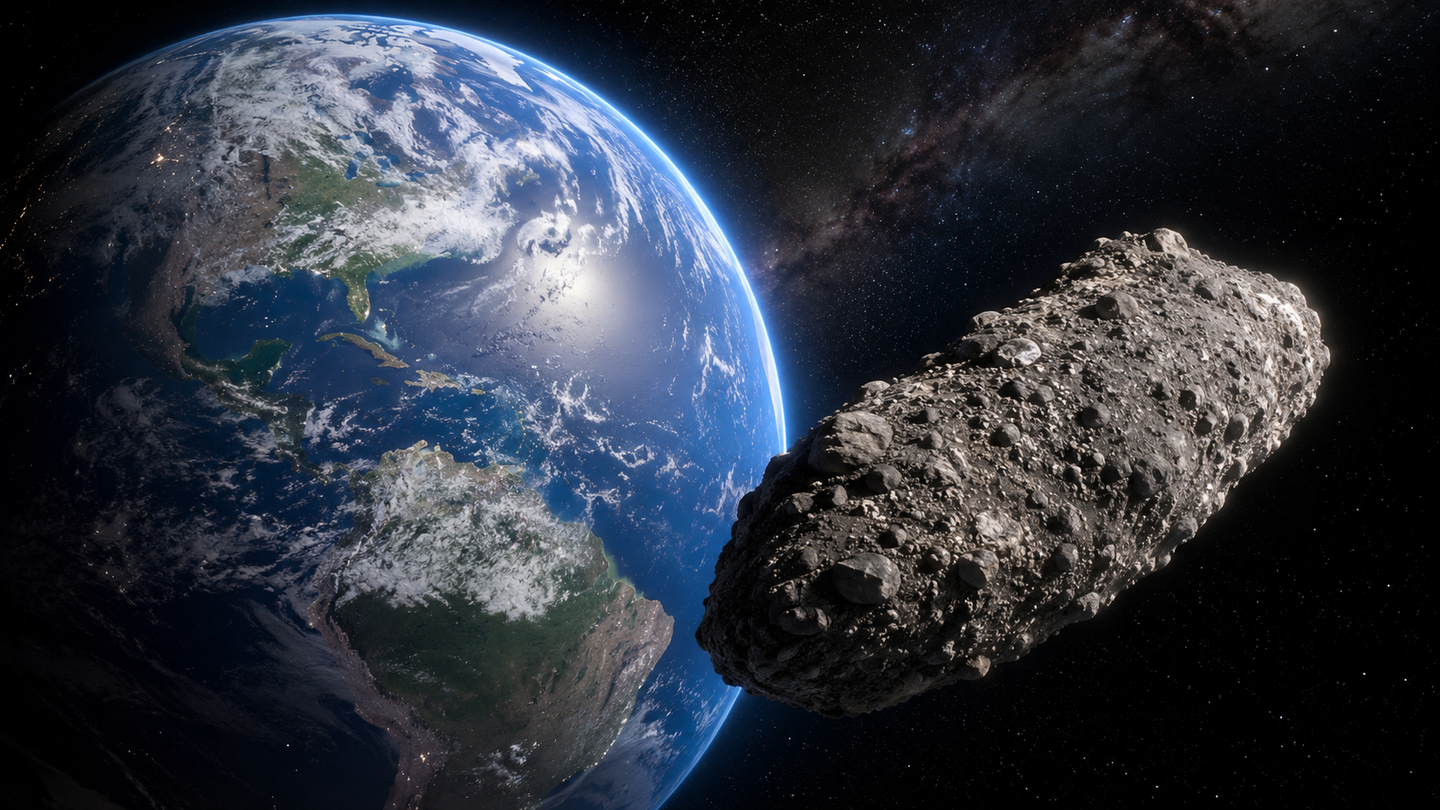
The Apophis 2029 flyby could reveal asteroid surface shifts, spin changes and new lessons for planetary defense. (CREDIT: Wikimedia / CC BY-SA 4.0)
- Apophis will pass about 38,000 kilometers from Earth in 2029, giving scientists a rare chance to watch a large asteroid react to our planet’s gravity.
- Models predict changes to its spin, small surface landslides and possible dust movement, while major structural damage is considered unlikely.
- Spacecraft, telescopes and radar systems will turn the encounter into a worldwide test of asteroid science and planetary-defense planning.
On April 13, 2029, a 340-meter asteroid will sweep past Earth at about 38,000 kilometers, close enough for its gravity-driven changes to become a natural experiment in planetary science.
The asteroid, (99942) Apophis, will pass at roughly one-tenth the Earth-Moon distance. An object of similar size comes this close only about once every 7,500 years. The encounter will let scientists watch how a large near-Earth asteroid reacts to a planet’s gravity in real time.
A review led by Li Jianyang of Sun Yat-sen University and published in Space: Science & Technology brings together current observations, modeling and mission plans for the flyby. The analysis focuses on Apophis’s physical state, the effects expected during the encounter and the value of the event for planetary defense.
Apophis was discovered in 2004 and initially drew concern because of a possible future impact. That threat has since been ruled out for at least the next 100 years. Its close approach remains scientifically important because many basic properties are still uncertain.
A rubble pile under gravitational stress
Radar and light-curve observations show that Apophis is elongated, asymmetric and somewhat bifurcated. It is also tumbling rather than rotating cleanly around a single axis. Its overall rotation period is about 30.6 hours.
Its estimated density is about 1.95 grams per cubic centimeter, with porosity near 55 percent. Those values support the idea that Apophis may be a rubble-pile asteroid, meaning it could consist of loosely bound blocks and smaller material rather than one solid body.
Spectroscopic observations classify Apophis as an Sq-type asteroid with a spectrum resembling LL ordinary chondrite meteorites. Its physical properties may therefore be similar to those of asteroid Itokawa, another small body that has been studied closely.
Earth’s gravity will strongly alter Apophis’s orbit during the 2029 pass. The asteroid is expected to move from an Aten-type orbit to an Apollo-type orbit. Its positional uncertainty is projected to grow from about 1 kilometer before the encounter to about 6,000 kilometers one year later.
Its spin could also change sharply. Simulations place the shift in spin period between minus 7.6 and plus 14.4 hours, depending on the asteroid’s orientation and other encounter conditions.
Small landslides could expose fresh material
The flyby is not expected to tear Apophis apart. Models consistently indicate that large-scale structural failure is unlikely because the asteroid will remain outside Earth’s Roche limit.
Smaller changes could still be measurable.
Simulations suggest local surface disturbances may affect about 1 percent of Apophis. Individual grains could move by no more than roughly three times the radius of the largest particles involved, producing changes on centimeter-to-decimeter scales.
Those movements could expose fresher material beneath the weathered surface. That possibility matters because close planetary encounters have been proposed as one explanation for why some asteroids show less space-weathered surfaces than others.
The encounter could also reveal clues about Apophis’s interior. By combining a more accurate shape model with measurements of spin changes, scientists may be able to estimate its center of mass and low-order mass distribution.
Dust offers another target. Apophis’s weak gravity may allow particles smaller than 50 micrometers to rise as high as about 130 meters above the surface. Some smaller grains could escape entirely.
During the flyby, Apophis will pass through several regions of Earth’s magnetosphere. Escaped dust could become electrically charged and interact with plasma and magnetic fields, potentially creating detectable signals on nearby spacecraft.
Spacecraft and telescopes will watch from many angles
The close approach creates unusually favorable conditions for spacecraft missions. The review examines rendezvous, flyby, sample-return and impact scenarios.
NASA’s OSIRIS-APEX spacecraft is expected to approach Apophis after the Earth encounter and arrive in June 2029. It will map the surface, study composition, measure the gravity field and investigate the regolith. Its planned thruster experiment will disturb surface material so instruments can examine material beneath.
The European Space Agency’s RAMSES mission is designed to arrive before the encounter. That timing would allow observations before, during and after the flyby, including direct comparisons of any changes caused by Earth’s gravity.
Japan’s DESTINY+ is also among the approved missions discussed in the review. Chinese teams have proposed concepts including the Apophis Recon Swarm and CROWN/Apophis, although those remain at earlier stages.
Ground-based observatories may be just as important. Several 10-meter-class telescopes could resolve Apophis during the closest approach, although its rapid motion across the sky will make tracking difficult.
Radar may provide especially sharp measurements. China’s Compound Eye radar system is expected to reach about 1-meter spatial resolution near the encounter. In theory, repeat-pass radar techniques could detect surface deformation below the centimeter scale.
Apophis will also become bright enough to reach about third magnitude. Nearly 2 billion people across parts of Europe, the Americas and Africa may be able to see it moving across the sky over several hours.
Practical implications of the research
The encounter gives planetary-defense planners something they rarely get: a hazardous-class asteroid passing close to Earth without posing an actual impact threat.
That makes Apophis a realistic rehearsal target. Space agencies can test how quickly reconnaissance missions can be prepared, how spacecraft and ground observatories can share observations, and which measurements are most useful before any future deflection attempt.
The coordinated campaign may also become the first global planetary-defense exercise of this kind under the International Asteroid Warning Network and the Space Mission Planning Advisory Group.
The flyby could help refine models of how close planetary encounters alter asteroid orbits, spin states and thermal forces such as the Yarkovsky effect. Those changes influence long-term trajectory predictions.
It could also show how well rubble-pile asteroids respond to tidal forces and help improve models used to estimate the outcome of future kinetic-impact missions.
The review compares the opportunity to rare moments such as the 1977 Voyager launch window and the multinational exploration of Halley’s Comet in 1986. Apophis offers a similarly unusual chance to coordinate science, engineering and planetary defense around a single event that will not soon repeat.
Dig deeper into Apophis, asteroid tidal effects and planetary defense
These resources examine how Apophis may physically change during its 2029 encounter, how spacecraft will study those changes and how the flyby can strengthen planetary-defense capabilities.
Tidal resurfacing model for (99942) Apophis during the 2029 close approach with Earth
Numerical simulations predict that Earth’s tides could disturb roughly 1 percent of Apophis’s surface, particularly steep terrain, potentially exposing fresher material that spacecraft and telescopes could detect after the encounter. (Monthly Notices of the Royal Astronomical Society, 2023)
Spin state evolution of (99942) Apophis during its 2029 Earth encounter
This analysis predicts substantial, measurable changes to Apophis’s tumbling rotation during the flyby, with its effective spin rate potentially halving or doubling and its rotational pole shifting by 10 degrees or more. (Icarus, 2023)
OSIRIS-APEX: An OSIRIS-REx Extended Mission to Apophis
This mission overview details how NASA’s repurposed OSIRIS-REx spacecraft will investigate Apophis’s surface, composition, structure and tidal evolution while characterizing an asteroid type important to planetary defense. (NASA Technical Reports Server, 2024)
Ramses: ESA’s mission to asteroid Apophis
ESA describes its mission to accompany Apophis through the 2029 encounter and measure changes in its shape, rotation, surface and internal properties, while also demonstrating rapid reconnaissance of a potentially hazardous asteroid. (European Space Agency, 2026)
Apophis Planetary Defense Campaign
More than 100 researchers used Apophis as the target of an international exercise testing asteroid detection, tracking, characterization, impact-risk assessment and communication, providing a practical foundation for future global defense campaigns. (The Planetary Science Journal, 2022)
Research findings are available online in the journal Space: Science & Technology.
The original story "Apophis will zoom past Earth in 2029, turning a rare flyby into a planetary defense test" is published in The Brighter Side of News.
Related Stories
- DART spacecraft's asteroid impact informs new planetary defense strategy
- A 1-megaton nuclear blast could prevent 97% of a city-killer asteroid from hitting Earth
- Deep-crater nuclear blasts could defend Earth against asteroids
Like these kind of feel good stories? Get The Brighter Side of News' newsletter.
Joseph Shavit
Writer, Editor-At-Large and Publisher
Joseph Shavit, based in Los Angeles, is a seasoned science journalist, editor and co-founder of The Brighter Side of News, where he transforms complex discoveries into clear, engaging stories for general readers. With vast experience at major media companies like The Los Angeles Times, Times Mirror and Tribune Publishing, he writes with both authority and curiosity. His writing focuses on space science, planetary science, quantum mechanics, geology. Known for linking breakthroughs to real-world markets, he highlights how research transitions into products and industries that shape daily life.