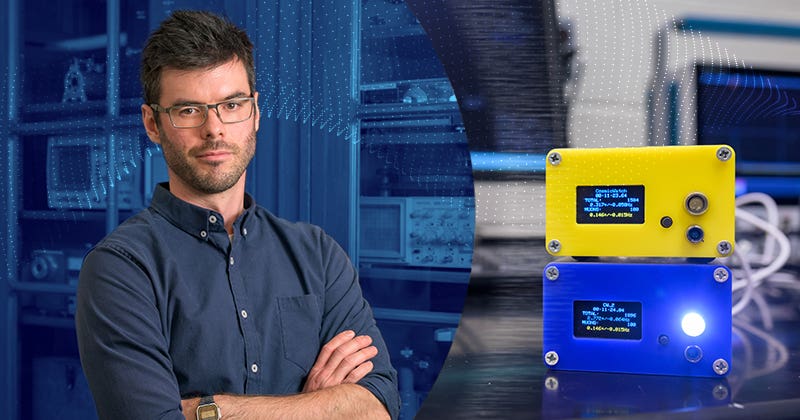
From Schrödinger’s cat to LIGO: quantum physics turned strange ideas into useful technology
Quantum mechanics powers lasers and precision measurements. A century-spanning perspective examines those successes and the questions ahead.
 Texas A&M Writer: Lesley Henton

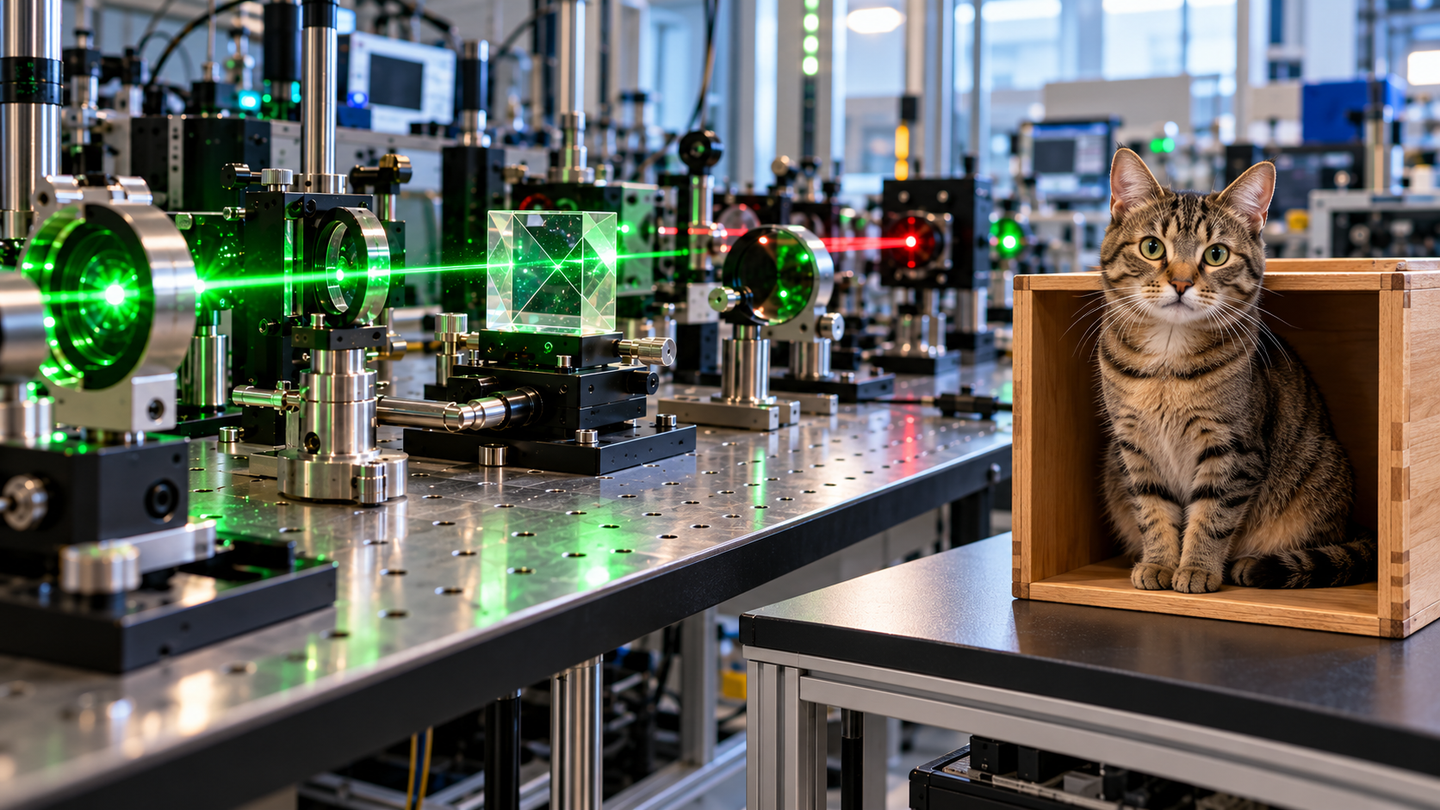
A new scientific perspective traces quantum mechanics from early theory to lasers, computing and gravitational-wave detection, with limits intact. (CREDIT: The Brighter Side of News)
- A Science perspective traces how a century of quantum mechanics led to lasers, advanced measurements and emerging information technologies.
- Quantum coherence helps explain how controlled light and matter can improve instruments and support new computing approaches.
- Quantum gravity remains unresolved, while proposed applications in computing, biology and energy require careful distinctions between demonstrated results and possibilities.
The same physics that once made a cat’s uncertain fate a famous puzzle now helps observatories detect collisions across the universe. Quantum mechanics has moved from disputed descriptions of atoms to tools that control light, measure faint signals and investigate living systems.
That transformation anchors Science perspective, “One hundred years of quantum mechanics,”. Its authors, Marlan Scully and William Unruh, examine how theoretical ideas became experimental techniques. The article is a perspective on the field’s development, rather than a report of one new experiment.
Scully is a university distinguished professor at Texas A&M University, with affiliations at Princeton and Baylor universities. Unruh is affiliated with Texas A&M and the University of British Columbia. Their account connects quantum theory’s early foundations with applications that remain at very different stages of maturity.
Two ways to describe an unfamiliar world
Quantum mechanics took shape through competing mathematical approaches during the 1920s. Werner Heisenberg’s matrix mechanics, developed in 1925, described physical quantities through mathematical operators. Erwin Schrödinger’s 1926 wave mechanics used equations describing matter’s wave-like behavior.
The approaches proved equivalent, although their mathematical forms differed. Schrödinger’s equations became particularly familiar across the physical sciences. Heisenberg’s formulation remained influential in areas including quantum optics, which studies light and its interaction with matter.
Schrödinger later used his cat thought experiment to expose a troubling consequence of applying quantum descriptions to everyday objects. The imagined cat connected microscopic uncertainty with a situation involving mutually exclusive outcomes. The exercise raised questions about superposition and measurement, rather than demonstrating that ordinary cats behave this way.
Superposition became central to quantum information research. It allows a system’s state to include multiple possible outcomes, with relationships that experiments can manipulate. Those relationships help explain why quantum devices operate differently from conventional technologies.
Another major development was quantum field theory, which brought quantum mechanics together with special relativity. The 1947 measurement of the Lamb shift, a tiny change in hydrogen’s energy levels, provided a crucial experimental test. It helped advance theories describing interactions between matter and electromagnetic fields.
Coherence makes controlled light possible
One concept linking these developments is quantum coherence. It describes a stable phase relationship between components of a quantum state. Phase determines how wave contributions reinforce or cancel one another.
Coherence differs from entanglement, which involves correlations between quantum systems that cannot be explained by treating each independently. Neither concept means particles can simply transmit usable information instantaneously over any distance. Their value comes from specific, controlled relationships that experiments can exploit.
The laser is among the clearest technological examples of coherent light. Its name refers to light amplification by stimulated emission of radiation. Work by Charles Townes helped establish the foundation for technologies that initially faced considerable skepticism.
Lasers now serve tasks ranging from barcode scanning to eye surgery. Research lasers also generate extraordinarily brief pulses that reveal processes hidden from slower measurements. Femtosecond pulses last one quadrillionth of a second; attosecond pulses last one quintillionth.
The perspective also describes light amplification without the usual requirement for more atoms to occupy an upper energy state. Quantum coherence enables this alternative approach. It illustrates how controlling relationships between states can change what an optical system can accomplish.
Measuring the universe and processing information
Quantum optics has become an operational tool for gravitational-wave astronomy. The Laser Interferometer Gravitational-Wave Observatory, or LIGO, measures tiny changes associated with passing ripples in spacetime. Quantum fluctuations in its light can limit measurement sensitivity.
Squeezed light redistributes quantum uncertainty, reducing noise in the measurement relevant to the detector. It does not eliminate uncertainty altogether. Carefully designed squeezing improves sensitivity and helps observatories extract weaker signals.
This is an established application of quantum control to astronomical measurements. Quantum computers, by comparison, present a broader collection of developing capabilities. Their potential advantages depend on the problem, algorithm and reliability of the hardware.
Some quantum algorithms offer substantial speedups over known classical approaches for particular tasks. That does not mean quantum machines perform every calculation faster, or automatically solve medical problems in seconds. Useful performance requires preserving fragile quantum information while controlling errors.
Quantum cryptography likewise applies quantum behavior to a specific problem: establishing secure communication. Its security depends on the protocol’s assumptions and the actual equipment. Claims of universally unbreakable communication extend beyond what a general description of quantum theory establishes.
Heat engines and biological measurements
The authors also consider quantum heat engines, which use quantum systems to convert supplied energy into work. Their example involves photons inside an optical cavity bounded by mirrors. One mirror acts as a piston, moving under radiation pressure.
In the classical comparison, efficiency is limited by the temperatures of hot and cold thermal reservoirs. This is the Carnot bound. Introducing coherence into the energy source changes the resources available to the engine.
Such systems can exceed a conventional thermal comparison without violating thermodynamics. The additional resource and its preparation must enter the accounting. The perspective discusses quantum thermodynamics as an emerging field, not a demonstrated route to unlimited energy.
Biological research provides another connection between quantum-based techniques and practical measurements. Advances in coherent Raman spectroscopy have enabled mapping of a single virus particle’s surface with nanometer resolution. This is a measurement capability, rather than evidence of a new treatment.
The distinction also matters for the broader phrase “quantum biology.” Quantum tools can investigate biological structures without establishing that a biological function requires a particular quantum mechanism. The authors describe the field as still developing.
Questions that remain open
Quantum mechanics also offers ways to investigate turbulence through superfluid helium cooled close to absolute zero. Tangled vortices provide insights into complex fluid behavior. Improved weather predictions or safer flights remain prospective connections, not results demonstrated by this perspective.
Gravity presents a deeper unresolved challenge. String theory and related research explore connections among quantum physics, gravity and black-hole properties. An experimentally confirmed, complete account bringing gravity and quantum mechanics together remains absent.
The century-long record therefore contains both working technologies and open questions. Lasers and enhanced detectors show what precise quantum control already accomplishes. Other ambitions still depend on theoretical progress, engineering and experimental tests.
Dig deeper into quantum technology and its limits
These resources examine quantum measurement, computing, communication and the thermodynamic limits of emerging devices.
Quantum error correction below the surface code threshold: Demonstrates error suppression in quantum memories, addressing a major requirement for reliable quantum computing. (Nature, 2025)
Broadband Quantum Enhancement of the LIGO Detectors with Frequency-Dependent Squeezing: Reports how squeezed light reduces quantum noise across a broad range of gravitational-wave detector frequencies. (Physical Review X, 2023)
Quantum internet: A vision for the road ahead: Reviews the capabilities and technical requirements of networks that distribute quantum information. (Science, 2018)
Quantum Computing in the NISQ era and beyond: Explains the opportunities and limitations of noisy quantum devices and the path toward more capable machines. (Quantum, 2018)
Quantum engine efficiency bound beyond the second law of thermodynamics: Examines efficiency limits when engines receive energy from nonthermal sources, clarifying comparisons with the Carnot bound. (Nature Communications, 2018)
Research findings are available online in the journal Science.
The original story "From Schrödinger’s cat to LIGO: quantum physics turned strange ideas into useful technology" is published in The Brighter Side of News.
Related Stories
- Quantum cat strategy reduces errors and speeds up quantum computing
- Schrödinger’s cat is helping quantum engineers detect errors
- Physicists convert microwaves to light helping quantum computers communicate over optical networks
Like these kind of feel good stories? Get The Brighter Side of News' newsletter.
Shy Cohen
Writer