Deep-crater nuclear blasts could defend Earth against asteroids
A new asteroid defense study suggests deeper nuclear detonations could shift large space rocks far faster.

 Edited By: Joseph Shavit

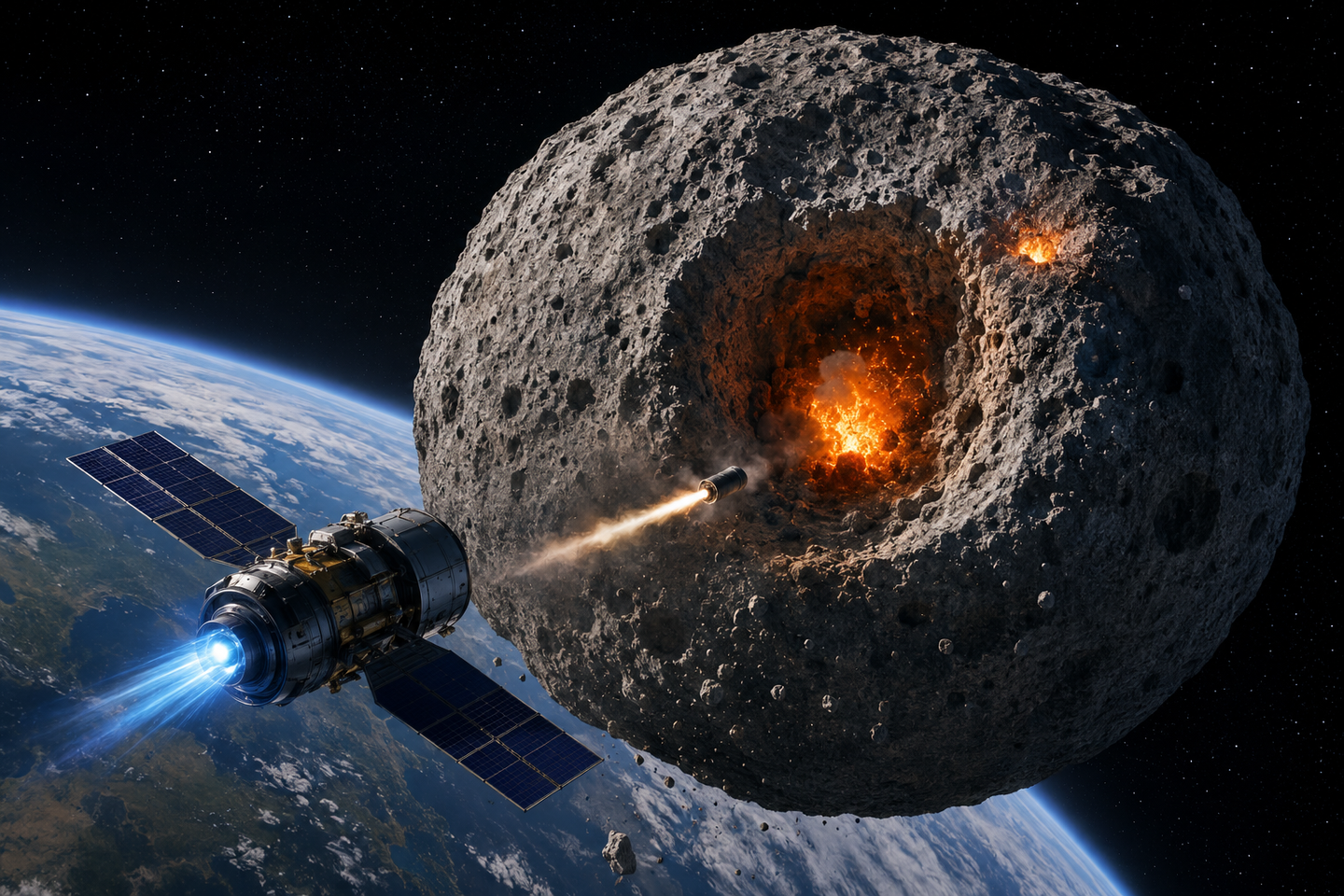
New research finds deep-crater nuclear blasts could deflect dangerous large asteroids faster than direct-impact methods. (CREDIT: Wikimedia / CC BY-SA 4.0)
A large asteroid does not need to hit Earth to expose a hard truth: the most dangerous space rocks may be the ones spotted too late. That is the problem behind a new analysis of how to stop the biggest threats. It is also why older interception ideas may not be enough when time is short.
The study examines near-Earth asteroids more than 100 meters wide, objects large enough to cause destruction on an intercontinental or even global scale. Some recent flybys have underscored the risk. The asteroid 2019 OK, estimated at 57 to 130 meters across, passed Earth in 2019 at 24.5 kilometers per second. It came within 72,000 kilometers. On June 29, 2024, asteroid 2024 MK, about 150 meters wide, passed at a distance of 295,000 kilometers. The paper notes that 2024 MK was identified only 13 days in advance.
That short warning time changes everything. Slower methods, such as using small forces over long periods or relying on a conventional kinetic impact, may not deliver enough energy to shift the path of a large asteroid in time. For the biggest objects, especially those found late, the authors argue that nuclear detonation remains the most effective option. In some cases, it may be the only realistic one.
In work published in Space: Science & Technology, a team led by Wang Xiaowei of the China Academy of Launch Vehicle Technology lays out two nuclear defense strategies. They compare how well these could work against a wide range of potential threats.
Two ways to strike a dangerous asteroid
The first strategy is built for emergencies. In this direct rendezvous mode, a defense craft slams into the asteroid at high speed, creating a shallow crater. A nuclear device then detonates in that crater. The appeal is speed. The system is relatively simple, and it can be launched quickly when warning time is extremely short.
But the simplicity comes with severe drawbacks. The impact point cannot be chosen freely, the crater is shallow, and the energy from the blast does not couple as efficiently into the asteroid. The paper also says this approach places extreme demands on the hardware. The nuclear device must survive a violent, fast impact environment. In addition, its detonation timing has to be precise on a very small timescale.
The second strategy is more elaborate but potentially much stronger. In this flyby pre-excavation mode, a space transfer platform first sends a conventional penetration device to dig a deeper crater at a chosen location. A nuclear device is then guided into that crater and detonated below the surface.
That deeper placement is the key point. Subsurface detonation produces stronger energy coupling. This means more of the explosion’s energy goes into breaking up the asteroid or changing its path instead of being wasted. Because the crater location can be selected in advance, the team argues that this mode is more controllable. It is also more reliable when there is enough warning time to carry out the mission.
A virtual test against unseen threats
To judge how broadly these ideas could work, the researchers did not limit themselves to known asteroids. They built a virtual threat asteroid database meant to represent dangerous objects that could still be undiscovered. Using assumed impact velocities and orbital angles, they generated large libraries of possible asteroid orbits. They used warning periods of one year and 20 years.
That virtual database let the team test how different mission designs would perform across many kinds of incoming threats, rather than a single case.
For the direct rendezvous mode, they modeled how launch energy and impact speed affect the time available for deflection. When the launch vehicle characteristic energy, or C3, was 30 square kilometers per second squared and the impact speed was capped at 10 kilometers per second, only 30% of simulated asteroids could be deflected for more than 50 days. Raising the impact speed to 20 kilometers per second improved coverage sharply. With all asteroids getting more than 30 days and about 16% getting more than 150 days. Pushing the speed to 30 kilometers per second produced only limited extra gain.
That makes 20 kilometers per second look like a practical design point on paper. But it also highlights the engineering problem: surviving and functioning at that kind of impact speed is extremely demanding.
For the flyby pre-excavation mode, the team modeled a three-pulse transfer orbit and studied how much added velocity a space transfer platform would need to reach possible threats. The result was encouraging. All virtual asteroids in the study could be covered with less than 10 kilometers per second of added velocity, and about 45% needed less than 6 kilometers per second. The paper says that puts most threats within reach of platforms using chemical or electric propulsion.
Why digging deeper matters
The biggest differences appeared when the team simulated blast effects.
The study compared conventional chemical explosions with nuclear detonations and found a huge gap. A 10-ton TNT-equivalent chemical blast at 10 meters depth against a 200-meter asteroid produced a velocity change of just 0.05 centimeters per second. A 300,000-ton nuclear blast at the same depth produced 3.4 meters per second. This is roughly four orders of magnitude higher.
For smaller asteroids, both defense modes could be destructive enough to break them apart. The authors report that a 300-kiloton detonation could directly disintegrate a 50-meter asteroid. For a 100-meter asteroid, that same yield could generate a velocity increase of 2 to 10 meters per second. A 3-megaton detonation could completely destroy it.
The harder targets are the kilometer-scale asteroids, the kind that could drive global disaster. In the direct rendezvous mode, a 3-megaton detonation in a shallow crater about 5 meters deep produced a velocity increment of 8 to 9.2 centimeters per second.
Flyby's and deeper detonations
In the flyby pre-excavation mode, the numbers rose sharply as burial depth increased. At 10 meters, the modeled increment was about 11 centimeters per second. At 20 meters, it was about 18 centimeters per second in one analysis and more than 30 centimeters per second in the broader comparison. Finally, at 30 meters, it reached roughly 30 centimeters per second.
The paper’s central argument rests on that improvement. Deeper detonation can make the difference between a modest nudge and a much faster orbital change.
The warning-time math shows why that matters. A velocity increment of 0.5 centimeters per second required at least 1,626 days, or 4.45 years, to achieve the deflection target across the simulated asteroid library. At 3 centimeters per second, the minimum dropped to 560 days. At 18 centimeters per second, it fell to 139 days. Finally, at 1 meter per second, the target could be met in just 60 days.
Practical implications of the research
The study points to a tiered defense logic rather than a one-size-fits-all answer. For extremely short warning times, the direct rendezvous mode may still be the only option. This is because it can be launched quickly with a simpler system. But its technical demands are severe, and its energy use is less efficient.
When more time is available, the flyby pre-excavation approach appears to offer the stronger path. It allows mission planners to observe the asteroid, choose a better detonation point, dig deeper, and get a larger change in velocity from the same explosive yield.
That could shorten the warning time needed for a successful deflection from years to months, or in some cases to about two months. The paper presents that approach as the preferred option for defending Earth against large near-Earth asteroids. It is also presented as a framework for future mission design.
Research findings are available online in the journal Space: Science and Technology.
The original story "Deep-crater nuclear blasts could defend Earth against asteroids" is published in The Brighter Side of News.
Related Stories
- Deflecting asteroids isn't as easy as scientists previously thought
- Astronomers weigh nuclear option to stop Moon-bound asteroid
- DART spacecraft's asteroid impact informs new planetary defense strategy
Like these kind of feel good stories? Get The Brighter Side of News' newsletter.
Joshua Shavit
Writer and Editor
Joshua Shavit is a NorCal-based science and technology writer with a passion for exploring the breakthroughs shaping the future. As a co-founder of The Brighter Side of News, he focuses on positive and transformative advancements in technology, physics, engineering, robotics, and astronomy. Having published articles on AOL.com, MSN, Yahoo News, and Ground News, Joshua's work highlights the innovators behind the ideas, bringing readers closer to the people driving progress.