Astronomers develop a faster way to simulate the complicated motion of binary asteroids
A new geometric method tracks binary asteroid motion more accurately, especially when irregular shapes complicate gravity.
 BIT Writer: Ning Xu

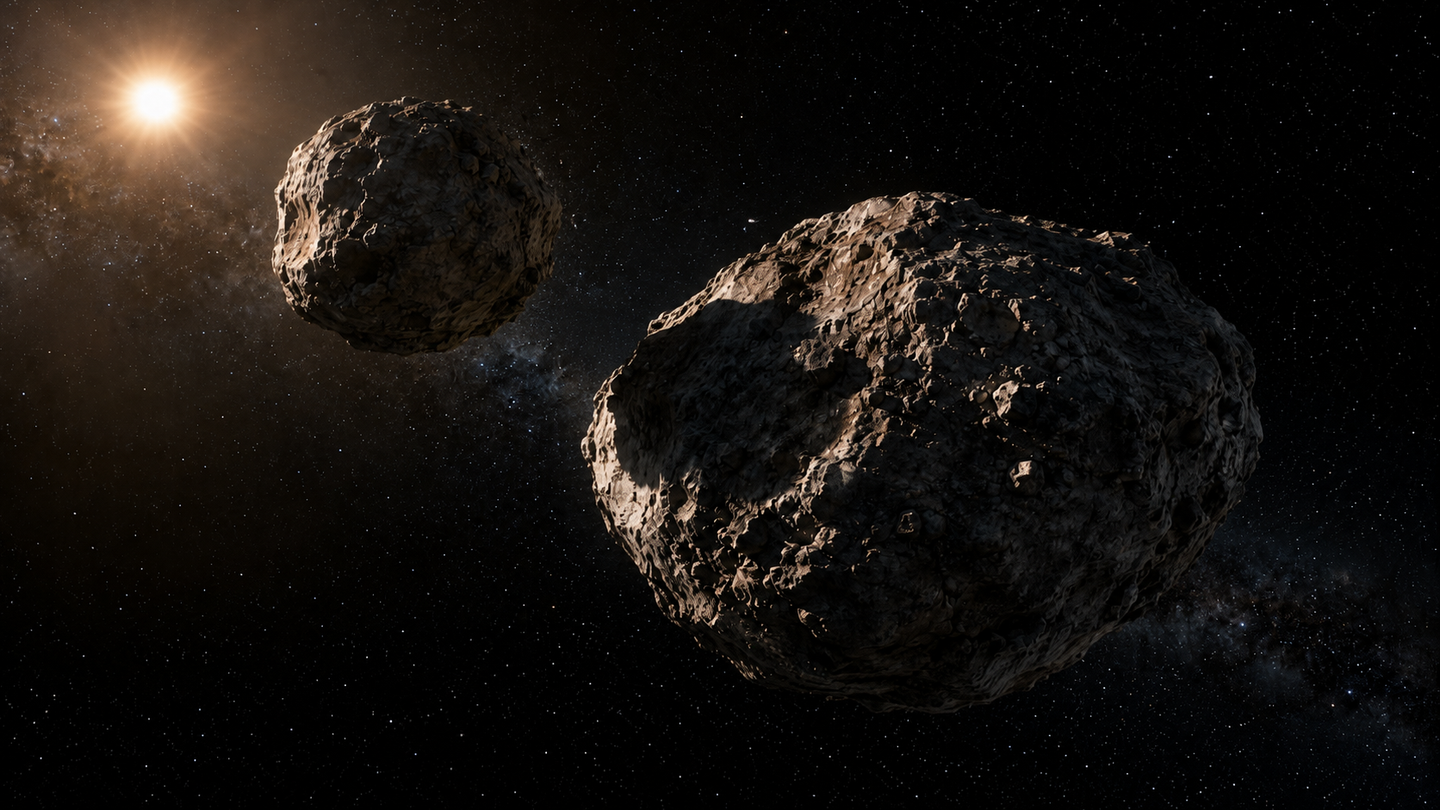
Binary asteroid simulations improve with a Hamel integrator that preserves energy, rotation geometry and computational efficiency. (CREDIT: Shutterstock)
- A new mathematical method could make long-term simulations of binary asteroids more reliable by preventing energy and rotational errors from building up.
- The method treats an asteroid pair’s position and rotation together, which becomes especially important when irregular shapes affect their mutual gravity.
- Tests showed the approach preserved key physical properties better than standard Runge–Kutta calculations while also reducing computational costs.
Binary asteroids can behave less like two simple rocks in orbit and more like a tightly coupled mechanical system. Their shapes, positions and rotations all influence one another, making long-term predictions difficult and exposing weaknesses in standard numerical methods.
That problem matters because binary systems may account for about 16% of identified near-Earth asteroids. Accurate modeling could support both impact-threat assessment and future exploration of small bodies.
A team led by Guo Yongxin of Liaoning University’s College of Physics developed a new integration method designed for this kind of motion. Published in Space: Science & Technology, the work applies a Hamel variational integrator to a simplified double-dumbbell model of a binary asteroid system.
Instead of treating orbital motion and rotation as separate problems, the method keeps them in one geometric framework. That matters when the bodies are irregular, because gravity depends not only on where each object is, but also on how each one is oriented.
A two-body problem with more moving parts
In the classical two-body problem, each object can often be treated as a point mass. That simplification breaks down when two nearby bodies have irregular shapes and comparable masses. Their orientation changes the gravitational potential, which couples translation and rotation.
To represent that interaction, the team modeled each binary system as two dumbbell-shaped rigid bodies. Each dumbbell contains two asteroids connected by a massless rod. The model assumes the mass difference between the paired asteroids is negligible and that their separation is small compared with the distance between the two dumbbell centers.
The researchers used the special Euclidean group SE(3), a mathematical framework that describes position and rotation together. They then attached a body-fixed coordinate frame to the second dumbbell. This reduced the problem to the relative position and orientation of the first body with respect to the second.
That choice also avoids singularities that can arise when rotations are represented with Euler angles. It allows the model to follow translation and attitude changes without introducing extra quaternion constraint equations.
Moving the equations onto the Lie algebra
The central step was building the numerical method from the discrete version of Hamilton’s principle. Rather than directly discretizing the continuous equations of motion, the approach constructs a discrete Lagrangian and derives the update equations from it.
The Hamel formulation uses left-invariant vector fields on the Lie group to provide a moving body frame. Both the continuous and discrete equations can then be expressed on the corresponding Lie algebra, which is the local vector-space structure associated with the group.
That distinction separates the new method from Lie group variational integrators that formulate their implicit equations using Lie group elements. In the Hamel approach, the implicit equations are solved at the Lie algebra level, reducing the number of operations required.
The resulting scheme is at least second-order accurate because the discrete Lagrangian is self-adjoint. Through a discrete Legendre transform, the researchers obtained an iterative Hamiltonian map that updates relative position, relative attitude and momentum variables from one time step to the next.
Energy and geometry stay under control
The team first tested the method on a regular-shaped double-dumbbell system made from identical rigid spheres and massless rods. They compared it with a Lie group variational integrator of the same order.
Both methods produced consistent energy evolution. Kinetic and potential energy exchanged periodically, while total energy remained constant. Around the ninth unit of normalized time, kinetic energy reached a maximum and potential energy reached a minimum, indicating the closest approach between the two dumbbells.
The Hamel method also produced smaller energy and rotation-matrix orthogonality errors. Orthogonality is important because a valid rotation matrix must preserve its geometric structure. Once that condition degrades, attitude calculations can become physically inconsistent.
CPU-time comparisons showed another advantage. Although both geometric methods solve implicit equations, the Hamel integrator required fewer operations because those equations were written in terms of Lie algebra elements rather than Lie group elements. The resulting computational efficiency was slightly higher.
Irregular shapes expose Runge–Kutta drift
The researchers then replaced the regular spheres with irregular rigid bodies and compared the geometric methods with a second-order explicit Runge–Kutta integrator.
The difference became more pronounced. The symplectic methods kept total-energy and orthogonality errors low, while the Runge–Kutta approach failed to preserve the rotation matrix’s orthogonal structure. That failure caused force and torque errors to accumulate because those calculations depend on both position and attitude.
The explicit method also consumed more CPU time in this test. It required two evaluations of the equations of motion per step, and each evaluation involved computationally demanding force and moment calculations. The Hamel method, despite being implicit, required only one such evaluation per step.
Shape itself also changed the predicted motion. When the team compared the center-of-mass trajectories from the regular and irregular models, the irregular geometry produced a noticeable deviation, especially along the y direction.
Practical implications of the research
For long-term binary-asteroid simulations, numerical stability is not just a mathematical preference. Errors that slowly distort energy, angular momentum or rotational geometry can undermine confidence in predicted trajectories, especially when simulations cover many orbital cycles.
The Hamel variational integrator offers a way to preserve the system’s symplectic and Lie group structures while reducing the computational burden associated with other geometric methods. The authors conclude that it provides a practical numerical approach for full-body dynamics involving binary asteroids.
The method could support high-precision predictions used in planetary-defense planning and in studies of binary-system evolution. It also highlights a modeling issue that cannot be ignored: irregular shape can meaningfully alter the motion of closely interacting celestial bodies.
The researchers plan to extend the work by studying double-dumbbell systems in which the distance between the asteroids within each dumbbell can vary.
Dig deeper into binary asteroid dynamics, irregular gravity and planetary defense
These resources explore how asteroid shape, spin-orbit coupling and high-fidelity numerical models affect predictions of binary-system motion and planetary-defense missions.
A global binary asteroid system model with irregularly shaped components via iterated surface integral
This work develops a high-precision gravitational model for two irregularly shaped asteroids and shows how their shapes, orientations and close separation affect mutual forces, torques and long-term orbital evolution. (Monthly Notices of the Royal Astronomical Society, 2025)
The Radio Science Experiment on Hera, Juventas and Milani
This overview of ESA’s Hera radio-science investigation describes how the mission will measure the Didymos-Dimorphos system’s gravity, rotation and orbit, including use of a full two-body model that couples translational and rotational motion. (Space Science Reviews, 2025)
Rotational lightcurves of Dimorphos and constraints on its post-DART impact spin state
Observations and high-fidelity simulations indicate that Dimorphos entered an excited, non-principal-axis rotation after the DART impact, illustrating how strongly spin and orbital motion can interact in a close binary asteroid. (Icarus, 2024)
Planar spacecraft trajectories in the Didymos–Dimorphos binary asteroid system
The researchers map stable and near-periodic spacecraft trajectories around Didymos and Dimorphos while progressively increasing the fidelity of their gravity models, highlighting the navigational consequences of irregular shapes and complex binary gravity. (Planetary and Space Science, 2024)
A benchmarking and sensitivity study of the full two-body gravitational dynamics of the DART mission target, binary asteroid 65803 Didymos
This foundational comparison of four simulation approaches shows that Didymos has strongly coupled, non-Keplerian spin and orbital dynamics and that predictions can be highly sensitive to initial conditions, underscoring the need for accurate full two-body integration. (Icarus, 2020)
Research findings are available online in the journal Space: Science & Technology.
The original story "Astronomers develop a faster way to simulate the complicated motion of binary asteroids" is published in The Brighter Side of News.
Related Stories
- NASA DART Mission data reshapes understanding of how near-Earth asteroids evolve over time
- NASA's Lucy prepares for second asteroid flyby on the road to Jupiter
- Astronomers discover ‘baby' asteroid circling between Mars and Jupiter
Like these kind of feel good stories? Get The Brighter Side of News' newsletter.
Joseph Shavit
Writer, Editor-At-Large and Publisher
Joseph Shavit, based in Los Angeles, is a seasoned science journalist, editor and co-founder of The Brighter Side of News, where he transforms complex discoveries into clear, engaging stories for general readers. With vast experience at major media companies like The Los Angeles Times, Times Mirror and Tribune Publishing, he writes with both authority and curiosity. His writing focuses on space science, planetary science, quantum mechanics, geology. Known for linking breakthroughs to real-world markets, he highlights how research transitions into products and industries that shape daily life.