Jonathan the 194-year-old tortoise offers new clues to extreme human longevity
A study of Jonathan’s genome and epigenome finds preserved regulation in key cellular pathways, with important limits.

 Edited By: Joseph Shavit

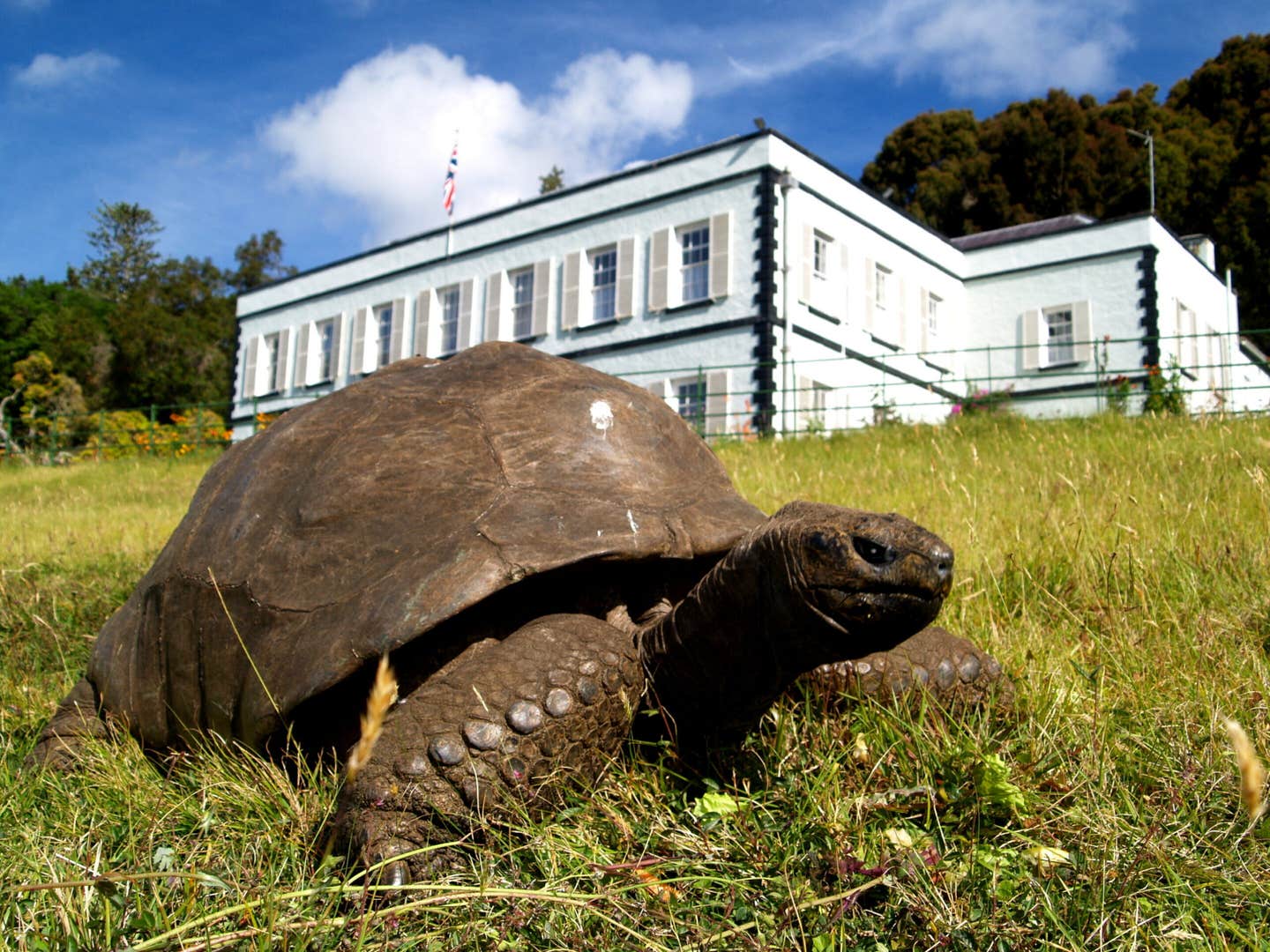
Jonathan arrived on St. Helena from the Seychelles 144 years ago as a fully grown tortoise and a gift to the island’s governor. He has lived ever since on the grounds of Plantation House, the governor’s official residence. (CREDIT: Joe Holland)
- Jonathan, an estimated 194-year-old giant tortoise, retains unusually orderly DNA regulation in pathways linked to cellular maintenance.
- Genome and epigenome comparisons offer clues to extreme longevity, including mitochondrial function and DNA repair.
- The small observational study does not establish what caused his long life or demonstrate a treatment for human aging.
Some of the genetic machinery inside the world's oldest known living land animal looks surprisingly youthful. Jonathan, a giant tortoise estimated to be 194, retains unusually orderly molecular patterns around genes involved in maintaining cells.
A comparative study led by the nonprofit Kallel Foundation, with collaborators including Vanderbilt Health and the University of Cambridge, examined his genome and epigenome. Published in Science Advances, it identifies possible clues to his exceptional longevity, particularly in cellular energy production and DNA repair.
The findings do not mean Jonathan has escaped aging. His DNA shows broader changes associated with advancing age, and the research cannot prove why he survived so long. Instead, it suggests that preserving regulation in particular biological pathways may matter more than keeping every part of the genome youthful.
A remarkable animal and a modest tissue sample
Jonathan lives at Plantation House, the governor's residence on St Helena, a British Overseas Territory in the South Atlantic. He arrived from the Seychelles in 1882, already fully grown, and is thought to have hatched around 1832.
His age is an estimate rather than a documented hatch date. Nevertheless, his long history makes him an extraordinary subject for research into how animals withstand biological decline.
Obtaining a sample required caution. In 2017, veterinarian Joe Hollins could not take blood because of concerns about Jonathan's health. A small sample collected from inside his cheek provided material for genetic analysis instead.
Researchers assembled his genetic information using sequencing and comparisons with a reference genome from Tank, a 36-year-old Aldabra giant tortoise. Both belong to the species Aldabrachelys gigantea.
The study combined genome analysis with an examination of DNA methylation, chemical tags that help regulate gene activity. These tags form part of the epigenome, which influences how cells use genetic instructions without changing the underlying DNA sequence.
The two approaches address different questions. Genome comparisons look for differences in inherited instructions, while methylation analysis examines patterns associated with their regulation. Combining them allows researchers to investigate both the biological equipment an animal possesses and how that equipment may be controlled.
Distinctive genes are leads, not established explanations
Comparing Jonathan's genome with other available sequences identified 287 genes containing distinctive protein-changing variants. Such changes can alter the instructions for building proteins, although their actual effects require further investigation.
The genes included candidates connected with DNA repair, inflammation, insulin signaling and cancer suppression. Those processes make them relevant to aging research, but their presence does not show that Jonathan's variants improved those functions.
Computational assessments flagged variants in 41 genes as potentially important for protein function. Twelve of those genes also appeared in aging-related databases, providing a narrower set of candidates for future experiments.
The distinction matters because a genomic difference can be beneficial, harmful or have little practical effect. The analysis identified possibilities, rather than testing how each variant behaves in living cells.
Comparisons with other tortoise genomes also helped separate Jonathan's individual characteristics from adaptations shared by long-lived species. His exceptional age makes him valuable, but a single animal cannot establish which genetic features explain longevity across a population.
Order survives in selected gene regulators
The epigenetic analysis compared Jonathan with four other giant tortoises, including juveniles aged five and 12. The remaining two were adults by 1969, but their exact ages were unknown.
Across the genome, Jonathan showed reduced DNA methylation and greater methylation entropy than a juvenile. Here, entropy describes disorder in methylation patterns, rather than a measurement of disorder throughout the entire animal.
The unexpected finding emerged in promoters, DNA regions that help control when and how strongly genes operate. For 272 promoters, Jonathan's methylation patterns remained relatively orderly, resembling those of the younger tortoises more than the older comparators.
These regions included promoters associated with 35 mitochondrial genes, 25 genes involved in RNA processing and related functions, and 15 involved in genome or telomere maintenance. Mitochondria supply energy that cells need to perform essential tasks.
Methylation is not a universal switch that simply turns every gene on or off. Its effects depend on where the tags occur and the surrounding biological context. The important result here concerns the organization of those patterns in selected promoters, rather than a claim that all of Jonathan's genes remain active.
“We found that the gene regulators involved in energy production and DNA repair have remained incredibly stable in Jonathan over almost two centuries,” said Justin Gerlach of Peterhouse, University of Cambridge.
The comparison provides a snapshot of Jonathan late in life. It does not track the same molecular patterns continuously across two centuries, so their lifelong stability remains an interpretation.
A possible connection between energy and repair
The researchers propose that orderly regulation of mitochondrial genes could support reliable cellular energy production. That energy could, in turn, help sustain DNA repair and the maintenance of methylation patterns.
Such a feedback loop would connect several processes implicated in aging. However, the study did not directly measure Jonathan's mitochondrial performance or establish that preserved methylation patterns caused more efficient energy production.
Nor did it show that the selected genes were expressed at youthful levels. DNA regulation offers clues about cellular activity, but measuring regulatory patterns is different from demonstrating how proteins and organelles function.
The findings nevertheless suggest useful questions for experimental work. Researchers could investigate whether altering these pathways preserves cellular function, and whether similar patterns occur in other exceptionally old animals.
Giant tortoises provide a distinctive comparison with shorter-lived species. Studying them may help identify biological strategies associated with longevity, while leaving open which strategies could be relevant to humans.
What a single tortoise cannot establish
The analysis has important limits beyond its small sample. Researchers could consistently assess methylation entropy in 2,895 promoters across the five animals, representing approximately 10% of the total promoters.
Jonathan's cheek sample also represents one tissue rather than his whole body. Different tissues may age differently, and samples from blood or other tissues would help test how broadly the findings apply.
The tortoises differed in age and living circumstances, complicating comparisons. With only one exceptionally old individual, the researchers cannot cleanly separate effects of age, individual biology and environmental history.
Additional sequencing and studies involving more long-lived animals could test the results. Functional experiments would be needed to determine whether the genetic variants or methylation patterns actually protect cells.
The research does not establish an antiaging treatment or show that any medicine reproduces Jonathan's biology in people. Its contribution is more specific: identifying parts of cellular regulation that appear unusually well preserved in an animal approaching two centuries of life.
Dig deeper into giant tortoises and the biology of aging
These resources explore long-lived animals, molecular aging and the use of DNA methylation to study biological age.
Giant tortoise genomes provide insights into longevity and age-related disease: Comparative genome research identifies tortoise adaptations associated with DNA repair, immune function and cancer biology. (Nature Ecology & Evolution, 2019)
Diverse aging rates in ectothermic tetrapods provide insights for the evolution of aging and longevity: This comparative study examines aging and longevity across wild populations of reptiles and amphibians. (Science, 2022)
Hallmarks of aging: An expanding universe: A major review explains interconnected mechanisms of aging, including epigenetic alterations and mitochondrial dysfunction. (Cell, 2023)
Universal DNA methylation age across mammalian tissues: Researchers develop methylation-based age estimators across mammalian species, illustrating how chemical DNA patterns reflect aging. (Nature Aging, 2023)
The multiomics blueprint of the individual with the most extreme lifespan: An analysis of a 117-year-old woman examines molecular characteristics of exceptional human longevity, including mitochondrial function. (Cell Reports Medicine, 2025)
Research findings are available online in the journal Science Advances.
The original story "Jonathan the 194-year-old tortoise offers new clues to extreme human longevity" is published in The Brighter Side of News.
Related Stories
- Tiny DNA fragments reveal two extinct Galápagos tortoise lineages
- Lion-sized armadillo, ancient tortoises: Ice Age creatures discovered in Central Texas
- Fossil tracks in Italy record a turtle stampede from 80 million years ago
Like these kind of feel good stories? Get The Brighter Side of News' newsletter.
Joshua Shavit
Writer and Editor
Joshua Shavit is a NorCal-based science and technology writer with a passion for exploring the breakthroughs shaping the future. As a co-founder of The Brighter Side of News, he focuses on positive and transformative advancements in technology, physics, engineering, robotics, and astronomy. Having published articles on AOL.com, MSN, Yahoo News, and Ground News, Joshua's work highlights the innovators behind the ideas, bringing readers closer to the people driving progress.